Digestive / VISUAL EXPLAINER
Why Does Your Body Reuse Bile Salts?
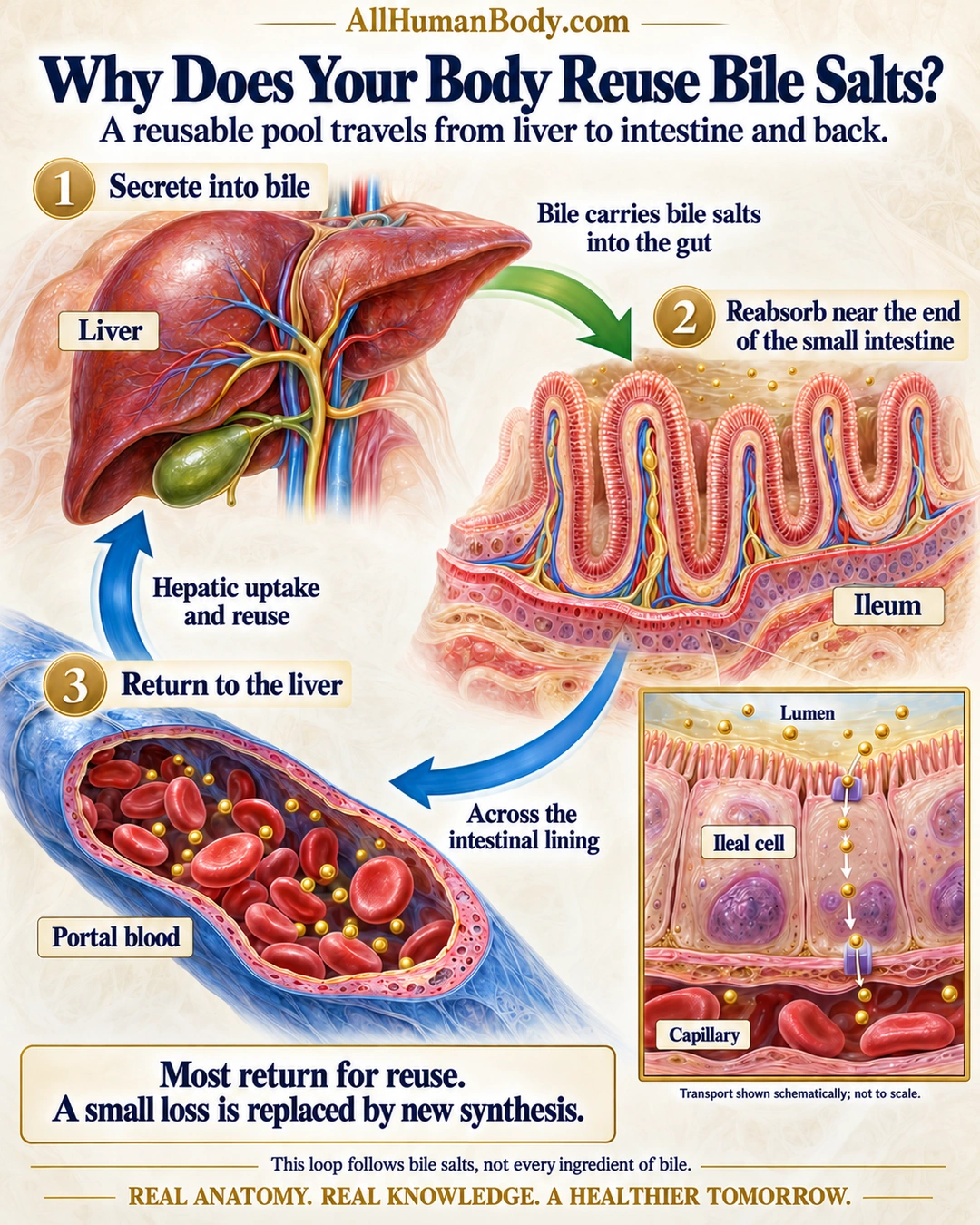
Bile salts enter the intestine in bile and are largely recovered for liver uptake and resecretion. Reabsorption is concentrated near the end of the small intestine, with portal blood carrying the return and new synthesis replacing a small loss.
READ THE IMAGE
What the illustration shows
English medical poster titled Why Does Your Body Reuse Bile Salts? Three dimensional panels form a clockwise process loop: liver secretion into bile, ileal lining reabsorption, and portal blood return to the liver. Green and blue arrows connect the panels as process steps, not physical ducts. A zoom inset shows gold schematic bile-salt dots crossing an ileal cell from the lumen through apical and basal transport symbols toward a capillary; red cells remain in the vessel. Text says most return for reuse and small losses are replaced by new synthesis. Gold AllHumanBody.com branding and the full project slogan appear. Transport is schematic and not to scale.
How to interpret this poster
- The loop follows bile salts, not every component of bile or all uptake exclusively in the ileum.
- Arrows connect process steps rather than drawing physical ducts; no fixed recovery percentage or cycle speed.
- Membrane symbols and shortened tissue distance are schematic, not transporter structures or exact histology.
- AI-assisted educational illustration; not physician certification, microscopy, a diagnosis or individualized medical advice.
- Fine annotations need enlargement; the full description provides an accessible text alternative.
- Display the full uncropped illustration; do not trim titles, legends or boundary annotations.
AI-assisted educational illustration, adapted into web-sized images without changing its composition. This is general education, not an individual diagnosis or treatment recommendation.
EVIDENCE / CONTEXT
Sources and what they support
- Anatomy and Physiology 2e: 23.6 Accessory Organs in Digestion: The Liver, Pancreas, and Gallbladder ↗
Bile-salt secretion, ileal recovery, portal return and hepatic resecretion; preserved lines 31,45–48,55.