Nervous / VISUAL EXPLAINER
Do Touch Signals Stop During Steady Contact?
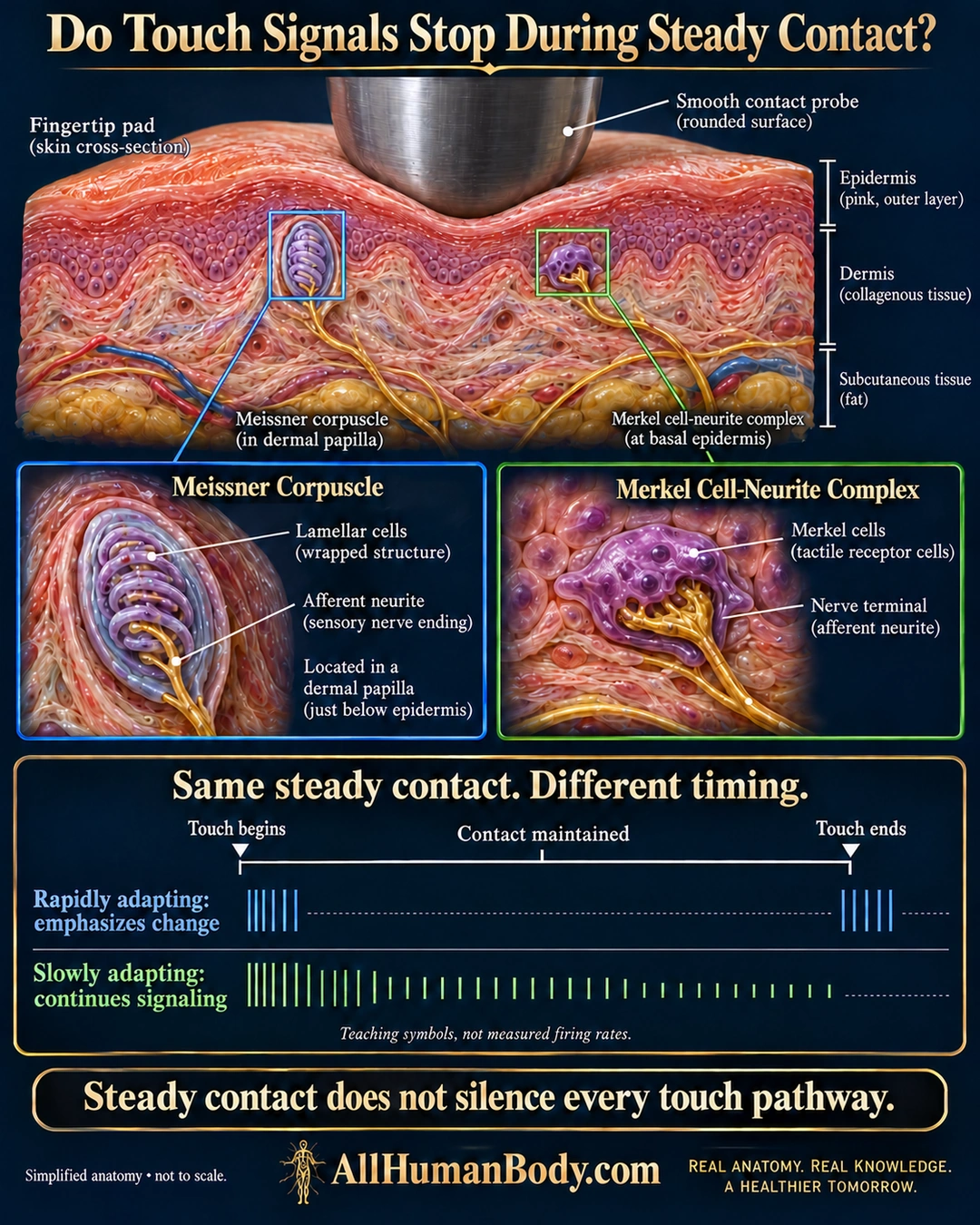
Steady contact does not silence every touch pathway. Rapidly adapting afferents emphasize changes, while slowly adapting afferents can continue signaling during maintained contact; these response patterns are not the same as conscious attention.
READ THE IMAGE
What the illustration shows
A rounded probe indents a dimensional fingertip skin cutaway. A Meissner corpuscle sits within a dermal papilla; a Merkel cell-neurite complex lies at basal epidermis. Two enlarged tissue insets show lamellar cells around a sensory ending and Merkel cells contacted by nerve terminals. Below, the same maintained-contact interval is compared: blue rapidly adapting activity marks cluster at onset and release, while green slowly adapting marks continue during contact. The chart explicitly says teaching symbols, not measured firing rates. Main takeaway: Steady contact does not silence every touch pathway. Gold AllHumanBody.com branding and the full slogan appear below.
How to interpret this poster
- Timing marks are invented teaching symbols, not measured rates, amplitudes or latency.
- Receptor cell counts, shapes and tissue proportions are illustrative rather than verified histology.
- Not an exclusive receptor-to-percept map or a sensory diagnostic test.
- AI-assisted educational illustration; not physician certification, microscopy, a diagnosis or individualized medical advice.
- Fine annotations need enlargement; the full description provides an accessible text alternative.
- Display the full uncropped illustration; do not trim titles, legends or boundary annotations.
AI-assisted educational illustration, adapted into web-sized images without changing its composition. This is general education, not an individual diagnosis or treatment recommendation.
EVIDENCE / CONTEXT
Sources and what they support
- Neuroscience Online: Somatosensory Systems ↗
Rapid versus sustained adaptation and broad Meissner/Merkel locations.