Musculoskeletal / VISUAL EXPLAINER
How Do Spinal Discs Get Nutrients Without Vessels in Their Center?
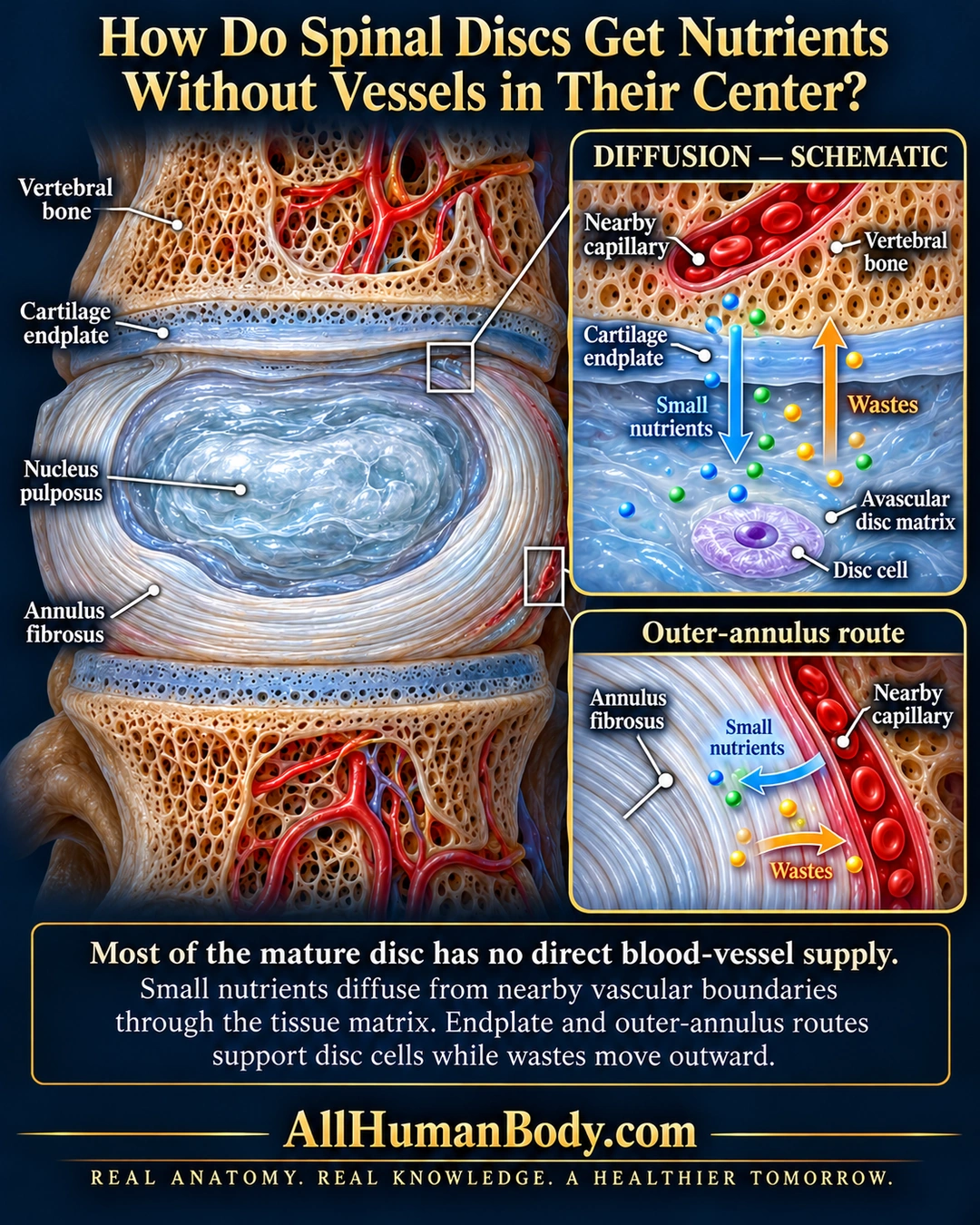
Most of a mature intervertebral disc lacks a direct blood-vessel supply. Small nutrients reach its cells mainly by diffusion from vascular boundaries through matrix, with endplate and peripheral-annulus routes supporting exchange.
READ THE IMAGE
What the illustration shows
A dimensional cutaway shows an intervertebral disc between two vascular vertebral bodies. Its nucleus pulposus lies inside layered annulus fibrosus, bounded by cartilage endplates. A diffusion schematic shows small nutrients moving from nearby capillary-bearing bone through an endplate toward a disc cell, and wastes moving outward. A second inset shows an outer-annulus route beside a capillary. Red cells remain within the illustrated capillaries. Gold AllHumanBody.com branding and the anatomy slogan appear below.
How to interpret this poster
- Urban review abstract plus directly read normal anatomy section support broad transport relationships, not full-paper review or an exact transport model.
- Molecule sizes, cells and endplate geometry are schematic; not all solutes and transport behave identically.
- No supplement, rehydration guarantee, exercise prescription or prevention/treatment claim.
- AI-assisted educational illustration; not physician certification, microscopy, a diagnosis or individualized medical advice.
- Fine annotations need enlargement; the full description provides an accessible text alternative.
- Display the full uncropped illustration; do not trim titles, legends or boundary annotations.
AI-assisted educational illustration, adapted into web-sized images without changing its composition. This is general education, not an individual diagnosis or treatment recommendation.
EVIDENCE / CONTEXT
Sources and what they support
- Nutrition of the intervertebral disc ↗
Marginal vascular supply, small-nutrient diffusion and metabolic waste removal.
Evidence correspondence is limited to the abstract. - Anatomy, Back, Intervertebral Discs — StatPearls ↗
Endplate and outer-annulus vascular boundary supply.