Digestive / VISUAL EXPLAINER
How Does Your Stomach Make Room for a Meal?
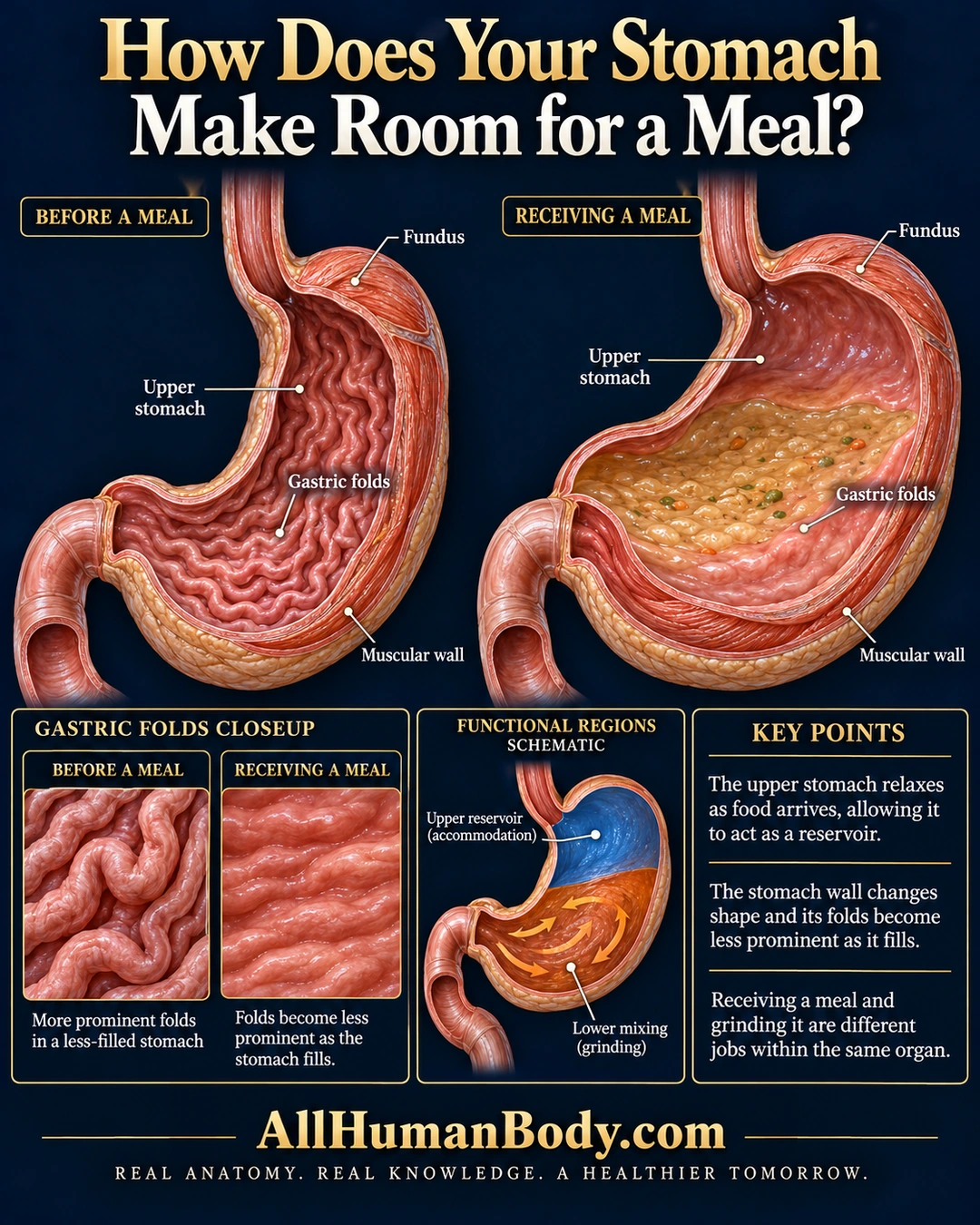
As a meal arrives, the upper stomach relaxes to receive it and the wall’s folds become less prominent. Reservoir accommodation and lower-stomach mixing are complementary functions, not a single uniform relaxation of the whole organ.
READ THE IMAGE
What the illustration shows
Two dimensional cutaway stomachs compare before a meal with receiving a meal. Labels identify fundus, upper stomach, gastric folds and muscular wall. The filling stomach has a larger reservoir and less prominent folds. Bottom panels compare fold closeups and mark upper accommodation and lower mixing as a schematic. Gold AllHumanBody.com branding and the anatomy slogan appear below.
How to interpret this poster
- No fixed capacity, meal duration, permanent growth or weight-loss inference.
- Folds are wall ridges, not intestinal villi or separate flow channels.
- Functional colors and arrows are schematic rather than measured muscle activity.
- AI-assisted educational illustration; not physician certification, microscopy, a diagnosis or individualized medical advice.
- Fine annotations need enlargement; the full description provides an accessible text alternative.
- Display the full uncropped illustration; do not trim titles, legends or boundary annotations.
AI-assisted educational illustration, adapted into web-sized images without changing its composition. This is general education, not an individual diagnosis or treatment recommendation.
EVIDENCE / CONTEXT
Sources and what they support
- Your Digestive System & How It Works ↗
Upper gastric relaxation contrasted with lower mixing.
- Anatomy and Physiology 2e: 23.4 The Stomach ↗
Changing shape, storage and empty-state mucosal folds, preserved lines 31–39.