Digestive / VISUAL EXPLAINER
What Protects Your Esophagus as Food Slides Through?
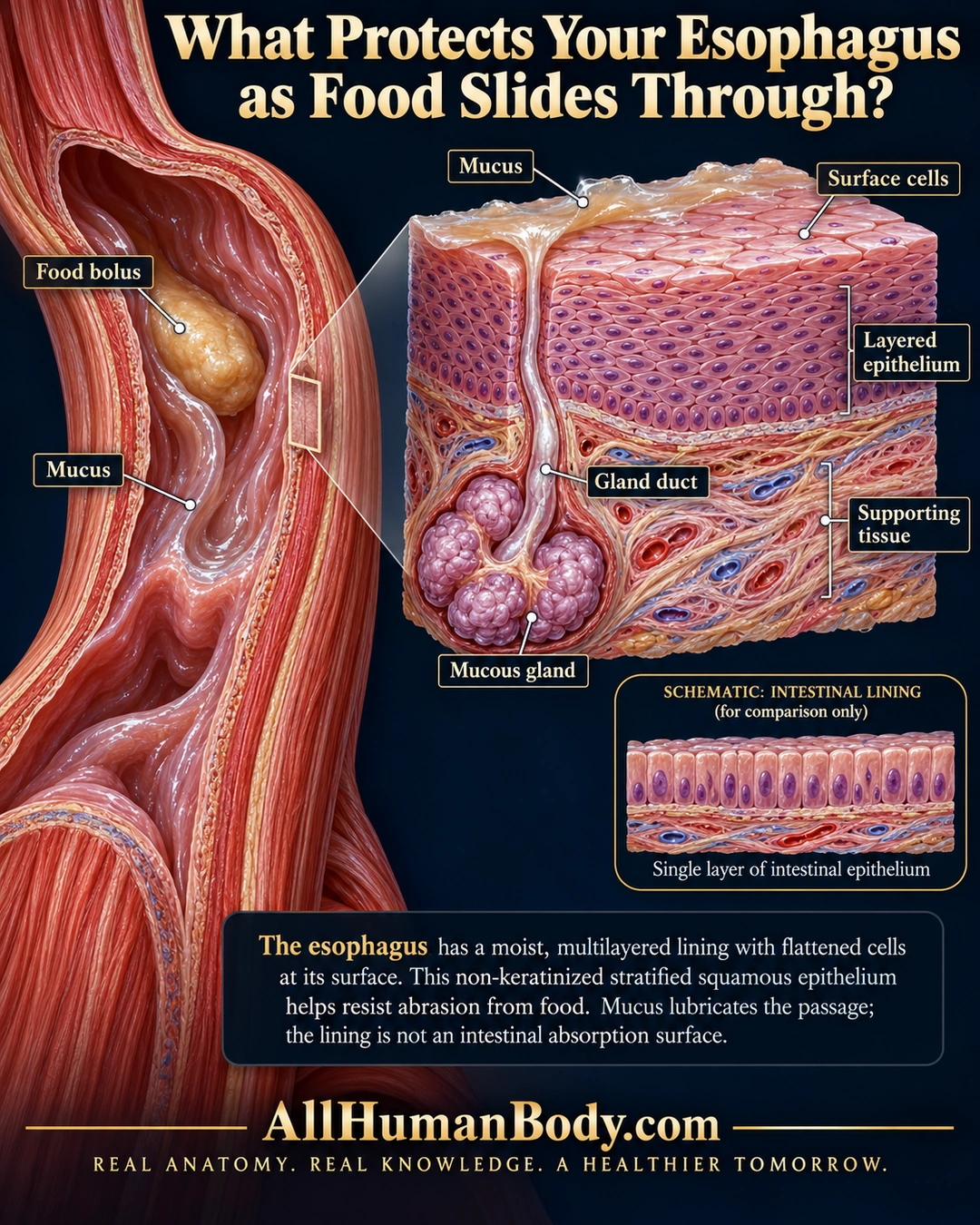
The esophagus has a moist, multilayered lining whose surface cells are flattened. This non-keratinized stratified squamous epithelium resists abrasion, while mucus lubricates passage; it is not the intestinal villous absorption surface.
READ THE IMAGE
What the illustration shows
English anatomy poster titled “What Protects Your Esophagus as Food Slides Through?” On the left, a dimensional longitudinal esophageal cutaway shows a soft food bolus inside a moist, folded passage. On the right, an enlarged wall block shows many layers of epithelial cells, flattened nucleated surface cells, a mucus film and supporting tissue beneath. A lobulated mucous gland connects to a duct reaching the surface. A separate, explicitly schematic intestinal comparison shows a single layer of tall cells. Text explains resistance to abrasion and lubrication, not intestinal absorption. Gold AllHumanBody.com branding and the slogan “REAL ANATOMY. REAL KNOWLEDGE. A HEALTHIER TOMORROW.” appear below.
How to interpret this poster
- General supporting tissue only, not precise lamina-propria versus submucosal gland depth.
- Cell counts and magnification are illustrative; the intestinal comparison teaches only a single-layer contrast.
- No acid-proof guarantee, swallowing advice, metaplasia or cancer claim.
- AI-assisted educational illustration; not physician certification, microscopy, a diagnosis or individualized medical advice.
- Fine annotations need enlargement; the full description provides an accessible text alternative.
- Display the full uncropped illustration; do not trim titles, legends or boundary annotations.
AI-assisted educational illustration, adapted into web-sized images without changing its composition. This is general education, not an individual diagnosis or treatment recommendation.
EVIDENCE / CONTEXT
Sources and what they support
- Anatomy and Physiology 2e: 23.3 The Mouth, Pharynx, and Esophagus ↗
Protective non-keratinized lining and mucus lubrication, preserved Histology lines 149–150 and 159/175.