Special Senses / VISUAL EXPLAINER
Why Does Your Inner Ear Have a Round Window?
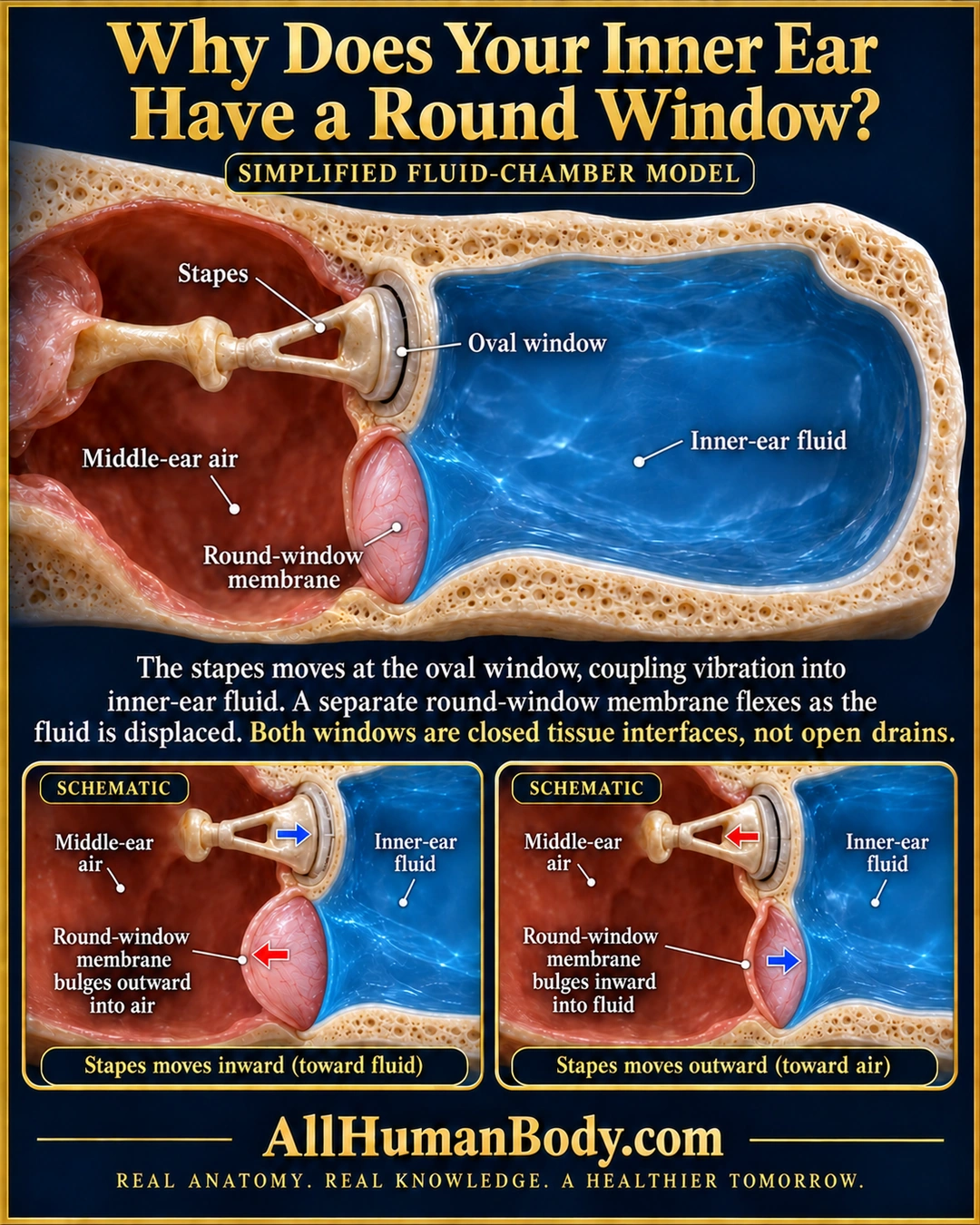
The stapes transmits vibration at the oval window while the separate round-window membrane accommodates fluid displacement. These are closed interfaces, not drains carrying air or fluid through the inner ear.
READ THE IMAGE
What the illustration shows
Anatomy poster titled “Why Does Your Inner Ear Have a Round Window?” A prominently labeled simplified fluid-chamber model shows a stapes at the oval window above a separate pink round-window membrane. Both closed interfaces separate middle-ear air on the left from blue inner-ear fluid on the right. Two schematic panels show opposite motion: when the stapes moves toward fluid, the round membrane bulges toward air; when the stapes moves toward air, the round membrane bows toward fluid. Arrows mark those directions. Text states that the windows transmit motion without acting as open drains. Gold AllHumanBody.com branding and the project slogan appear at the bottom.
How to interpret this poster
- A mechanical window-interface model, not reconstructed cochlear scalae, vestibule or spiral anatomy.
- Displacement is exaggerated and unmeasured.
- Not Eustachian-tube pressure equalization or a claim that the membrane prevents bursting.
- AI-assisted educational illustration; not physician certification, microscopy, a diagnosis or individualized medical advice.
- Fine annotations need enlargement; the full description provides an accessible text alternative.
- Display the full uncropped illustration; do not trim titles, legends or boundary annotations.
AI-assisted educational illustration, adapted into web-sized images without changing its composition. This is general education, not an individual diagnosis or treatment recommendation.
EVIDENCE / CONTEXT
Sources and what they support
- Anatomy and Physiology 2e: 14.1 Sensory Perception ↗
Stapes/oval input and fluid-retaining round-window membrane motion; preserved lines 107–110.