Special Senses / VISUAL EXPLAINER
Why Does One Eye Muscle Take a Turn Before Reaching the Eye?
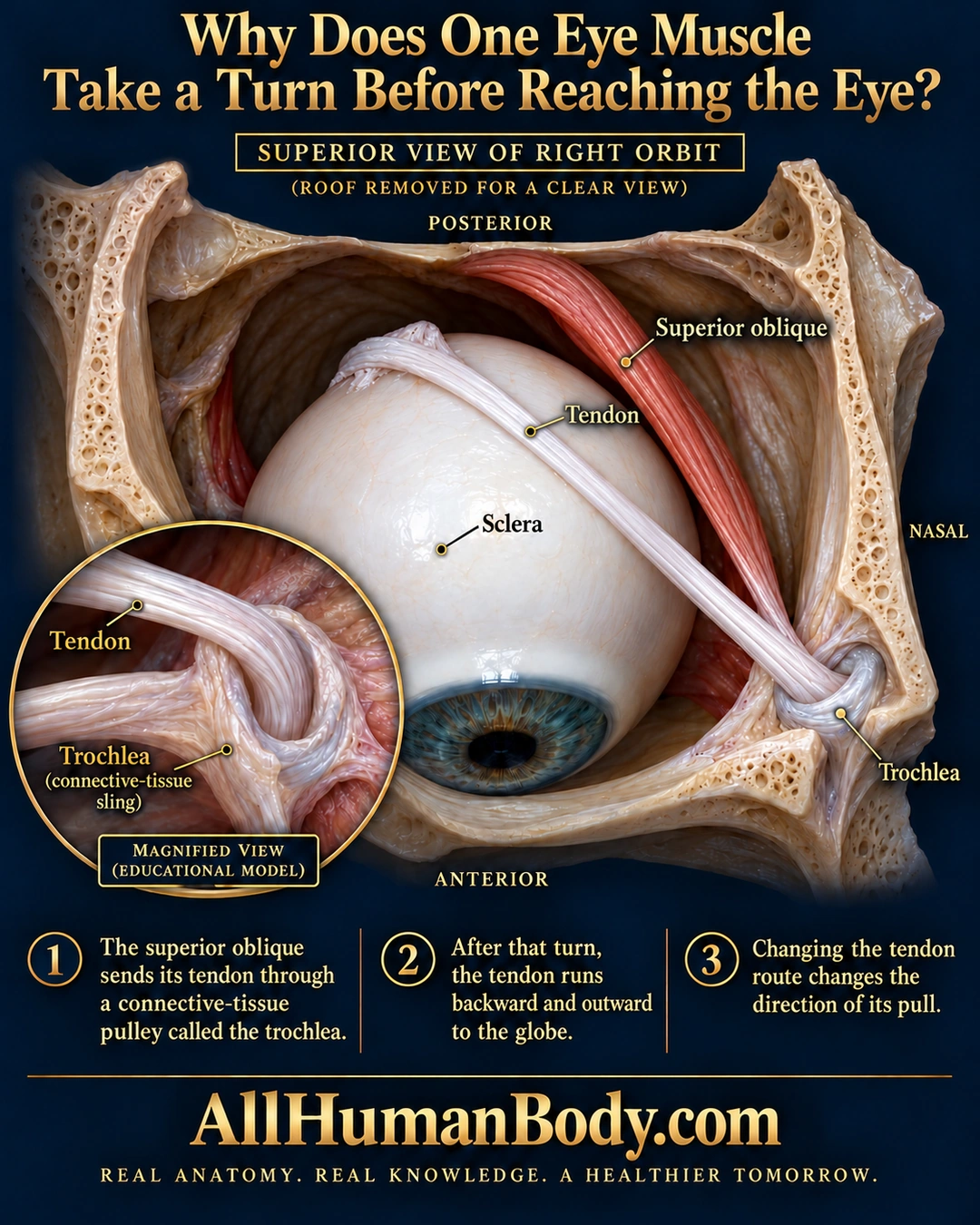
The superior oblique tendon changes course through the trochlea, a connective-tissue pulley in the upper nasal orbit. Its returning route toward the globe redirects the pull; eye action depends on position rather than a fixed downward-only rule.
READ THE IMAGE
What the illustration shows
Gold-on-navy anatomy poster titled “Why Does One Eye Muscle Take a Turn Before Reaching the Eye?” A roof-removed superior view of the right orbit labels posterior at the top, anterior below and nasal side at right. The red superior-oblique belly follows the nasal orbital wall toward the trochlea at the front. Its pale tendon turns through the connective-tissue sling and returns diagonally across the upper globe to a posterior attachment. Labels identify the muscle, tendon, trochlea and white sclera. A circular enlarged educational-model inset shows the tendon and sling. Three statements explain the turn and change in pulling direction. AllHumanBody.com and the exact project slogan appear in gold below.
How to interpret this poster
- Regional teaching geometry, not a measured insertion map, surgical model or exact force vector.
- Other eye muscles are omitted for clarity; the enlarged sling is an educational model.
- No nerve-palsy diagnosis or exercise advice.
- AI-assisted educational illustration; not physician certification, microscopy, a diagnosis or individualized medical advice.
- Fine annotations need enlargement; the full description provides an accessible text alternative.
- Display the full uncropped illustration; do not trim titles, legends or boundary annotations.
AI-assisted educational illustration, adapted into web-sized images without changing its composition. This is general education, not an individual diagnosis or treatment recommendation.
EVIDENCE / CONTEXT
Sources and what they support
- Neuroanatomy, Cranial Nerve 4 (Trochlear) — StatPearls ↗
Connective sling, posterolateral tendon route and position-dependent action.