Special Senses / VISUAL EXPLAINER
How Do Your Eyes Refocus from Far to Near?
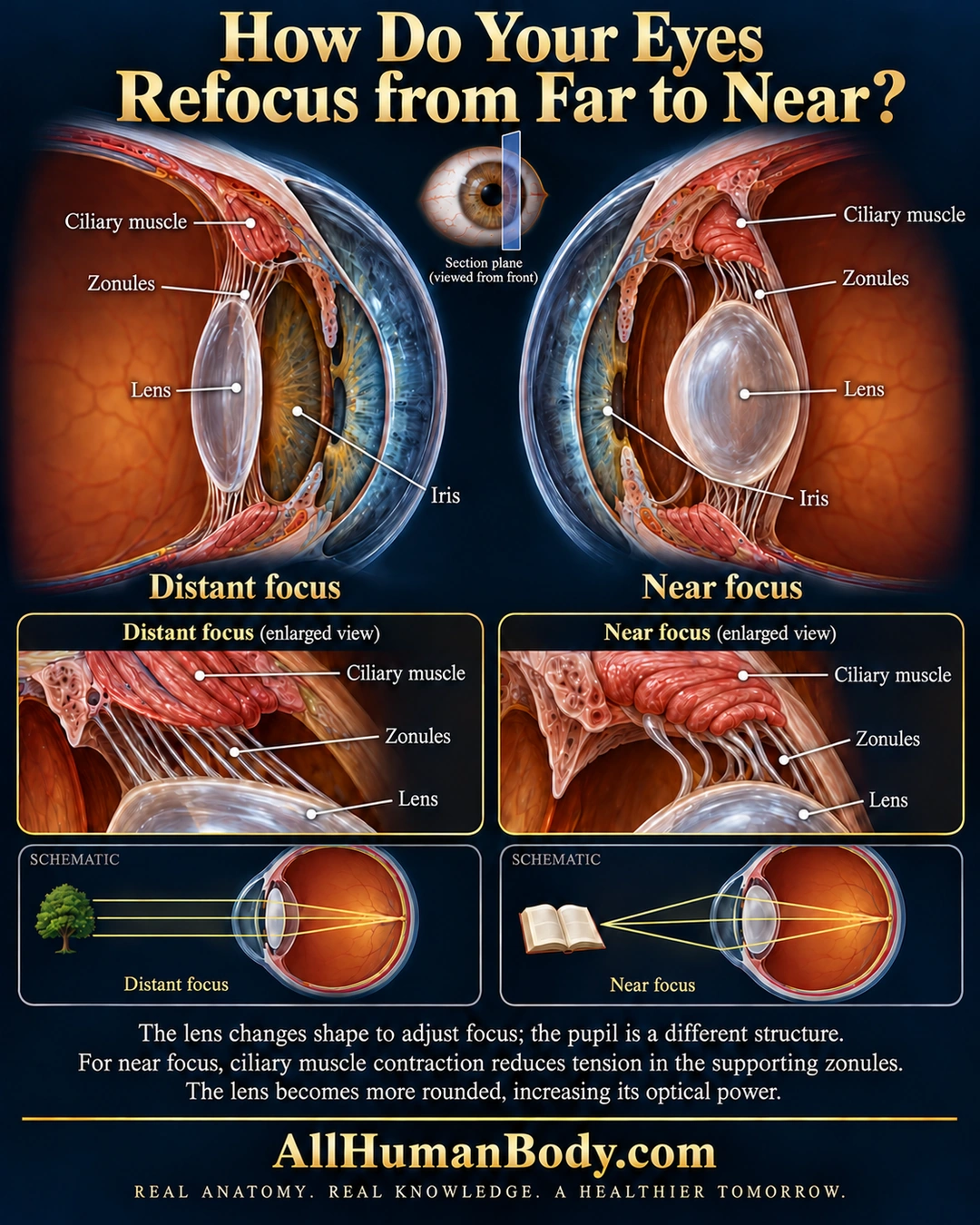
Lens accommodation adjusts optical power rather than pupil size. In the standard teaching model, ciliary contraction reduces tension in lens-supporting zonules, allowing a more rounded lens for near focus.
READ THE IMAGE
What the illustration shows
Navy and gold anatomy poster titled “How Do Your Eyes Refocus from Far to Near?” Two mirrored eye cutaways compare a thinner lens for distant focus with a rounder lens for near focus. Labels identify ciliary muscle, zonules, lens and the pigmented iris. Enlarged tissue panels contrast straighter supporting fibers with looser curved fibers. Small schematic eye diagrams show distant parallel rays and rays from a nearby book focusing at the back of the eye. Text explains that ciliary contraction reduces zonular tension so the lens becomes more rounded. Gold AllHumanBody.com branding and the slogan “REAL ANATOMY. REAL KNOWLEDGE. A HEALTHIER TOMORROW.” appear below.
How to interpret this poster
- Mirrored layouts, not identical camera views or measured ray tracing.
- A simplified support model, not every zonular fiber group, material property or age-related change.
- No vision-training, refractive-error diagnosis or treatment advice.
- AI-assisted educational illustration; not physician certification, microscopy, a diagnosis or individualized medical advice.
- Fine annotations need enlargement; the full description provides an accessible text alternative.
- Display the full uncropped illustration; do not trim titles, legends or boundary annotations.
AI-assisted educational illustration, adapted into web-sized images without changing its composition. This is general education, not an individual diagnosis or treatment recommendation.
EVIDENCE / CONTEXT
Sources and what they support
- OPTI-201/202 Geometrical and Instrumental Optics, Section 16: The Eye — John E. Greivenkamp ↗
Normal ciliary/zonular tension contrast and increased near-focus lens power.
- Anatomy and Physiology 2e: 14.1 Sensory Perception ↗
Lens-support anatomy distinct from iris aperture; not sole evidence for accommodation direction.