Nervous / VISUAL EXPLAINER
Does Your Spinal Cord Reach the Bottom of Your Spine?
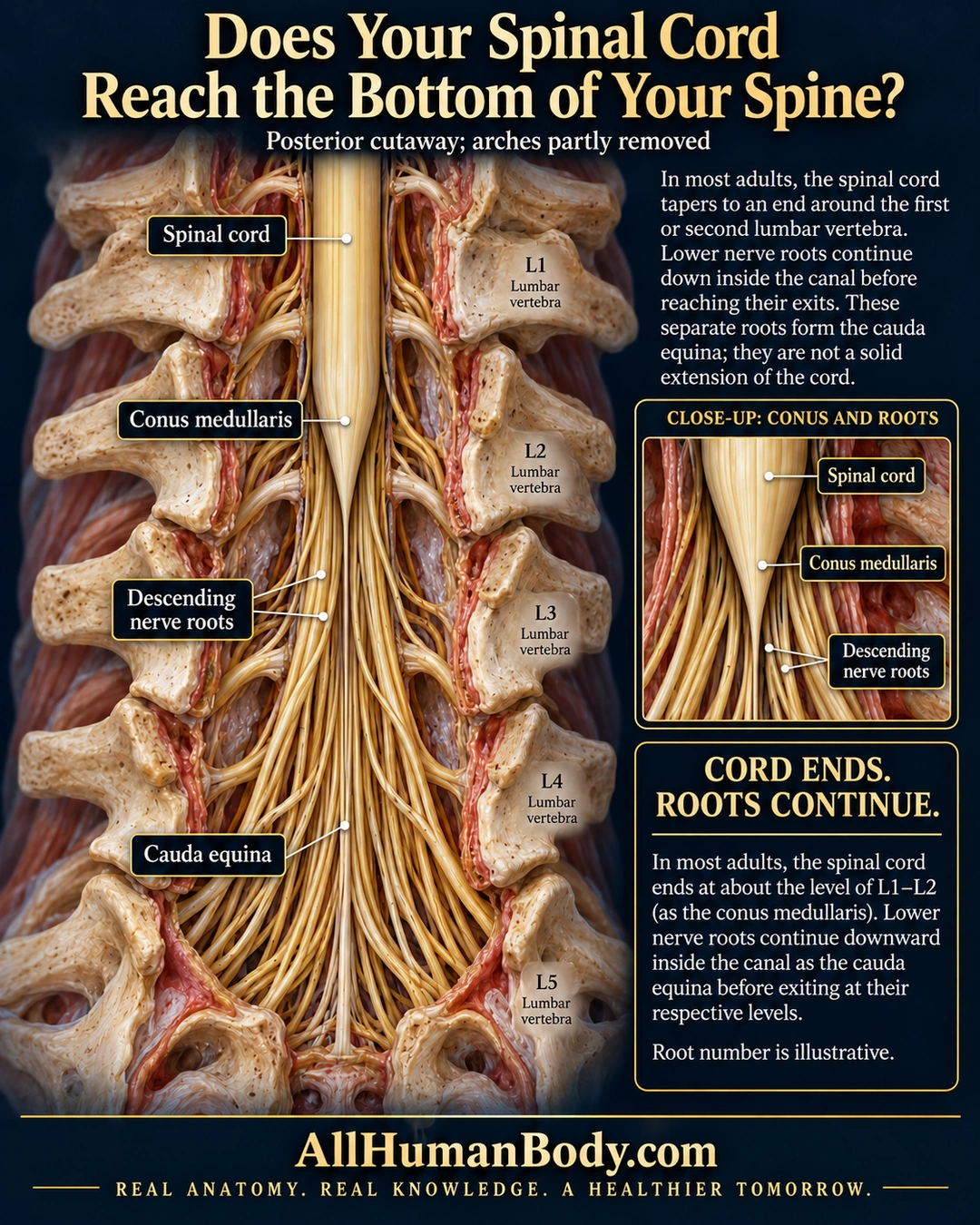
In most adults the spinal cord ends in a taper around the first or second lumbar vertebra. Lower nerve roots continue through the canal as the cauda equina before reaching their exits; they are not a solid continuation of the cord.
READ THE IMAGE
What the illustration shows
English anatomy poster asking whether the spinal cord reaches the bottom of the spine. A posterior lumbar cutaway, marked as having arches partly removed, shows a thick pale yellow cord narrowing to the conus medullaris around the upper lumbar region. Numerous separate nerve roots continue downward through the canal and fan toward lower exits. Leaders identify spinal cord, conus medullaris, descending nerve roots and cauda equina; visible bone levels are labeled L1 through L5. A right inset enlarges the taper and nearby roots. Text explains that the adult cord usually ends around L1–L2 while lower nerve roots continue, with root number marked illustrative. Gold AllHumanBody.com and the project slogan appear below.
How to interpret this poster
- Typical adult level, not a universal exact boundary or a child-anatomy claim.
- Root count, tiny attachments and bone geometry are illustrative; vertebral labels are not spinal-cord segments.
- No lumbar-puncture instructions, lesion localization or procedure guidance.
- AI-assisted educational illustration; not physician certification, microscopy, a diagnosis or individualized medical advice.
- Fine annotations need enlargement; the full description provides an accessible text alternative.
- Display the full uncropped illustration; do not trim titles, legends or boundary annotations.
AI-assisted educational illustration, adapted into web-sized images without changing its composition. This is general education, not an individual diagnosis or treatment recommendation.
EVIDENCE / CONTEXT
Sources and what they support
- Neuroscience Online: Anatomy of the Spinal Cord ↗
Typical adult upper-lumbar cord end and descending lower roots.