Musculoskeletal / VISUAL EXPLAINER
What Do the Small Joints Behind Your Spine Do?
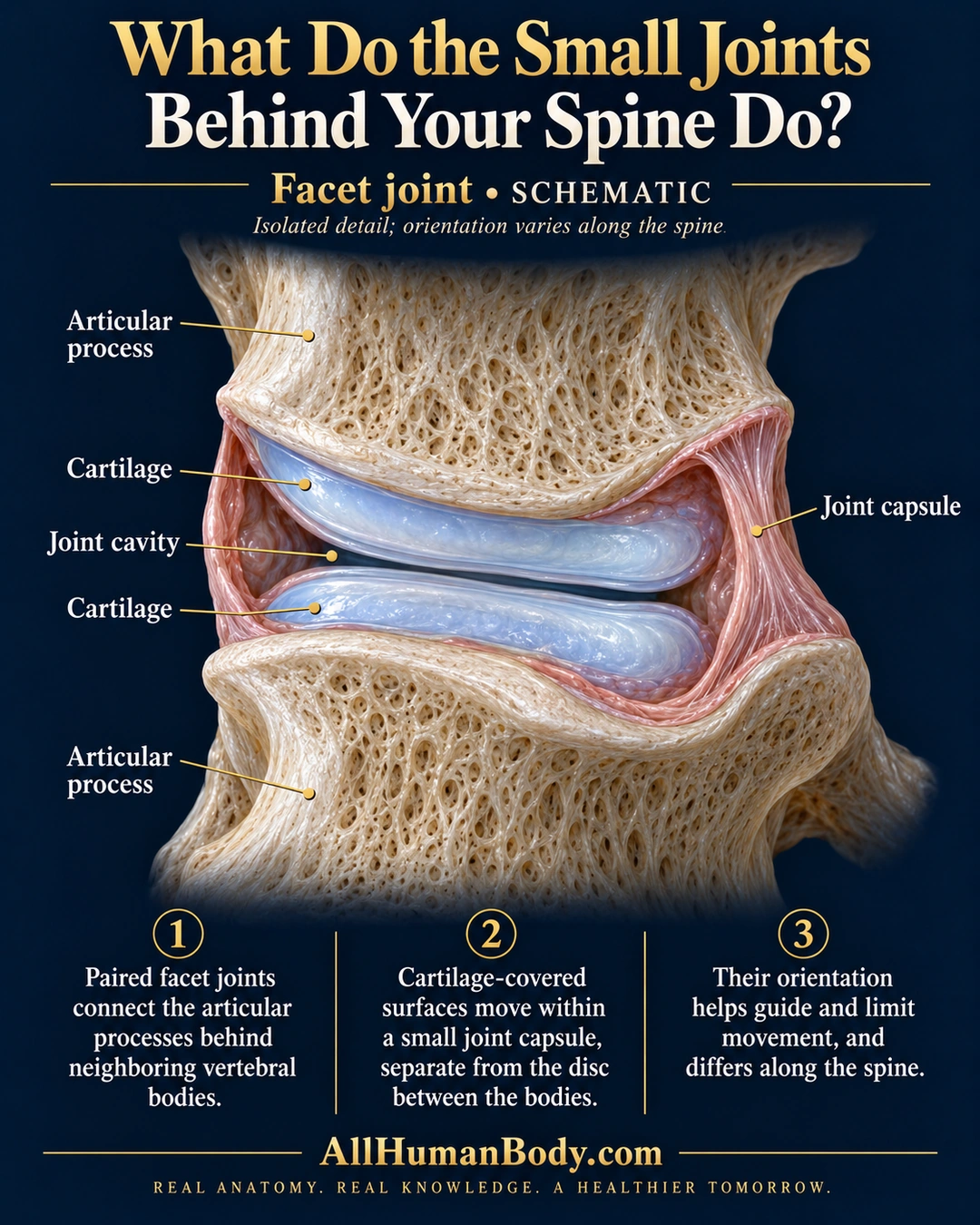
Facet joints form paired contacts behind neighboring vertebral bodies. Their cartilage-covered surfaces and capsules are separate from the disc between the bodies; regional orientation helps guide and constrain spinal movement.
READ THE IMAGE
What the illustration shows
English anatomy poster asking what the small joints behind the spine do. A large isolated facet-joint schematic shows two ivory articular-process bone ends with separate pale blue cartilage surfaces and a narrow dark joint cavity between them. A pink capsule surrounds the joint and is cut away at the front. Direct labels identify both articular processes, both cartilage layers, joint cavity and joint capsule. A note states that this is an isolated detail and orientation varies along the spine. Three text blocks explain paired facet contacts behind vertebral bodies, separation from the disc, and guidance and limitation of movement. Gold AllHumanBody.com and the project slogan appear below.
How to interpret this poster
- Only an isolated joint detail: no verified lumbar side, angle, process attachment or complete spinal segment.
- The paired arrangement and disc separation are explained in text, not shown in this cutaway.
- No fixed load percentage, posture prescription or back-pain diagnosis.
- AI-assisted educational illustration; not physician certification, microscopy, a diagnosis or individualized medical advice.
- Fine annotations need enlargement; the full description provides an accessible text alternative.
- Display the full uncropped illustration; do not trim titles, legends or boundary annotations.
AI-assisted educational illustration, adapted into web-sized images without changing its composition. This is general education, not an individual diagnosis or treatment recommendation.
EVIDENCE / CONTEXT
Sources and what they support
- Anatomy and Physiology 2e: 7.3 The Vertebral Column ↗
Adjacent articular contacts and regional orientation affecting movement.
- Anatomy and Physiology 2e: 9.4 Synovial Joints ↗
Separate articular cartilage, cavity and capsule.