Lymphatic & Immune / VISUAL EXPLAINER
What Does Your Thymus Do for T Cells?
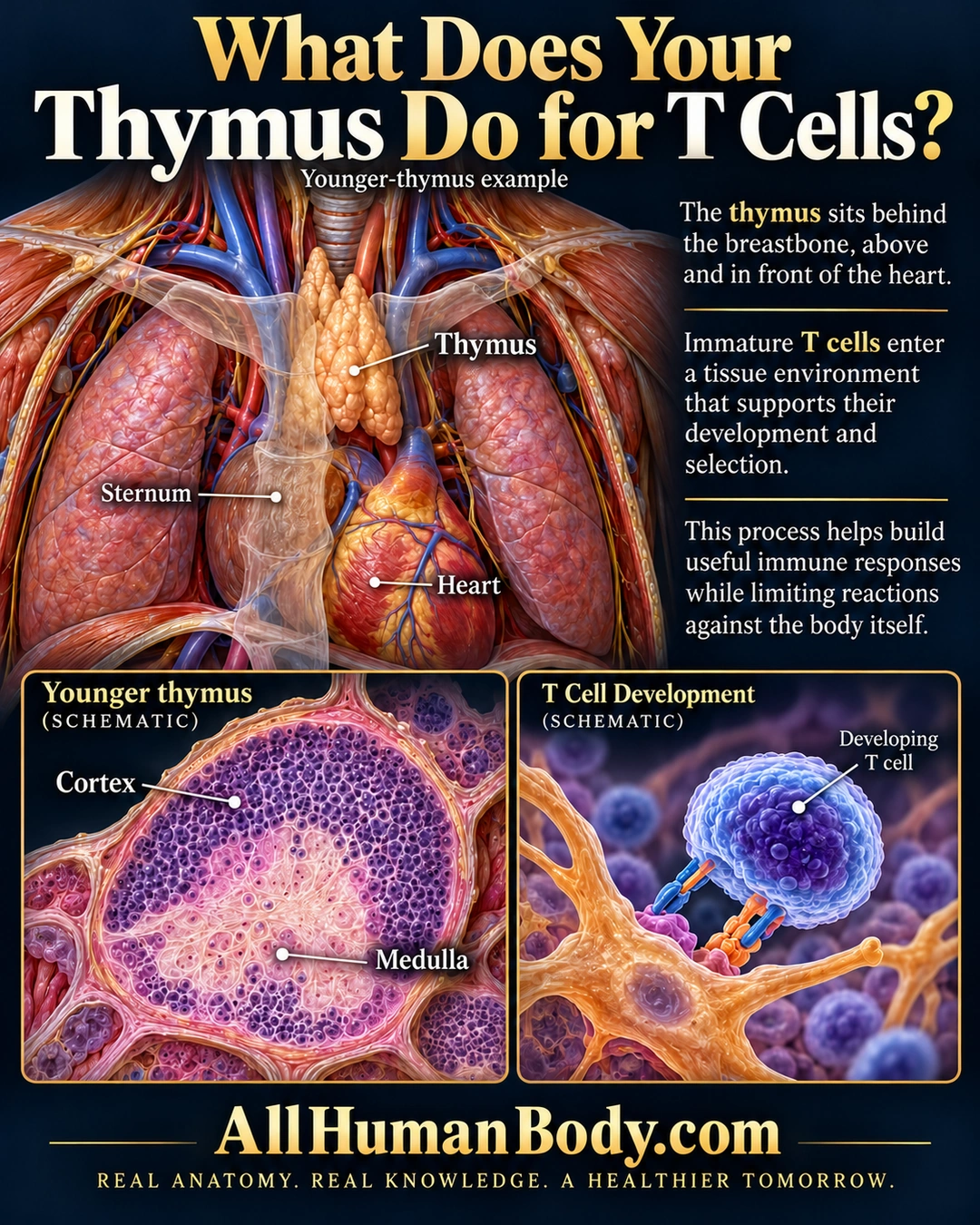
The thymus provides a tissue environment for developing T cells. Interactions with supporting cells help select useful immune responses while limiting self-reactivity; its prominent appearance here represents a younger thymus, not a fixed adult size.
READ THE IMAGE
What the illustration shows
English anatomy poster asking what the thymus does for T cells. A younger-thymus example in an anterior chest cutaway shows an orange lobulated thymus behind a translucent sternum and above the heart between the lungs. Leaders identify thymus, sternum and heart. Two lower schematic panels show dark peripheral cortex and pale central medulla in thymic tissue, and a round developing T cell contacting a branching supporting cell. Text explains the thymus location, T-cell development and selection, and limiting reactions against the body's own tissues. Gold AllHumanBody.com branding and the project slogan appear below.
How to interpret this poster
- Selection is simplified, not a complete migration sequence or guaranteed prevention of autoimmunity.
- Cell colors and contacts do not establish a specific developmental or receptor state.
- No claim that the adult thymus is useless or all lifetime T cells are supplied by puberty.
- AI-assisted educational illustration; not physician certification, microscopy, a diagnosis or individualized medical advice.
- Fine annotations need enlargement; the full description provides an accessible text alternative.
- Display the full uncropped illustration; do not trim titles, legends or boundary annotations.
AI-assisted educational illustration, adapted into web-sized images without changing its composition. This is general education, not an individual diagnosis or treatment recommendation.
EVIDENCE / CONTEXT
Sources and what they support
- Professor Thymus ↗
T-cell maturation and education; age-related shrinkage without loss of all adult importance.
- Thymus ↗
Normal location, lobes and precursor arrival/departure.