Musculoskeletal / VISUAL EXPLAINER
How Do Tendons Straighten Your Fingers?
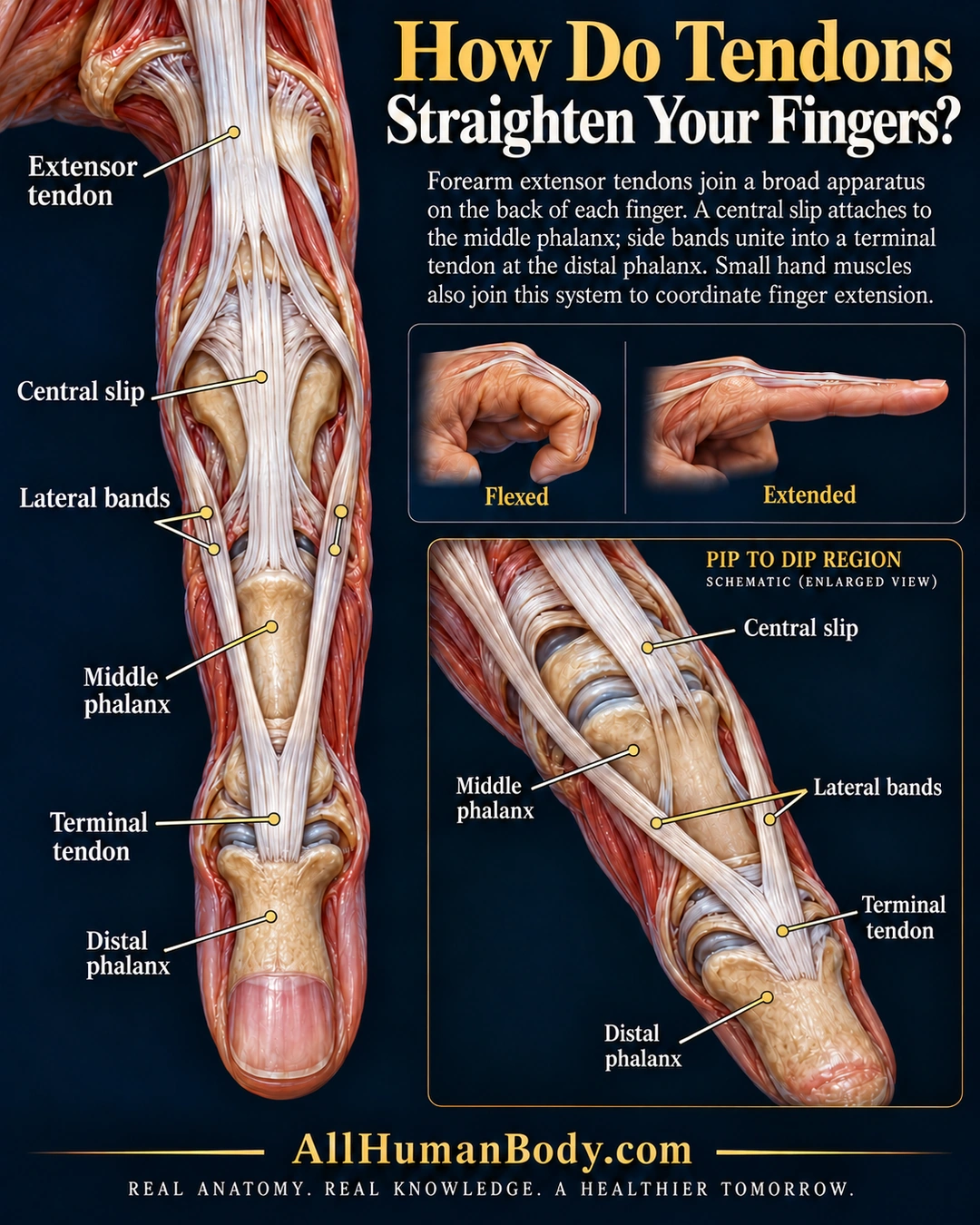
Finger extension uses a shared tendon apparatus on the back of the finger. A central slip reaches the middle phalanx, while lateral bands join a terminal tendon at the distal phalanx; small hand muscles also contribute to coordination.
READ THE IMAGE
What the illustration shows
A dorsal finger dissection shows a long extensor tendon dividing into a central slip and lateral bands. The central slip crosses the proximal interphalangeal joint and attaches near the base of the middle phalanx. The side bands continue distally, unite into a terminal tendon, cross the distal interphalangeal joint and attach near the base of the distal phalanx, leaving bone visible toward the nail. A larger oblique inset repeats those destinations. Small flexed and extended finger views show the action. Gold AllHumanBody.com branding appears below.
How to interpret this poster
- Not a complete intrinsic-muscle, ligament or surgical map.
- Tendons transmit muscle force rather than contracting themselves.
- No injury test, treatment or measured motion range.
- AI-assisted educational illustration; not physician certification, microscopy, a diagnosis or individualized medical advice.
- Fine annotations need enlargement; the full description provides an accessible text alternative.
- Display the full uncropped illustration; do not trim titles, legends or boundary annotations.
AI-assisted educational illustration, adapted into web-sized images without changing its composition. This is general education, not an individual diagnosis or treatment recommendation.
EVIDENCE / CONTEXT
Sources and what they support
- Extensor Tendon Injuries — Matzon and Bozentka, Journal of Hand Surgery (2010) ↗
Normal extensor apparatus, central slip, lateral bands and intrinsic contributions.