Special Senses / VISUAL EXPLAINER
Are the Bumps on Your Tongue Really Taste Buds?
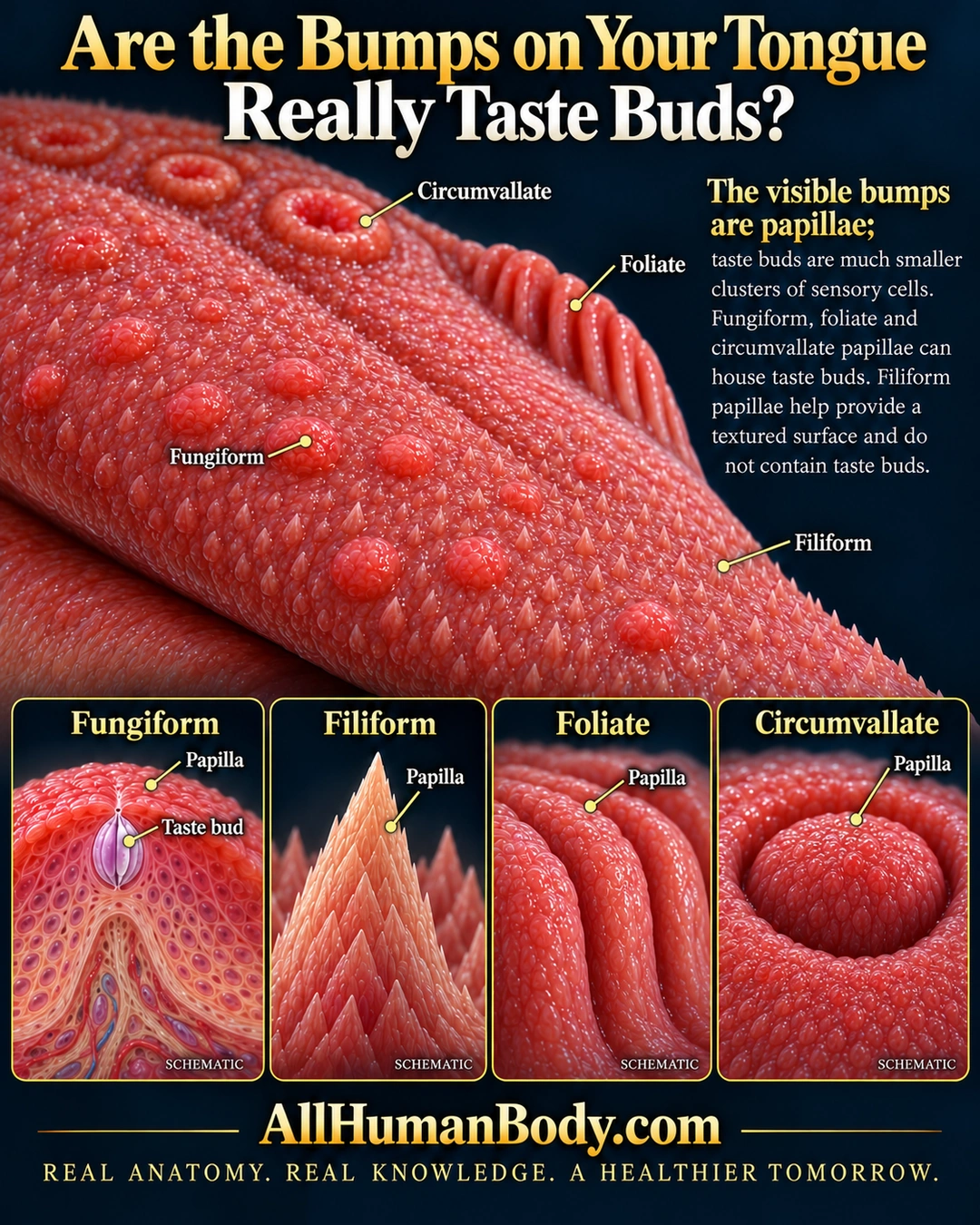
Visible tongue bumps are papillae, not individual taste buds. Fungiform, foliate and circumvallate papillae can contain much smaller taste-cell clusters, while filiform papillae provide surface texture without taste buds.
READ THE IMAGE
What the illustration shows
A close anatomical view of the tongue labels rounded fungiform papillae, fine pointed filiform papillae, lateral foliate folds and larger posterior circumvallate papillae. Four lower schematic insets compare their shapes. The fungiform inset is cut open to show a smaller oval taste bud within its upper epithelium, opening to the surface. The filiform inset has no taste bud; foliate and circumvallate insets show outer morphology only. Text distinguishes visible papillae from microscopic taste buds and states that filiform papillae do not contain taste buds. Gold AllHumanBody.com branding appears below.
How to interpret this poster
- Foliate and circumvallate panels show gross surfaces only; their lack of a drawn bud is not an absence claim.
- Scale, counts and distribution are illustrative, not a tongue taste-zone map.
- No diagnosis or treatment of swollen or painful bumps.
- AI-assisted educational illustration; not physician certification, microscopy, a diagnosis or individualized medical advice.
- Fine annotations need enlargement; the full description provides an accessible text alternative.
- Display the full uncropped illustration; do not trim titles, legends or boundary annotations.
AI-assisted educational illustration, adapted into web-sized images without changing its composition. This is general education, not an individual diagnosis or treatment recommendation.
EVIDENCE / CONTEXT
Sources and what they support
- Anatomy, Head and Neck, Tongue Taste Buds ↗
Papilla types and explicit filiform taste-bud exception.
- Anatomy and Physiology 2e: 14.1 Sensory Perception ↗
Papilla versus microscopic taste-bud hierarchy; broad papilla wording qualified by explicit filiform exception.