Respiratory / VISUAL EXPLAINER
Why Can a Quiet Breath Out Happen Without a Push?
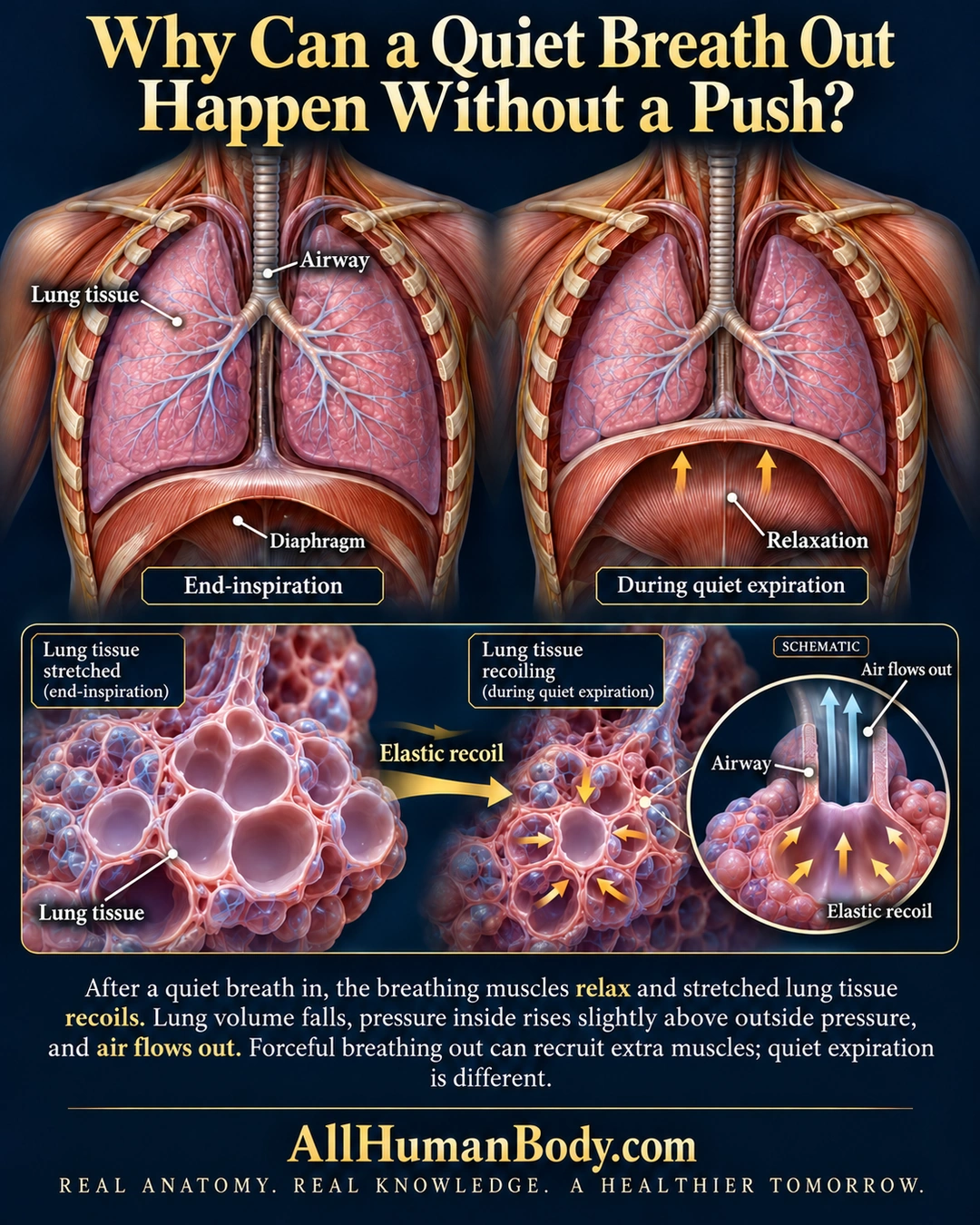
After an ordinary quiet inspiration, inspiratory muscles relax and elastic recoil helps reduce lung volume. Pressure inside rises relative to outside, allowing air to flow out; forceful expiration can recruit additional muscles.
READ THE IMAGE
What the illustration shows
Anatomy poster comparing the chest at end-inspiration and during quiet expiration. The right diaphragm is higher and more domed, and the lungs are smaller but remain inflated. Magnified lung-tissue views show stretched air spaces beside recoiling tissue. A schematic inset uses inward gold arrows for recoil and blue arrows for air leaving the airway. Text explains that relaxation and elastic recoil raise pressure inside the lungs above outside pressure; forceful expiration can recruit extra muscles. Gold AllHumanBody.com branding appears below.
How to interpret this poster
- Quiet breathing only, not every cough, exercise or forced breath.
- Upward diaphragm arrows show displacement during relaxation, not active upward contraction.
- Closeups are not measured alveolar dimensions or pressure recordings; recoil is not attributed to one elastic fiber alone.
- AI-assisted educational illustration; not physician certification, microscopy, a diagnosis or individualized medical advice.
- Fine annotations need enlargement; the full description provides an accessible text alternative.
- Display the full uncropped illustration; do not trim titles, legends or boundary annotations.
AI-assisted educational illustration, adapted into web-sized images without changing its composition. This is general education, not an individual diagnosis or treatment recommendation.
EVIDENCE / CONTEXT
Sources and what they support
- Anatomy and Physiology 2e: 22.3 The Process of Breathing ↗
Normal expiratory relaxation, recoil, volume reduction and outward pressure gradient, distinguished from forced breathing.