Digestive / VISUAL EXPLAINER
Why Are Your Teeth Different Shapes?
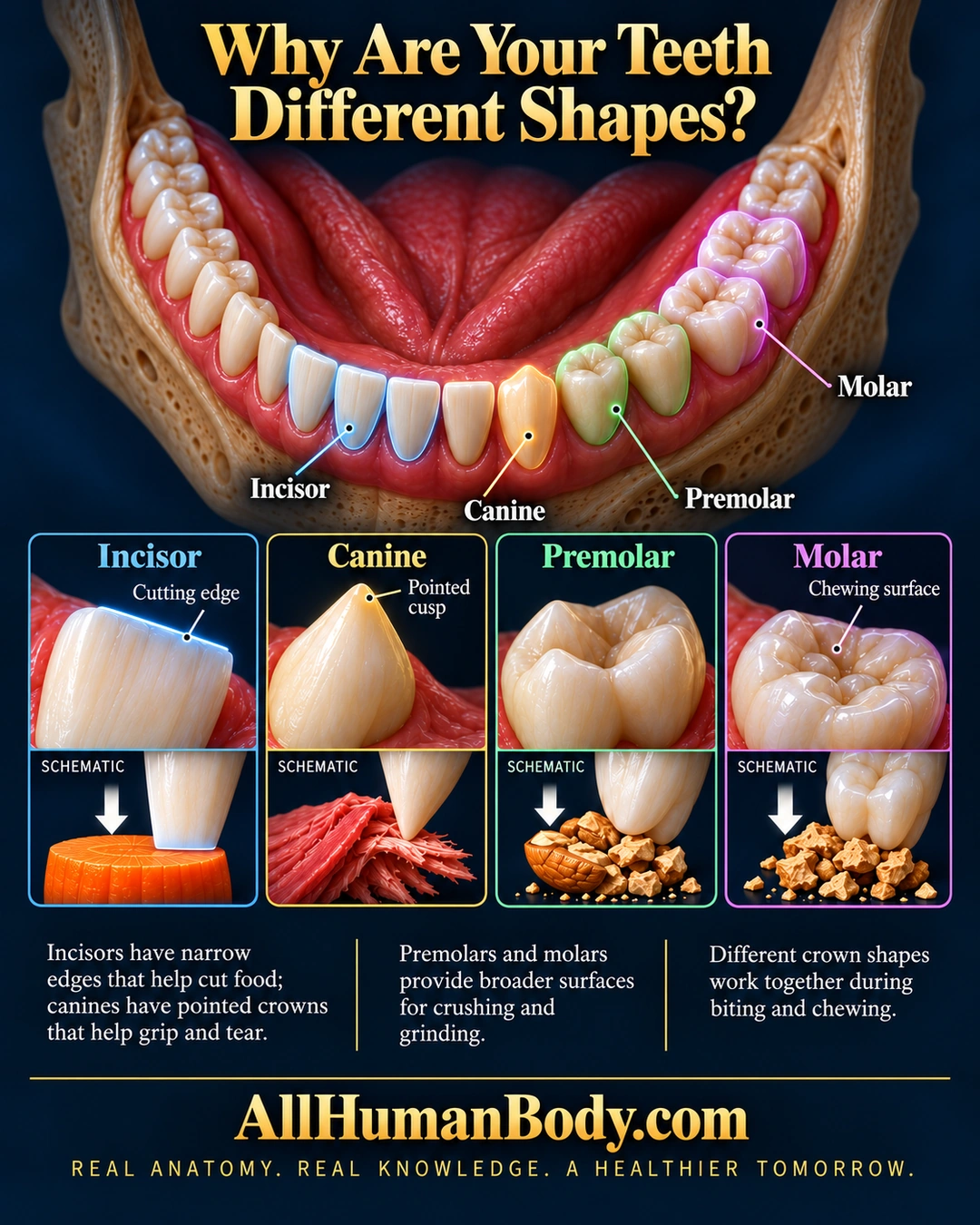
Different tooth crowns contribute complementary contacts during biting and chewing. Narrow incisor edges help divide food, pointed canines can grip and tear, and broader posterior surfaces support crushing and grinding.
READ THE IMAGE
What the illustration shows
Navy-and-gold poster titled Why Are Your Teeth Different Shapes? An oblique lower dental arch highlights and labels an incisor in blue, canine in gold, premolar in green and molar in purple. Four enlarged crown panels compare cutting edge, pointed cusp and broader chewing surfaces. Small schematics show a straight edge pressing carrot, a pointed tooth contacting fibrous food, and broader teeth crushing pieces. Text explains complementary cutting, gripping, tearing, crushing and grinding. Gold AllHumanBody.com and project slogan appear below.
How to interpret this poster
- Representative crown forms, not a universal cusp, root or tooth-count chart.
- Isolated contact sketches omit opposing teeth and do not reconstruct a complete bite.
- Roles overlap; no diet, dental treatment or orthodontic advice.
- AI-assisted educational illustration; not physician certification, microscopy, a diagnosis or individualized medical advice.
- Fine annotations need enlargement; the full description provides an accessible text alternative.
- Display the full uncropped illustration; do not trim titles, legends or boundary annotations.
AI-assisted educational illustration, adapted into web-sized images without changing its composition. This is general education, not an individual diagnosis or treatment recommendation.
EVIDENCE / CONTEXT
Sources and what they support
- Teeth ↗
Normal four-tooth-type shape and function comparison.
- Anatomy and Physiology 2e: 23.3 The Mouth, Pharynx, and Esophagus ↗
Mechanical food preparation with jaw, tongue and cheek coordination.