Special Senses / VISUAL EXPLAINER
Why Are Tears More Than Water?
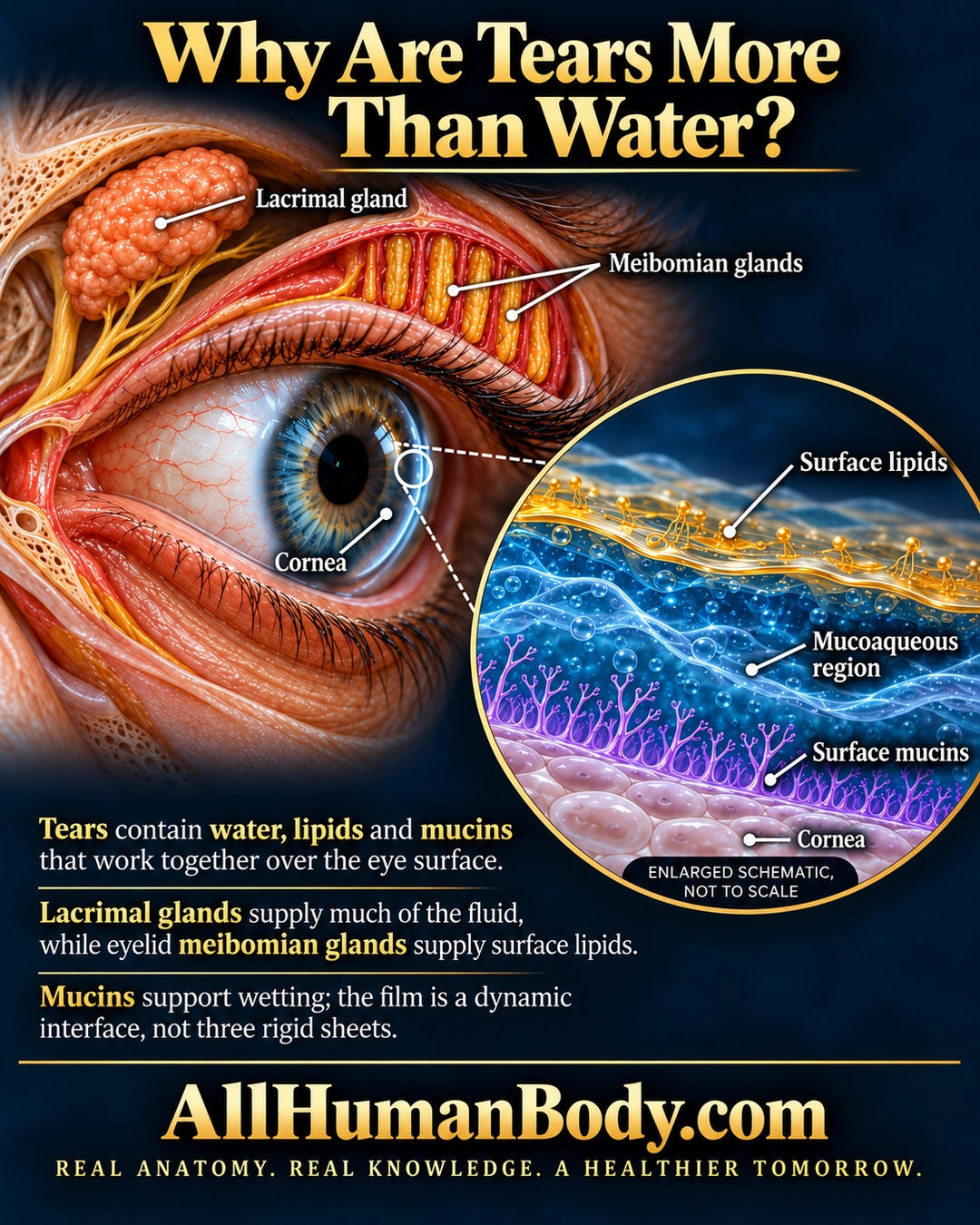
Tears combine water, dissolved components, lipids and mucins over the eye. Lacrimal glands contribute much of the fluid and meibomian glands supply surface lipids; mucins help maintain wetting within a dynamic film, not three rigid sheets.
READ THE IMAGE
What the illustration shows
Navy-and-gold poster titled Why Are Tears More Than Water? Eye and upper-eyelid cutaway labels the lacrimal gland, meibomian glands and cornea. A large circular enlargement, marked schematic and not to scale, shows gold surface lipids above a blue mucoaqueous region, purple surface mucins and corneal epithelial cells. Three blocks explain tear components, gland contributions and a dynamic rather than rigid-layer film. Gold AllHumanBody.com and project slogan appear below.
How to interpret this poster
- Magnified film thickness, gland counts and molecular symbols are illustrative.
- Pale spheres are not literal air bubbles, and the inset does not show all corneal layers.
- No dry-eye diagnosis or tear-product recommendation.
- AI-assisted educational illustration; not physician certification, microscopy, a diagnosis or individualized medical advice.
- Fine annotations need enlargement; the full description provides an accessible text alternative.
- Display the full uncropped illustration; do not trim titles, legends or boundary annotations.
AI-assisted educational illustration, adapted into web-sized images without changing its composition. This is general education, not an individual diagnosis or treatment recommendation.
EVIDENCE / CONTEXT
Sources and what they support
- How Tears Work ↗
Normal tear components and gland contributions.
- TFOS DEWS II Tear Film Report ↗
Dynamic mucoaqueous region, surface mucins and meibomian lipid contribution.