Nervous / VISUAL EXPLAINER
How Does One Neuron Send a Message to Another?
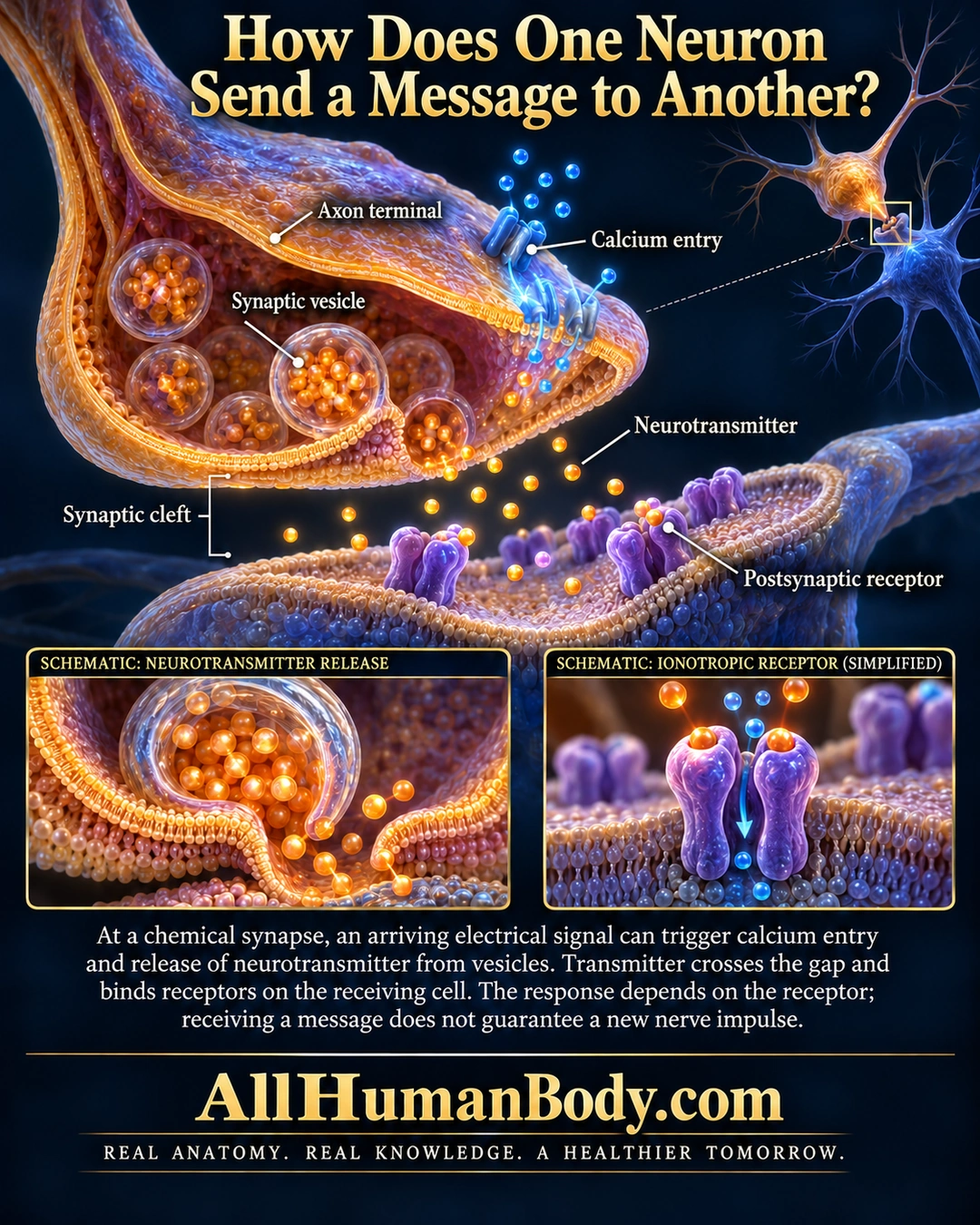
At a chemical synapse, an electrical signal can trigger calcium entry and transmitter release. The transmitter crosses an extracellular gap and binds receptors; the receiving response depends on the receptor and need not produce another nerve impulse.
READ THE IMAGE
What the illustration shows
English anatomy poster titled “How Does One Neuron Send a Message to Another?” A large cutaway shows an orange axon terminal above a separate blue-purple receiving membrane. Blue calcium particles enter the terminal at channels. Round vesicles release orange neurotransmitter particles into the labeled synaptic cleft; the particles meet purple postsynaptic receptors. Two schematic insets enlarge vesicle fusion and a simplified ionotropic receptor. A small pair of neurons locates the junction. Text explains chemical release, receptor binding and why receiving a message does not guarantee a new nerve impulse. Gold footer reads AllHumanBody.com and “REAL ANATOMY. REAL KNOWLEDGE. A HEALTHIER TOMORROW.”
How to interpret this poster
- The ionotropic receptor inset is one simplified example, not all receptor types or ion gradients.
- Molecule counts, channel shapes and the small neuron locator are schematic, not a mapped circuit.
- Electrical synapses are a different arrangement; no medication or mental-health claim.
- AI-assisted educational illustration; not physician certification, microscopy, a diagnosis or individualized medical advice.
- Fine annotations need enlargement; the full description provides an accessible text alternative.
- Display the full uncropped illustration; do not trim titles, legends or boundary annotations.
AI-assisted educational illustration, adapted into web-sized images without changing its composition. This is general education, not an individual diagnosis or treatment recommendation.
EVIDENCE / CONTEXT
Sources and what they support
- Anatomy and Physiology 2e: 12.5 Communication Between Neurons ↗
Calcium-triggered release, extracellular diffusion and receptor-dependent postsynaptic responses.