Musculoskeletal / VISUAL EXPLAINER
What Cushions Your Heel When It Meets the Ground?
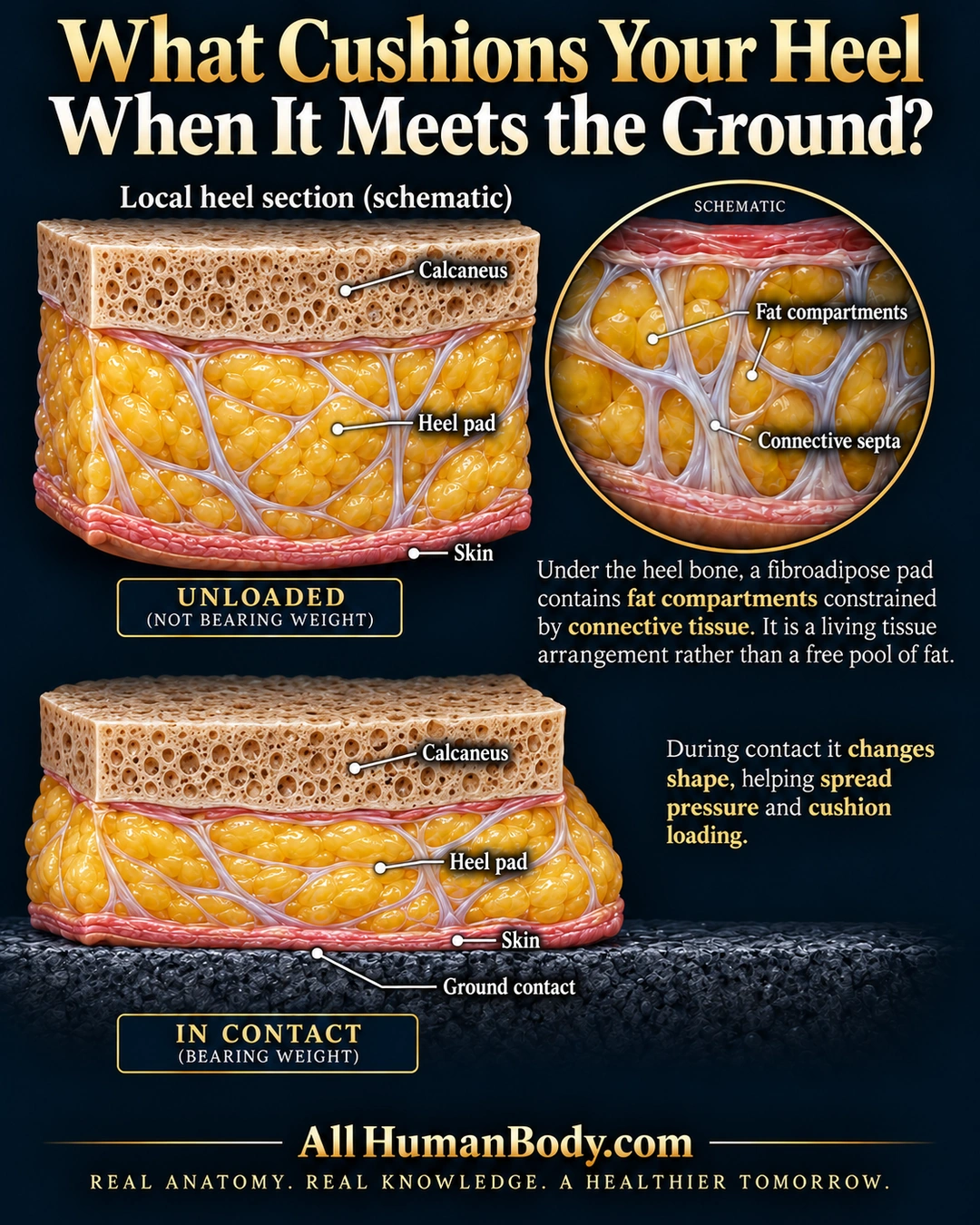
Below the heel bone, fat compartments constrained by connective tissue form a living cushion. The pad changes shape under contact and helps distribute loading; it is not bare bone on the ground or a free pool of fat.
READ THE IMAGE
What the illustration shows
Navy and gold poster asking what cushions the heel. Two explicitly schematic local tissue sections show a cut piece of calcaneal bone above yellow fibroadipose heel padding and pink skin. The unloaded section is taller; the ground-contact section shows the pad flattened and spreading sideways, with skin against the ground. A circular inset labels irregular fat compartments and connective septa. Text explains that the living pad changes shape to help spread pressure and cushion loading. These are local tissue models, not whole ankle reconstructions or measured deformation. AllHumanBody.com branding appears below.
How to interpret this poster
- Truncated bone blocks are local sections, not whole calcanei or ankle reconstructions.
- Deformation, tissue thickness, pores and compartment counts are illustrative, not measured matched-scale mechanics.
- No fixed pressure reduction, guaranteed protection, footwear or treatment advice.
- AI-assisted educational illustration; not physician certification, microscopy, a diagnosis or individualized medical advice.
- Fine annotations need enlargement; the full description provides an accessible text alternative.
- Display the full uncropped illustration; do not trim titles, legends or boundary annotations.
AI-assisted educational illustration, adapted into web-sized images without changing its composition. This is general education, not an individual diagnosis or treatment recommendation.
EVIDENCE / CONTEXT
Sources and what they support
- Pain in your heel: Fat pad syndrome ↗
Normal fat-pad compartment structure and cushioning only.