Lymphatic & Immune / VISUAL EXPLAINER
What Happens as Lymph Passes Through a Lymph Node?
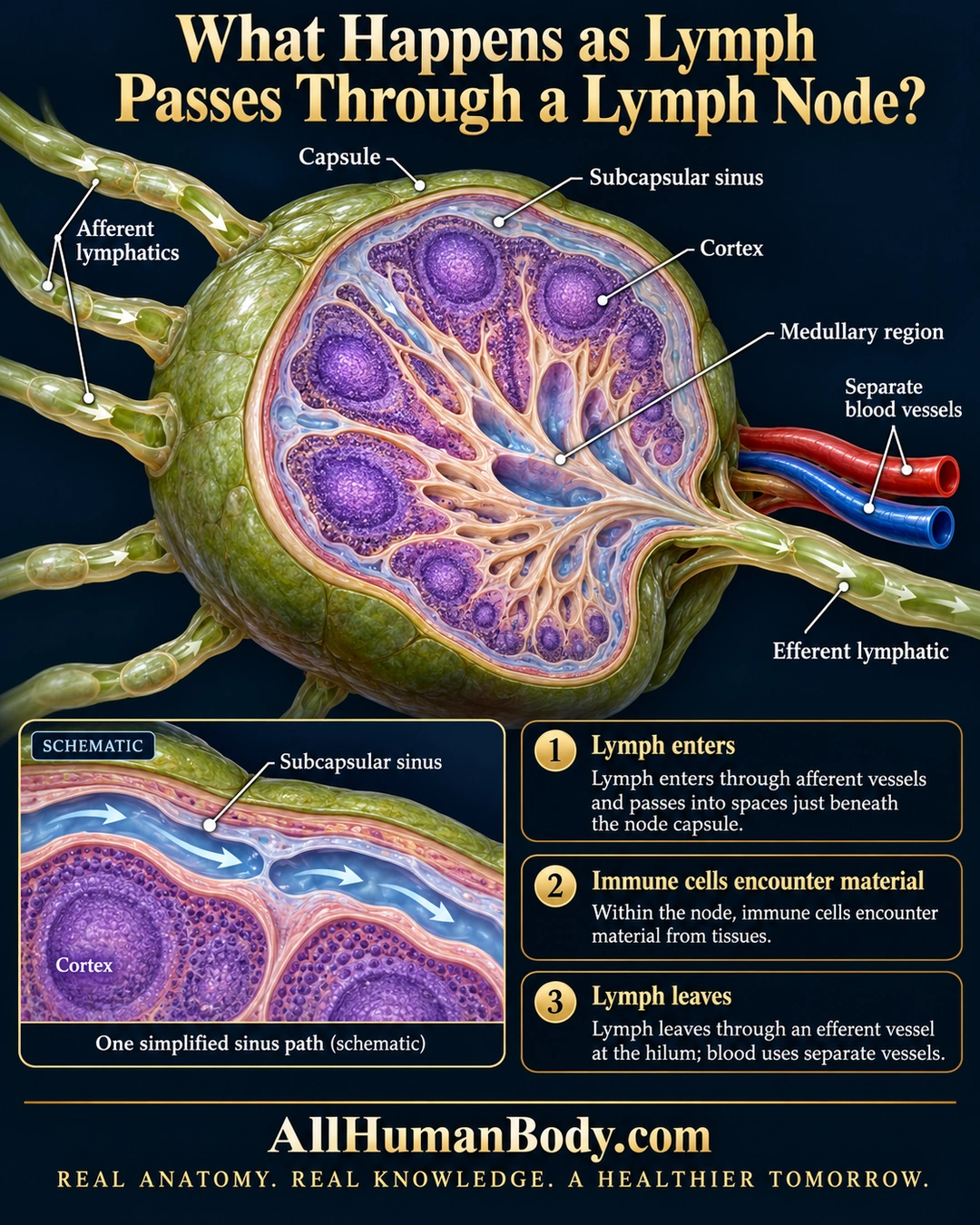
Lymph enters a node through afferent vessels and reaches spaces beneath its capsule. Immune cells can encounter tissue-derived material within the node; lymph then leaves by an efferent route at the hilum, separate from blood vessels.
READ THE IMAGE
What the illustration shows
Navy and gold poster showing a dimensional cutaway lymph node. Several green afferent lymphatic vessels enter its rounded left surface; white arrows point inward. Labels identify capsule, subcapsular sinus, cortex and medullary region. A green efferent lymphatic carries lymph out at the right-hand hilum beside separate red and blue blood vessels. A lower schematic enlarges a sinus beneath the capsule, and three panels explain lymph entry, immune-cell encounters and lymph exit. AllHumanBody.com branding is at the bottom.
How to interpret this poster
- The inset shows one simplified sinus segment, not a full traced flow network or validated cell identities.
- A node is not a pump, germ-proof sieve or generic detox device.
- No interpretation of swelling or diagnosis.
- AI-assisted educational illustration; not physician certification, microscopy, a diagnosis or individualized medical advice.
- Fine annotations need enlargement; the full description provides an accessible text alternative.
- Display the full uncropped illustration; do not trim titles, legends or boundary annotations.
AI-assisted educational illustration, adapted into web-sized images without changing its composition. This is general education, not an individual diagnosis or treatment recommendation.
EVIDENCE / CONTEXT
Sources and what they support
- Anatomy and Physiology 2e: 21.1 Anatomy of the Lymphatic and Immune Systems ↗
Lymph-node entry, subcapsular spaces, immune encounters and efferent exit; unrelated capillary-fluid and splenic-venule simplifications excluded.