Digestive / VISUAL EXPLAINER
How Do Stomach Cells Make Acid?
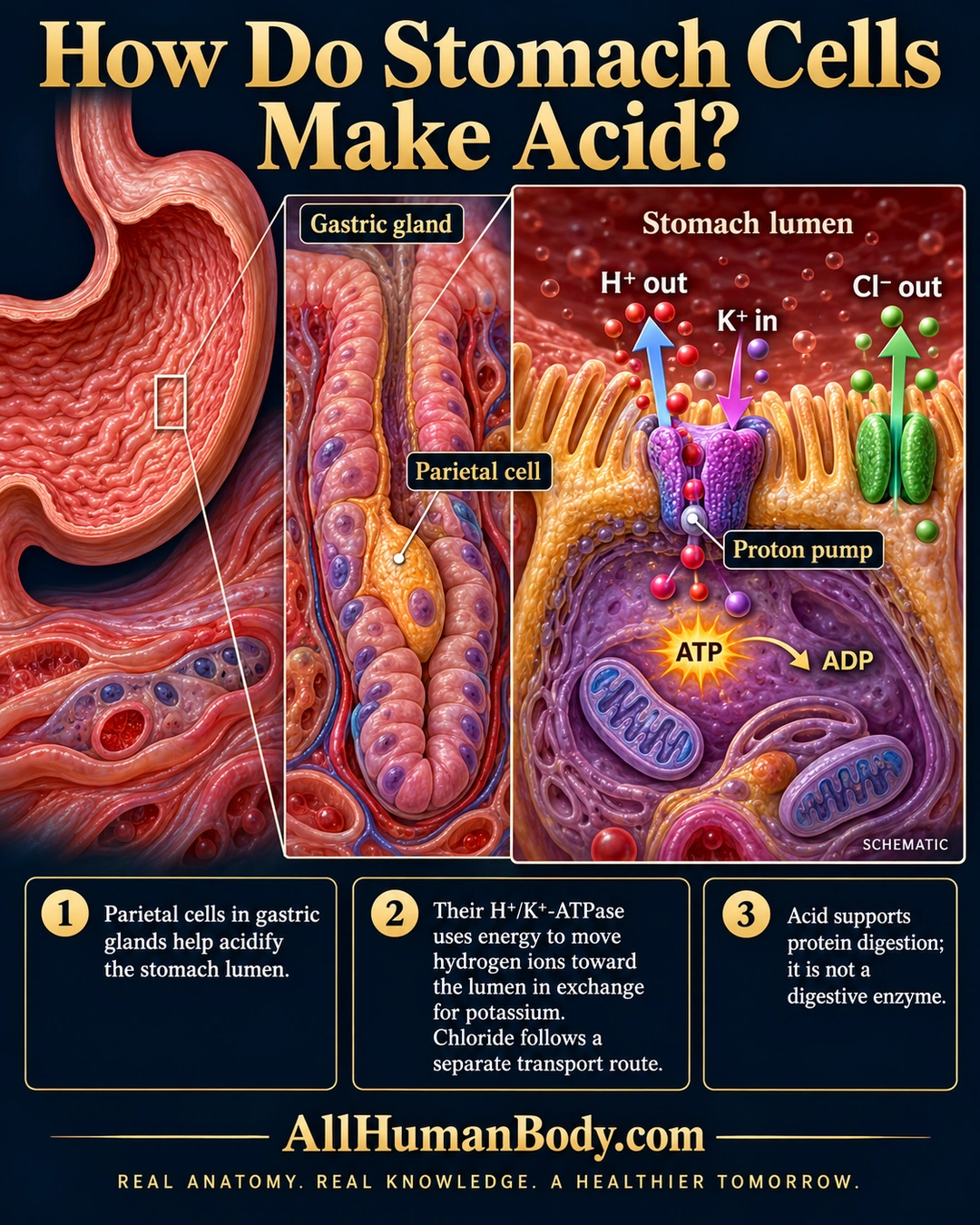
Gastric parietal cells use an ATP-dependent hydrogen–potassium pump at their luminal surface to help acidify the stomach. Chloride uses a separate route; the acidic environment supports digestion but is not itself a digestive enzyme.
READ THE IMAGE
What the illustration shows
A dimensional stomach cutaway expands into a gastric gland and a schematic parietal-cell membrane. Labels identify gastric gland, parietal cell, stomach lumen and proton pump. Blue H+ out and purple K+ in arrows point in opposite directions through the luminal pump; a green Cl− out arrow uses a separate route. An ATP-to-ADP cue is below the pump. Three teaching boxes describe acid secretion and distinguish acid from digestive enzymes. Gold AllHumanBody.com and the exact brand slogan appear below.
How to interpret this poster
- Canalicular continuity, membrane recycling, potassium recycling and basolateral transport are omitted from the simplified surface.
- Protein shapes and ATP imagery are symbolic, not exact molecular reconstructions or a complete balanced energy reaction.
- No antacid, proton-pump inhibitor, diet or pH-testing advice.
- AI-assisted educational illustration; not physician certification, microscopy, a diagnosis or individualized medical advice.
- Fine annotations need enlargement; the full description provides an accessible text alternative.
- Display the full uncropped illustration; do not trim titles, legends or boundary annotations.
AI-assisted educational illustration, adapted into web-sized images without changing its composition. This is general education, not an individual diagnosis or treatment recommendation.
EVIDENCE / CONTEXT
Sources and what they support
- Anatomy and Physiology 2e: 23.4 The Stomach ↗
Gastric parietal-cell identity and acid role, distinct from digestive enzymes.
- The Physiology of the Gastric Parietal Cell ↗
Apical H+/K+-ATPase exchange and ATP-linked pump cycle.
- Functional Transformation of Gastric Parietal Cells and Intracellular Trafficking of Ion Channels/Transporters in the Apical Canalicular Membrane Associated with Acid Secretion ↗
Separate apical chloride efflux alongside proton pumping; no channel subtype asserted.
Evidence correspondence is limited to the abstract.