Respiratory / VISUAL EXPLAINER
How Does Carbon Dioxide Travel Back to Your Lungs?
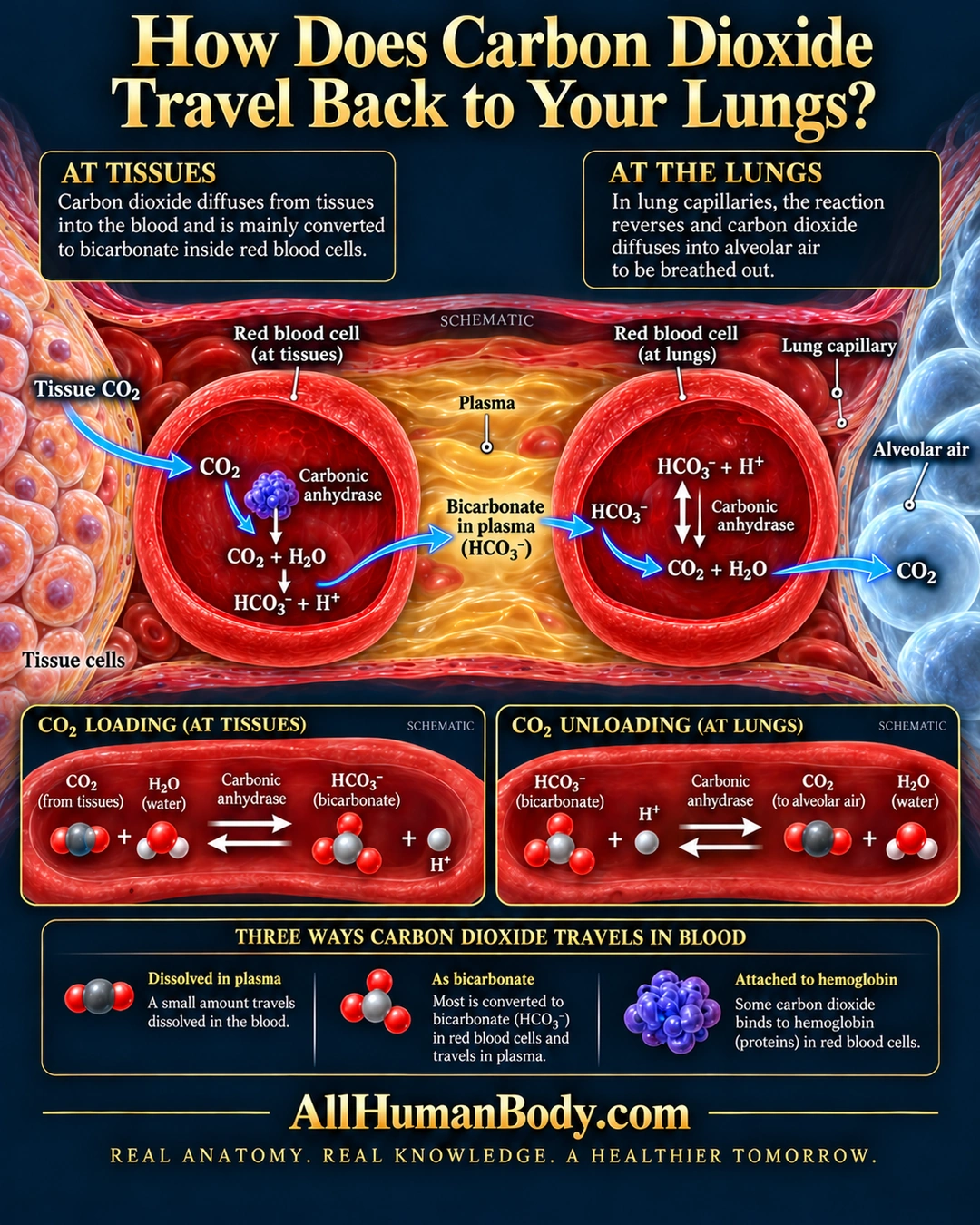
Blood carries carbon dioxide from tissues to lungs in several forms. Much is transported as bicarbonate after reactions involving red cells; in lung capillaries the chemistry reverses so carbon dioxide, not bicarbonate, can diffuse into alveolar air.
READ THE IMAGE
What the illustration shows
Two red-blood-cell cutaways show tissue-side CO2 loading on the left and lung-side unloading on the right. Blue arrows lead from tissue CO2 into the left cell, from bicarbonate products into plasma, back into the right cell, then as CO2 into alveolar air. Carbonic anhydrase and capillary/plasma compartments are labeled. Lower schematic panels show reversible CO2-water and bicarbonate-hydrogen chemistry. A three-route legend names dissolved, bicarbonate and hemoglobin-bound transport. Gold AllHumanBody.com and exact slogan appear below.
How to interpret this poster
- Net chemistry omits the carbonic-acid intermediate, chloride exchange and a full buffering network.
- Molecular spheres are symbols; formulas, not sphere geometry, define the chemical species.
- The lesson anchor supplies blood-transport foundations rather than this complete CO2 reaction sequence.
- AI-assisted educational illustration; not physician certification, microscopy, a diagnosis or individualized medical advice.
- Fine annotations need enlargement; the full description provides an accessible text alternative.
- Display the full uncropped illustration; do not trim titles, legends or boundary annotations.
AI-assisted educational illustration, adapted into web-sized images without changing its composition. This is general education, not an individual diagnosis or treatment recommendation.
EVIDENCE / CONTEXT
Sources and what they support
- Anatomy and Physiology 2e: 22.5 Transport of Gases ↗
Bicarbonate formation and plasma exchange, reverse lung reactions and dissolved/hemoglobin-associated alternatives.