Nervous / VISUAL EXPLAINER
How Do You Know Where Your Arm Is Without Looking?
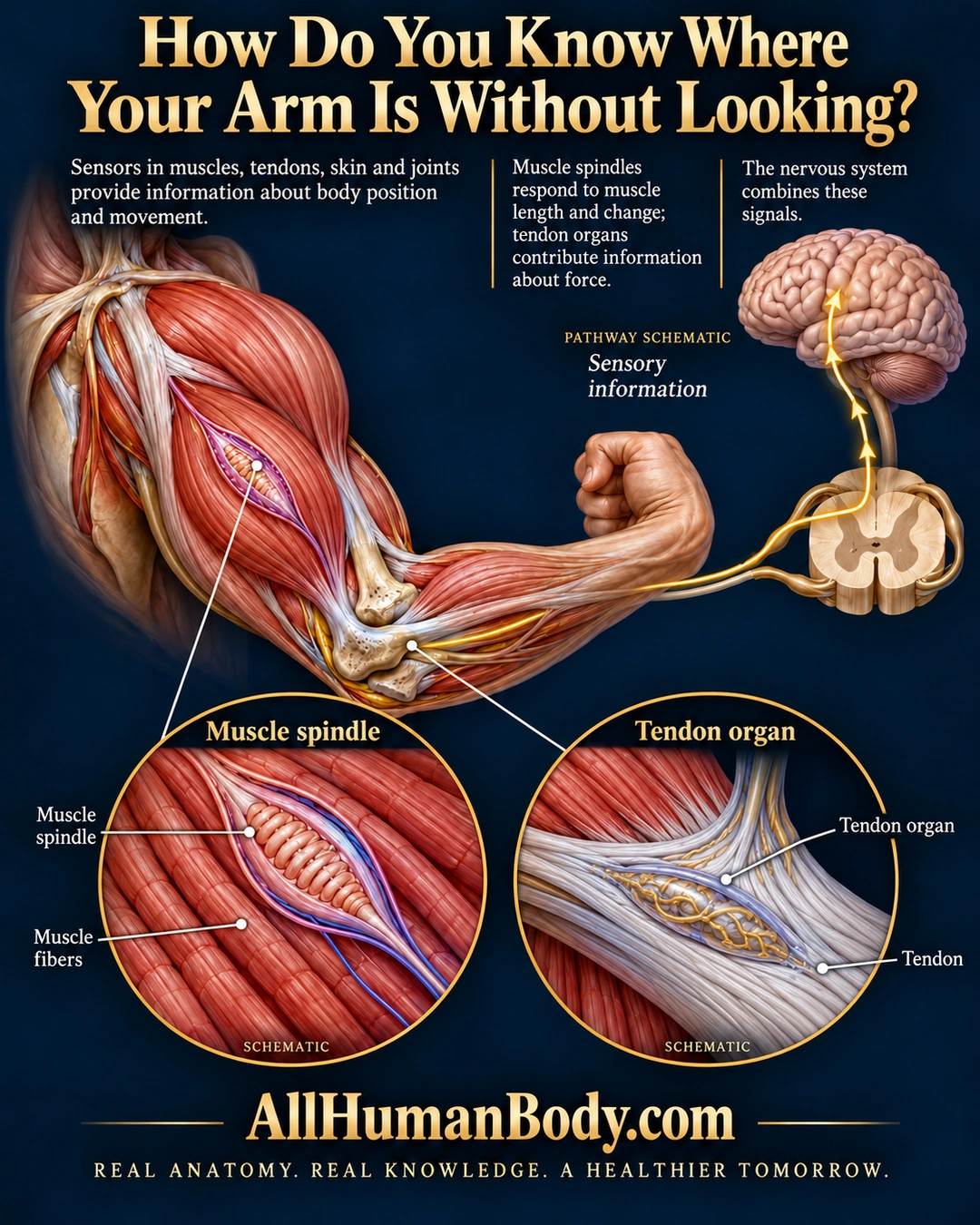
Body-position sensing draws on muscles, tendons, skin and joints. Muscle spindles provide information about muscle length and change, while tendon organs contribute force information; the nervous system combines these signals.
READ THE IMAGE
What the illustration shows
A flexed arm with exposed muscles connects through one gold sensory-information pathway to spinal cord and brain locators, marked PATHWAY SCHEMATIC. A muscle-spindle inset shows a capsule aligned with surrounding muscle fibers. A separate tendon-organ inset shows an elongated capsule and sensory endings among tendon fibers near a muscle-tendon junction. Three statements explain distributed body-position sensing, muscle-length and force feedback, and nervous-system integration. Gold AllHumanBody.com and the exact slogan form the footer.
How to interpret this poster
- One broad sensory-information route, not a named tract, synapse map or exact brain destination.
- Receptor shapes and surrounding fibers are schematic, not measured histology.
- No balance challenge, diagnostic test or single-sensor joint-angle gauge.
- AI-assisted educational illustration; not physician certification, microscopy, a diagnosis or individualized medical advice.
- Fine annotations need enlargement; the full description provides an accessible text alternative.
- Display the full uncropped illustration; do not trim titles, legends or boundary annotations.
AI-assisted educational illustration, adapted into web-sized images without changing its composition. This is general education, not an individual diagnosis or treatment recommendation.
EVIDENCE / CONTEXT
Sources and what they support
- Proprioception ↗
Distributed body-position and movement sensing.
- Neuroscience Online: Motor Units and Muscle Receptors ↗
Parallel muscle-spindle context and series tendon-organ placement, with length/change versus load information.