Special Senses / VISUAL EXPLAINER
How Do Three Tiny Ear Bones Carry Sound?
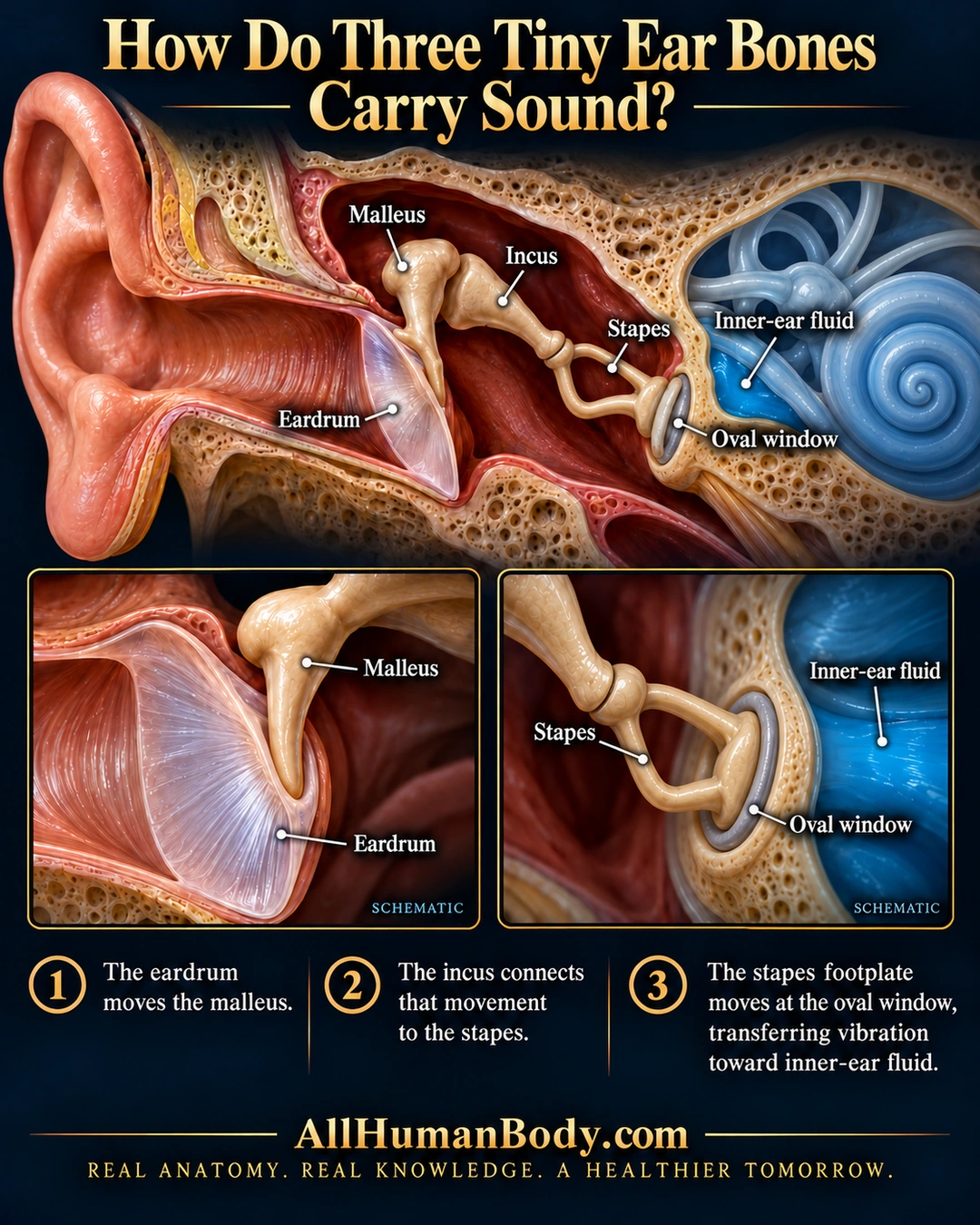
Vibration of the eardrum moves the malleus, and the incus links that movement to the stapes. The stapes footplate acts at the oval-window interface, transferring mechanical vibration toward inner-ear fluid.
READ THE IMAGE
What the illustration shows
Gold-titled anatomical poster, “How Do Three Tiny Ear Bones Carry Sound?” A cutaway through the ear shows the eardrum attached to the malleus, followed by the incus and stirrup-shaped stapes at the oval window. Blue inner-ear fluid lies beyond the window. Two enlarged schematic panels show the malleus against the eardrum and the stapes footplate seated at the oval-window interface. Three numbered statements follow vibration from eardrum through the bones toward inner-ear fluid. AllHumanBody.com and its educational slogan appear below.
How to interpret this poster
- Enlarged teaching schematic, not measured ossicle geometry or a surgical reference.
- No energy creation, fixed amplification ratio, air crossing the window or round-window drain is implied.
- AI-assisted educational illustration; not physician certification, microscopy, a diagnosis or individualized medical advice.
- Fine annotations need enlargement; the full description provides an accessible text alternative.
- Display the full uncropped illustration; do not trim titles, legends or boundary annotations.
AI-assisted educational illustration, adapted into web-sized images without changing its composition. This is general education, not an individual diagnosis or treatment recommendation.
EVIDENCE / CONTEXT
Sources and what they support
- How Do We Hear? ↗
Eardrum-to-ossicle-to-inner-ear mechanical sequence.
- Anatomy and Physiology 2e: 14.1 Sensory Perception ↗
Stapes/oval-window relationship and transfer of vibrations to inner-ear fluid.