Lymphatic & Immune / VISUAL EXPLAINER
How Does Your Spleen Filter Blood?
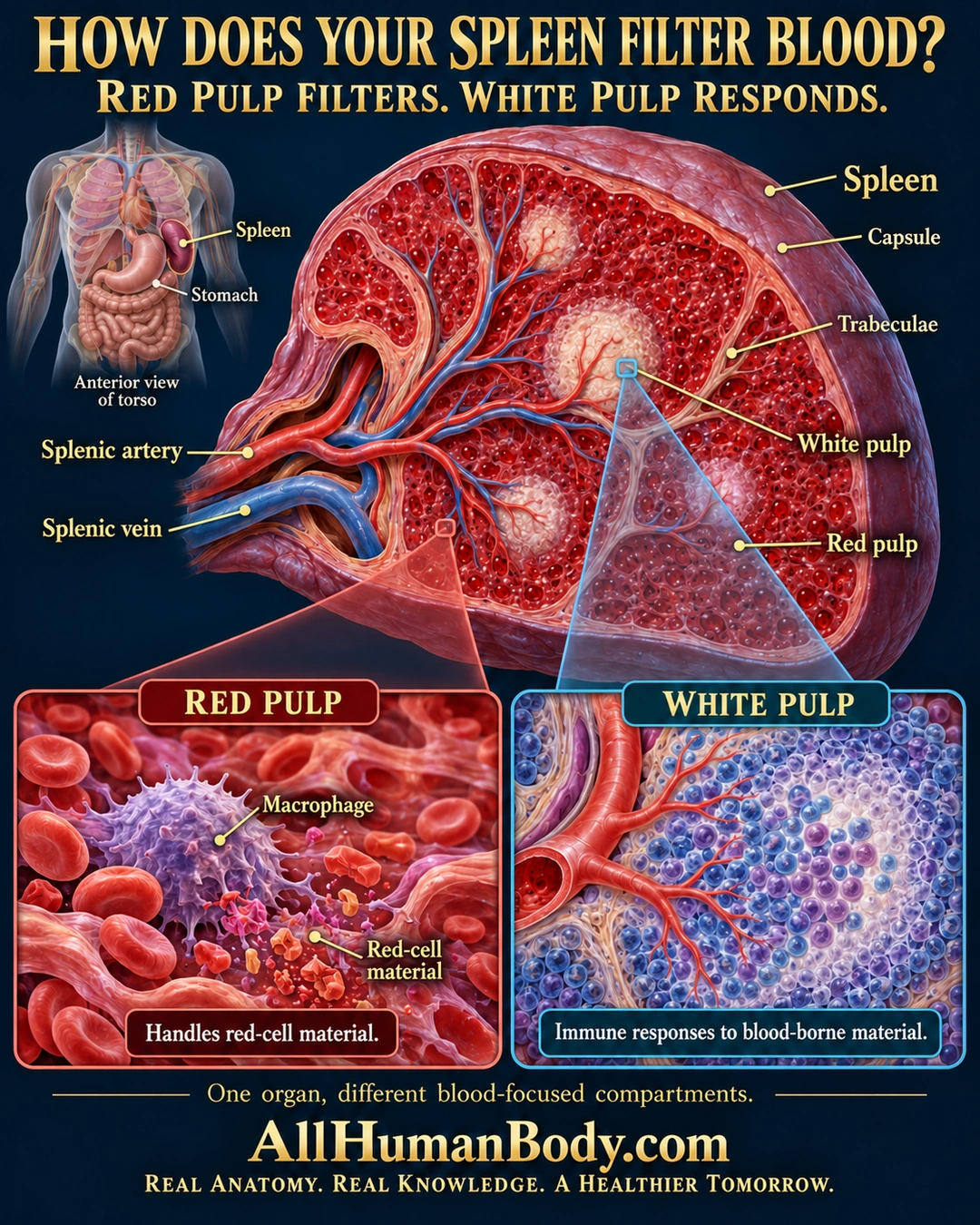
The spleen processes blood in different tissue compartments. Red pulp helps handle aged or altered red-cell material, while white pulp supports immune responses to blood-borne material; turnover is more varied than one intact-cell engulfment scene.
READ THE IMAGE
What the illustration shows
Medical poster titled How Does Your Spleen Filter Blood? An anterior torso locator places the spleen beside the stomach in the person's left upper abdomen. A large spleen cutaway labels capsule, trabeculae, splenic artery, splenic vein, red pulp and scattered pale white-pulp nodules. Red and blue magnification cones connect the compartments to two lower panels. The red-pulp panel shows red blood cells, red-cell fragments and a macrophage, with the caption Handles red-cell material. The white-pulp panel shows an arterial branch among lymphocyte-rich tissue and the caption Immune responses to blood-borne material. Gold branding reads AllHumanBody.com beneath One organ, different blood-focused compartments, followed by the standard slogan.
How to interpret this poster
- No exact human sinus architecture, complete circulation map or species-specific immune zoning is shown.
- Red-cell fragments are one possible part of turnover, not a universal sequence or direct living-human recording.
- No claim that every old red cell is removed only in the spleen.
- AI-assisted educational illustration; not physician certification, microscopy, a diagnosis or individualized medical advice.
- Fine annotations need enlargement; the full description provides an accessible text alternative.
- Display the full uncropped illustration; do not trim titles, legends or boundary annotations.
AI-assisted educational illustration, adapted into web-sized images without changing its composition. This is general education, not an individual diagnosis or treatment recommendation.
EVIDENCE / CONTEXT
Sources and what they support
- Anatomy and Physiology 2e: 21.1 Anatomy of the Lymphatic and Immune Systems ↗
Blood-focused red-pulp handling and white-pulp immune organization.
- Hemolysis in the spleen drives erythrocyte turnover ↗
Red-cell retention, hemolysis and subsequent handling of material, without an exclusive intact-engulfment model.
Evidence correspondence is limited to the abstract.