Digestive / VISUAL EXPLAINER
Why Does Vitamin B12 Need Help from Several Organs?
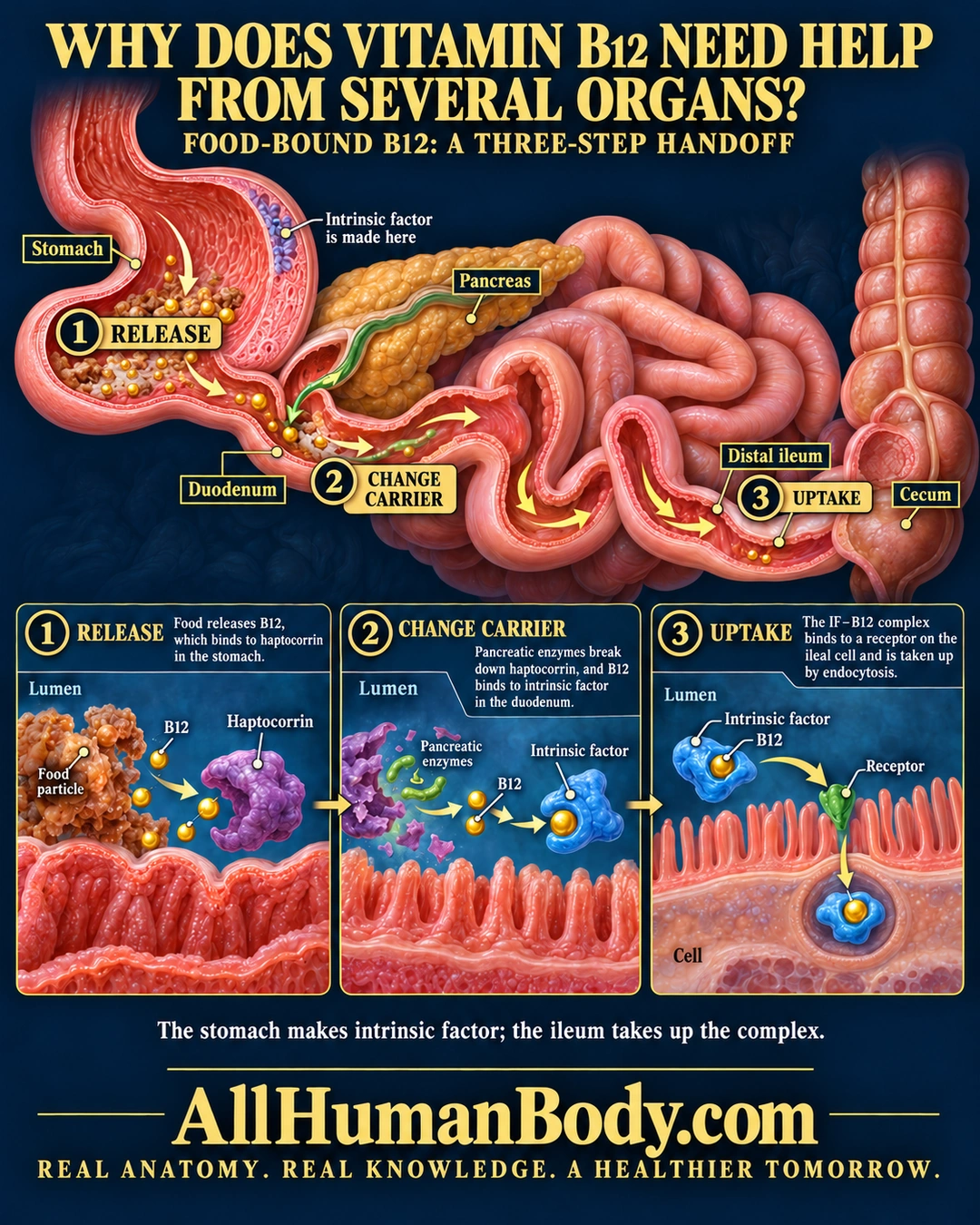
Normal food-bound vitamin B12 handling links several organs. Gastric processing releases more B12 from food; pancreatic enzymes free it from haptocorrin, allowing binding to stomach-derived intrinsic factor before receptor-mediated uptake in the distal ileum.
READ THE IMAGE
What the illustration shows
Dimensional navy-and-gold medical poster explaining food-bound vitamin B12 handling in three numbered stages: release in the stomach, carrier change in the duodenum, and uptake in the distal ileum. A continuous cutaway digestive route runs from stomach past pancreatic duct entry through intestinal loops toward the cecum. A stomach-wall label identifies where intrinsic factor is made. Three lower panels use gold dots for B12, purple haptocorrin and blue intrinsic factor. Pancreatic enzymes break down haptocorrin before B12 binds intrinsic factor; the complex then meets a receptor on an ileal cell and enters a vesicle. Footer states that the stomach makes intrinsic factor and the ileum takes up the complex, above AllHumanBody.com and its slogan.
How to interpret this poster
- The illustration starts with gastric handling; some release and haptocorrin binding can begin in the mouth.
- Not a claim that all oral B12 uses only this route; no supplement, dose or deficiency advice.
- The complex enters an ileal cell, not intact directly into blood; organ loops and carrier shapes are schematic.
- AI-assisted educational illustration; not physician certification, microscopy, a diagnosis or individualized medical advice.
- Fine annotations need enlargement; the full description provides an accessible text alternative.
- Display the full uncropped illustration; do not trim titles, legends or boundary annotations.
AI-assisted educational illustration, adapted into web-sized images without changing its composition. This is general education, not an individual diagnosis or treatment recommendation.
EVIDENCE / CONTEXT
Sources and what they support
- Vitamin B12: Fact Sheet for Health Professionals ↗
Food release, haptocorrin processing, gastric intrinsic factor and receptor-mediated distal ileal uptake.