Digestive / VISUAL EXPLAINER
How Does Your Intestine Ask the Pancreas to Buffer Acid?
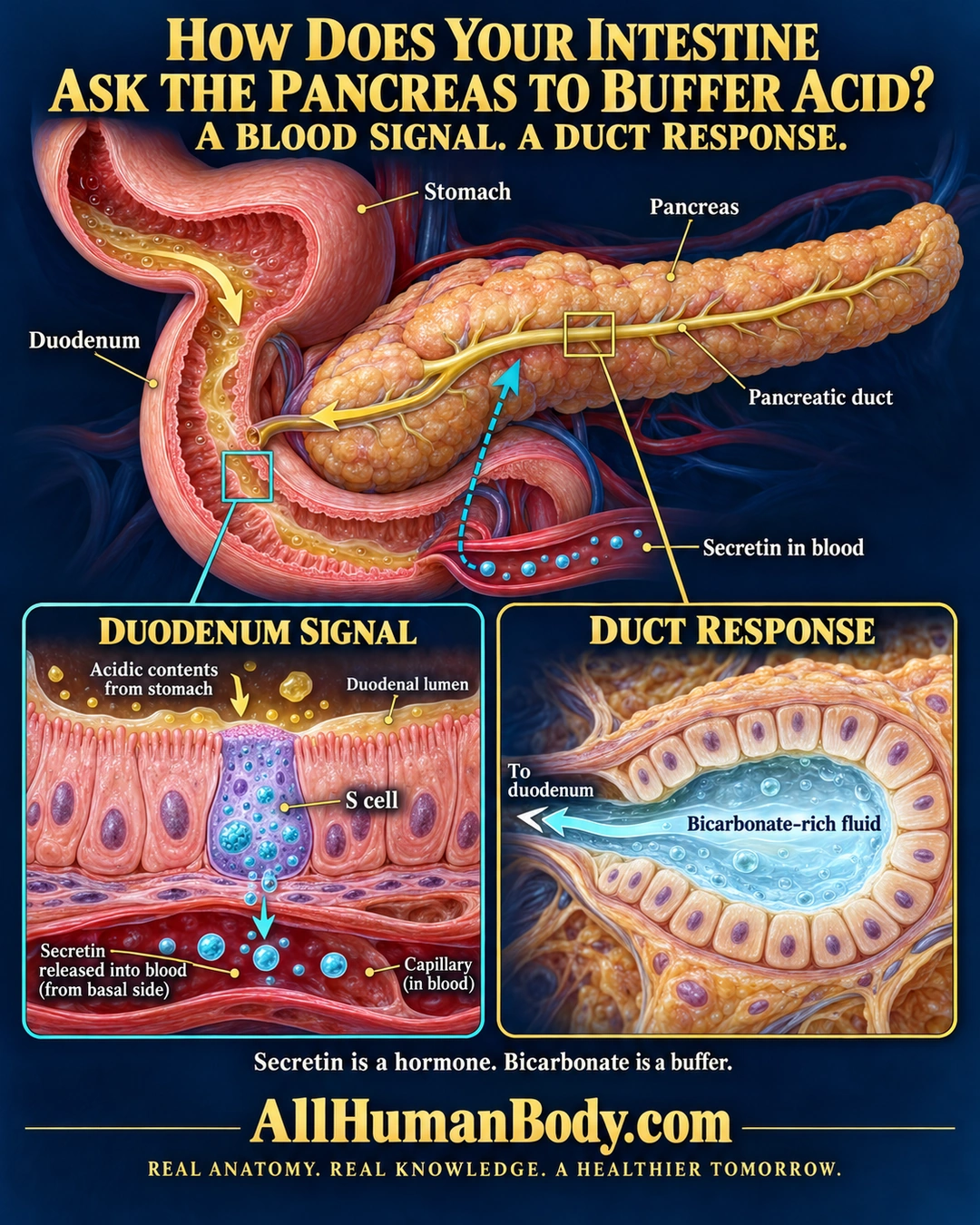
Acid entering the duodenum helps trigger secretin release into blood. This hormone promotes bicarbonate-rich pancreatic duct output into the intestine, where bicarbonate buffers acid; neural signals also coordinate the response.
READ THE IMAGE
What the illustration shows
Navy-and-gold medical poster titled How Does Your Intestine Ask the Pancreas to Buffer Acid? A stomach outlet leads into the C-shaped duodenum around the pancreatic head. A gold pancreatic duct and leftward arrow show fluid delivery into the duodenum; a separate dashed teal arrow from blood to pancreas represents secretin signaling. The lower-left Duodenum Signal inset shows an S cell beneath acidic intestinal contents releasing secretin from its basal side into a capillary. The lower-right Duct Response inset shows bicarbonate-rich fluid within a duct and an arrow toward the duodenum. Text states Secretin is a hormone. Bicarbonate is a buffer. Gold AllHumanBody.com branding and the standard slogan appear at the bottom.
How to interpret this poster
- Secretin is a hormone and bicarbonate a buffer, not a digestive enzyme.
- Blood signaling and duct delivery are separate routes; pancreas is not the only bicarbonate source.
- Organ orientation and cell-scale secretion are schematic, not measured output.
- AI-assisted educational illustration; not physician certification, microscopy, a diagnosis or individualized medical advice.
- Fine annotations need enlargement; the full description provides an accessible text alternative.
- Display the full uncropped illustration; do not trim titles, legends or boundary annotations.
AI-assisted educational illustration, adapted into web-sized images without changing its composition. This is general education, not an individual diagnosis or treatment recommendation.
EVIDENCE / CONTEXT
Sources and what they support
- Anatomy and Physiology 2e: 23.6 Accessory Organs in Digestion: The Liver, Pancreas, and Gallbladder ↗
Duodenal secretin response, pancreatic bicarbonate-rich fluid and coordinated secretion.