Respiratory / VISUAL EXPLAINER
How Does Surfactant Help Your Lung Air Sacs Stay Open?
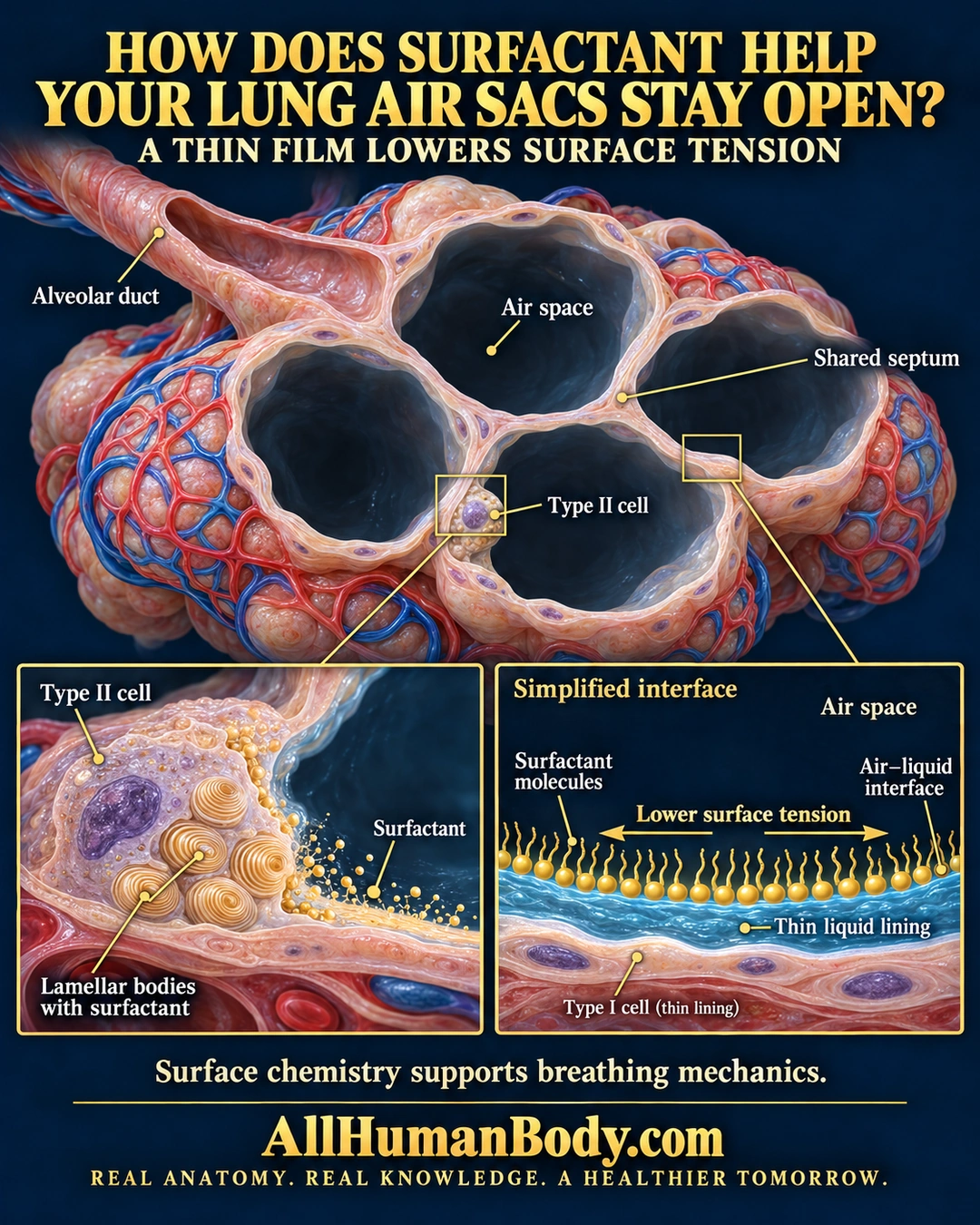
Surfactant acts at the air–liquid interface of lung air spaces, reducing surface tension and helping make expansion easier. Type II alveolar cells supply it; it is not mucus filling the air space or the only factor maintaining lung expansion.
READ THE IMAGE
What the illustration shows
Medical illustration on navy showing connected lung air spaces in cutaway, with shared thin septa and an external red-and-blue capillary mesh. Gold leaders identify an alveolar duct, air space, shared septum and a localized type II cell. A lower-left enlargement shows lamellar bodies inside the type II cell releasing surfactant toward the air-facing surface. A lower-right simplified interface shows surfactant molecules with heads at the thin liquid lining and tails toward air, with opposing tangential arrows labeled Lower surface tension. The title asks how surfactant helps lung air sacs stay open. Footer: AllHumanBody.com; REAL ANATOMY. REAL KNOWLEDGE. A HEALTHIER TOMORROW.
How to interpret this poster
- Alveoli share walls rather than behaving as independent soap bubbles.
- Cell layers, lining thickness and molecular symbols are magnified schematics, not measured histology.
- No guarantee against collapse or clinical treatment claim.
- AI-assisted educational illustration; not physician certification, microscopy, a diagnosis or individualized medical advice.
- Fine annotations need enlargement; the full description provides an accessible text alternative.
- Display the full uncropped illustration; do not trim titles, legends or boundary annotations.
AI-assisted educational illustration, adapted into web-sized images without changing its composition. This is general education, not an individual diagnosis or treatment recommendation.
EVIDENCE / CONTEXT
Sources and what they support
- Anatomy and Physiology 2e: 22.1 Organs and Structures of the Respiratory System ↗
Type II cells and alveolar surfactant secretion.
- Anatomy and Physiology 2e: 22.3 The Process of Breathing ↗
Surface tension and surfactant contributions to expansion mechanics.