Integumentary / VISUAL EXPLAINER
Where Does the Oil on Your Skin Come From?
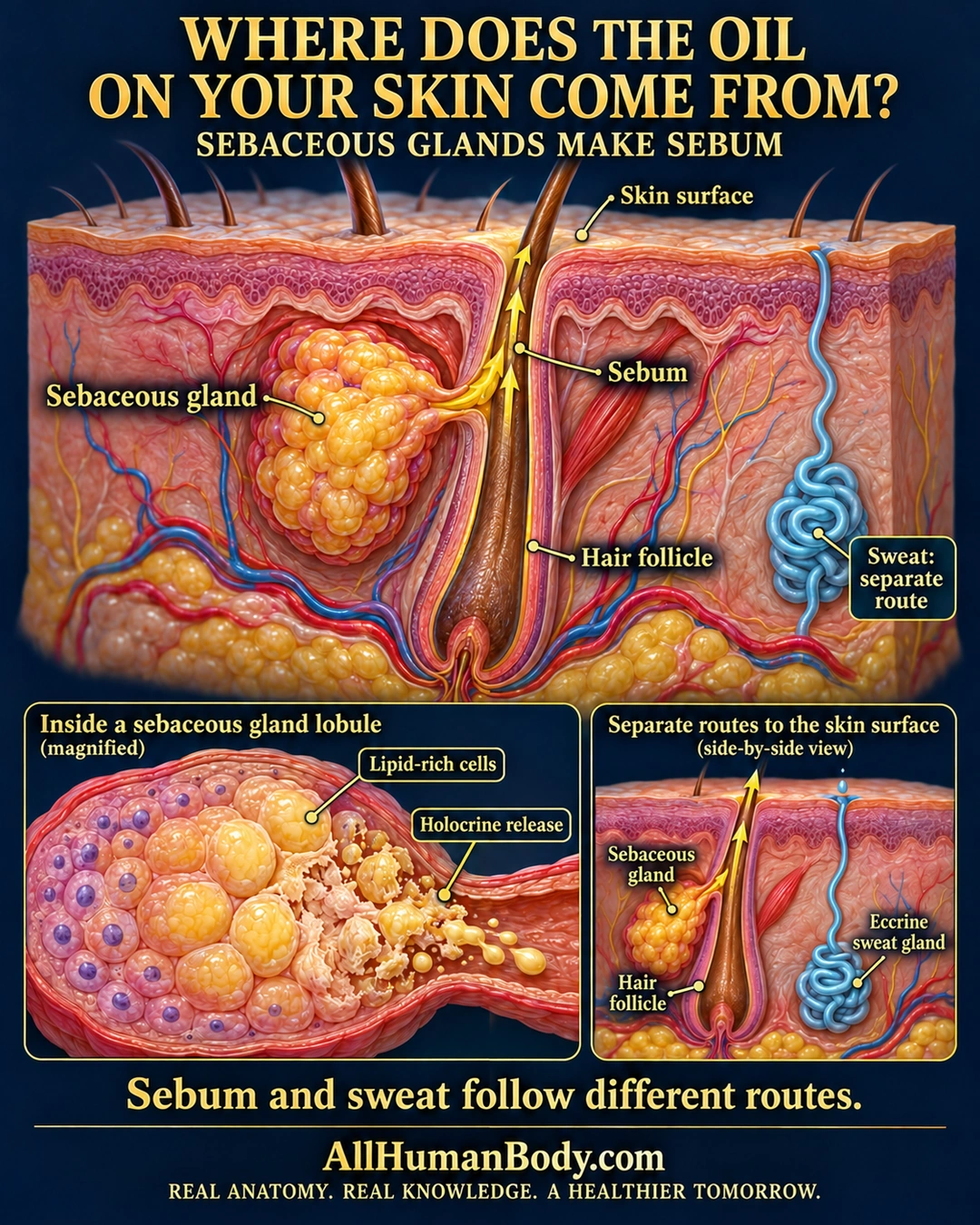
Most sebaceous glands release sebum into a hair follicle, from which it reaches the surface. Mature lipid-rich cells break down during this holocrine release; the oily output differs from sweat and from intercellular barrier lipids.
READ THE IMAGE
What the illustration shows
Skin cutaway shows a lobulated sebaceous gland beside the upper hair follicle. Gold arrows trace sebum through its short duct and upward around the hair to the surface. A separate blue coiled sweat gland has its own surface duct. Lower panels enlarge lipid-rich cells breaking down during holocrine release and compare the separate sebum and sweat routes. Gold AllHumanBody.com branding appears below.
How to interpret this poster
- Most, not all, sebaceous glands use a follicular route.
- Insets are conceptual, not matched serial sections or a quantified secretion model.
- No acne explanation or skincare regimen is implied.
- AI-assisted educational illustration; not physician certification, microscopy, a diagnosis or individualized medical advice.
- Fine annotations need enlargement; the full description provides an accessible text alternative.
- Display the full uncropped illustration; do not trim titles, legends or boundary annotations.
AI-assisted educational illustration, adapted into web-sized images without changing its composition. This is general education, not an individual diagnosis or treatment recommendation.
EVIDENCE / CONTEXT
Sources and what they support
- Anatomy and Physiology 2e: 5.2 Accessory Structures of the Skin ↗
Sebaceous gland location, oily mixture and usual follicular route.
- Sebocytes, multifaceted epithelial cells: lipid production and holocrine secretion ↗
Lipid production and mature-cell breakdown in holocrine secretion.
Evidence correspondence is limited to the abstract.