Special Senses / VISUAL EXPLAINER
How Do Your Eyes Stay on Target When Your Head Turns?
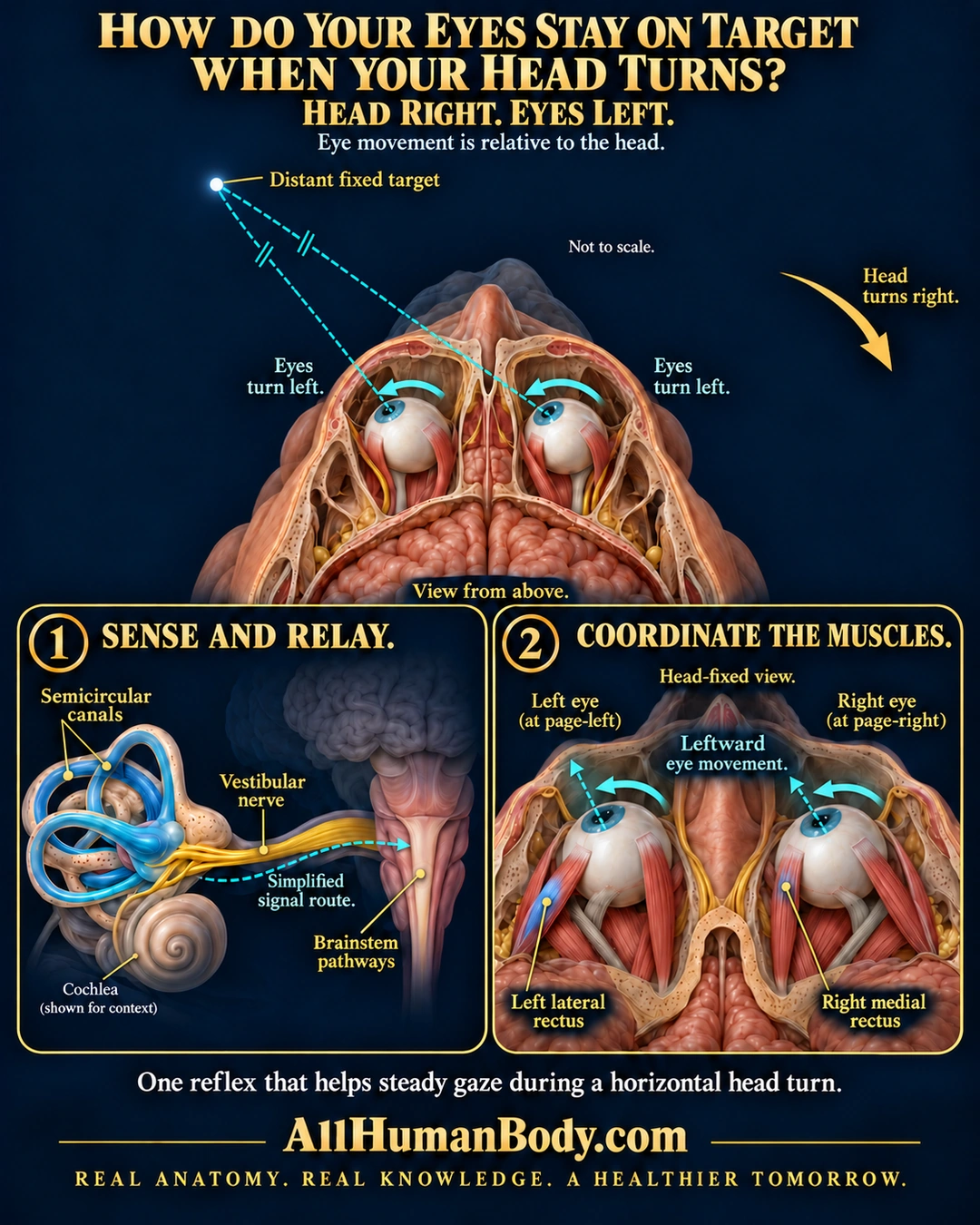
The vestibulo-ocular reflex helps steady gaze during head movement. In this horizontal example, the eyes turn left relative to a head turning right, with coordinated muscle activity rather than one muscle acting alone.
READ THE IMAGE
What the illustration shows
Gold-and-navy anatomy poster explaining how the vestibulo-ocular reflex helps steady gaze. An overhead cutaway of a head shows a clockwise head-right arrow and both eyes turning left relative to the head. Broken cyan guides connect both pupils with a fixed target above and left of the skull midline; the geometry is labeled not to scale. A lower inset shows semicircular canals, vestibular nerve and a simplified signal route toward brainstem pathways, with cochlea shown for context. A head-fixed eye-muscle inset highlights the left lateral rectus and right medial rectus while both eyes turn left. The poster describes one reflex that helps steady gaze during a horizontal head turn.
How to interpret this poster
- Broken target guides are conceptual and not to scale, not measured optical axes or distant-target vergence.
- One horizontal example, not perfect gaze locking or a full synapse-level circuit.
- The lesson anchor provides coordination foundations rather than reconstructing this complete reflex.
- AI-assisted educational illustration; not physician certification, microscopy, a diagnosis or individualized medical advice.
- Fine annotations need enlargement; the full description provides an accessible text alternative.
- Display the full uncropped illustration; do not trim titles, legends or boundary annotations.
AI-assisted educational illustration, adapted into web-sized images without changing its composition. This is general education, not an individual diagnosis or treatment recommendation.
EVIDENCE / CONTEXT
Sources and what they support
- Neuroscience Online: Ocular Motor Control ↗
Extraocular muscle actions and coordinated left lateral rectus/right medial rectus contribution to leftward gaze.
- Neuroscience Online: Vestibular System: Structure and Function ↗
Semicircular sensory input and broadly compensatory opposite-direction eye movement.