Special Senses / VISUAL EXPLAINER
How Can You Tell Where a Sound Comes From?
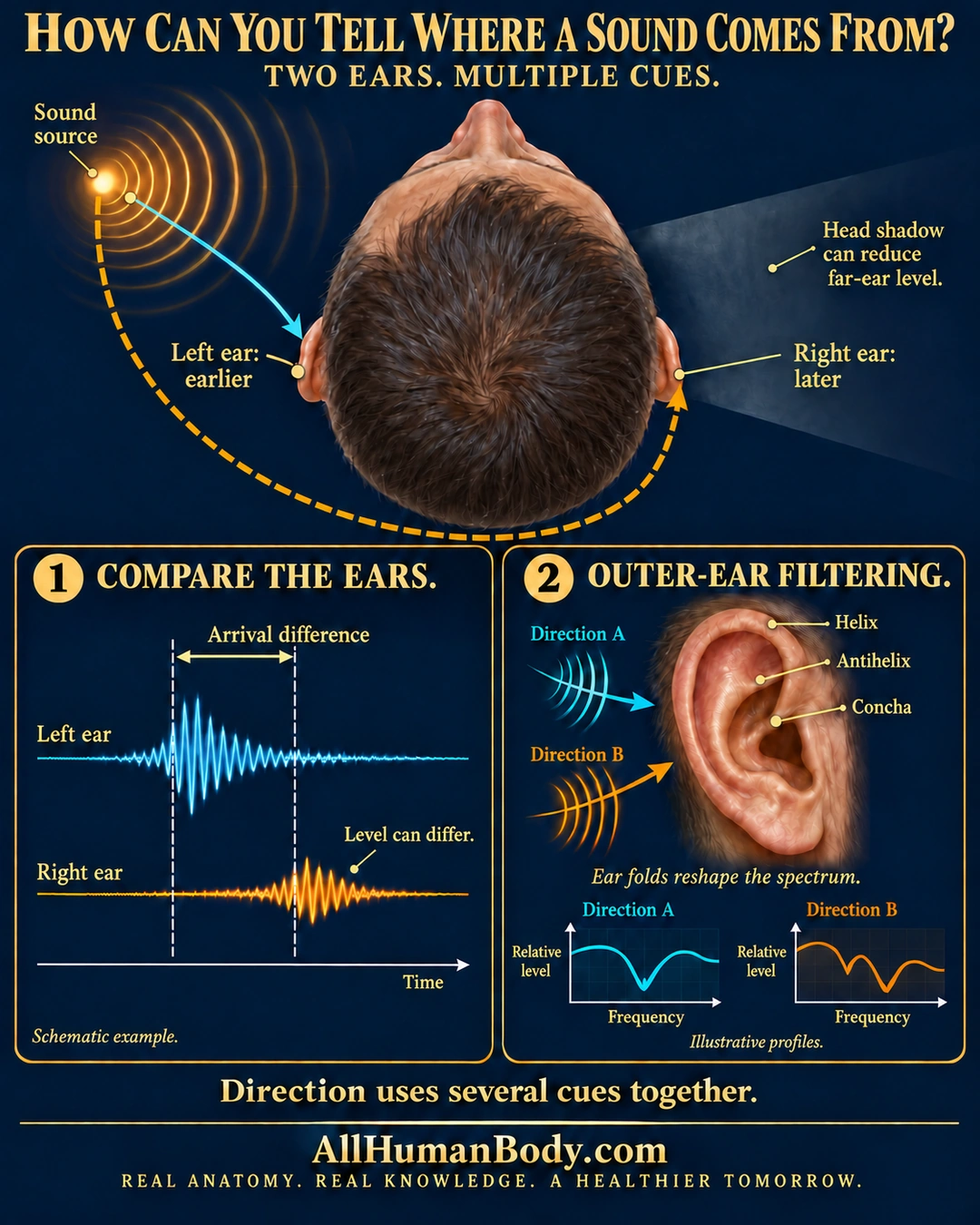
Sound direction is inferred from several cues together. Timing and level differences between ears help with lateral direction, while outer-ear filtering adds information; no single cue uniquely specifies every location.
READ THE IMAGE
What the illustration shows
A top view of a head illustrates a sound source on the listener’s left. A short cyan arrow reaches the left ear earlier, while a dashed gold route curves around the head to the right ear later. A shaded region illustrates conditional head-shadow reduction. Paired schematic waveforms show earlier left-ear and later right-ear signals with different levels. A separate outer-ear inset labels helix, antihelix and concha and compares two incoming directions with illustrative frequency spectra. The takeaway is that sound direction uses several cues together.
How to interpret this poster
- Waveforms and spectra are illustrative, not recordings or universal frequency rules.
- Head-shadow effects depend on frequency and context; loudness alone does not establish distance.
- No exact human brainstem wiring, localization accuracy or hearing treatment is claimed.
- AI-assisted educational illustration; not physician certification, microscopy, a diagnosis or individualized medical advice.
- Fine annotations need enlargement; the full description provides an accessible text alternative.
- Display the full uncropped illustration; do not trim titles, legends or boundary annotations.
AI-assisted educational illustration, adapted into web-sized images without changing its composition. This is general education, not an individual diagnosis or treatment recommendation.
EVIDENCE / CONTEXT
Sources and what they support
- Listener weighting of cues for lateral angle: The duplex theory of sound localization revisited ↗
Human stimulus-dependent weighting of interaural time and level cues.
Evidence correspondence is limited to the abstract. - Relearning sound localization with new ears ↗
Human pinna-shape experiment supports direction-related outer-ear spectral cues.
Evidence correspondence is limited to the abstract.