Urinary / VISUAL EXPLAINER
Why Does Your Liver Help Make Waste for Your Kidneys?
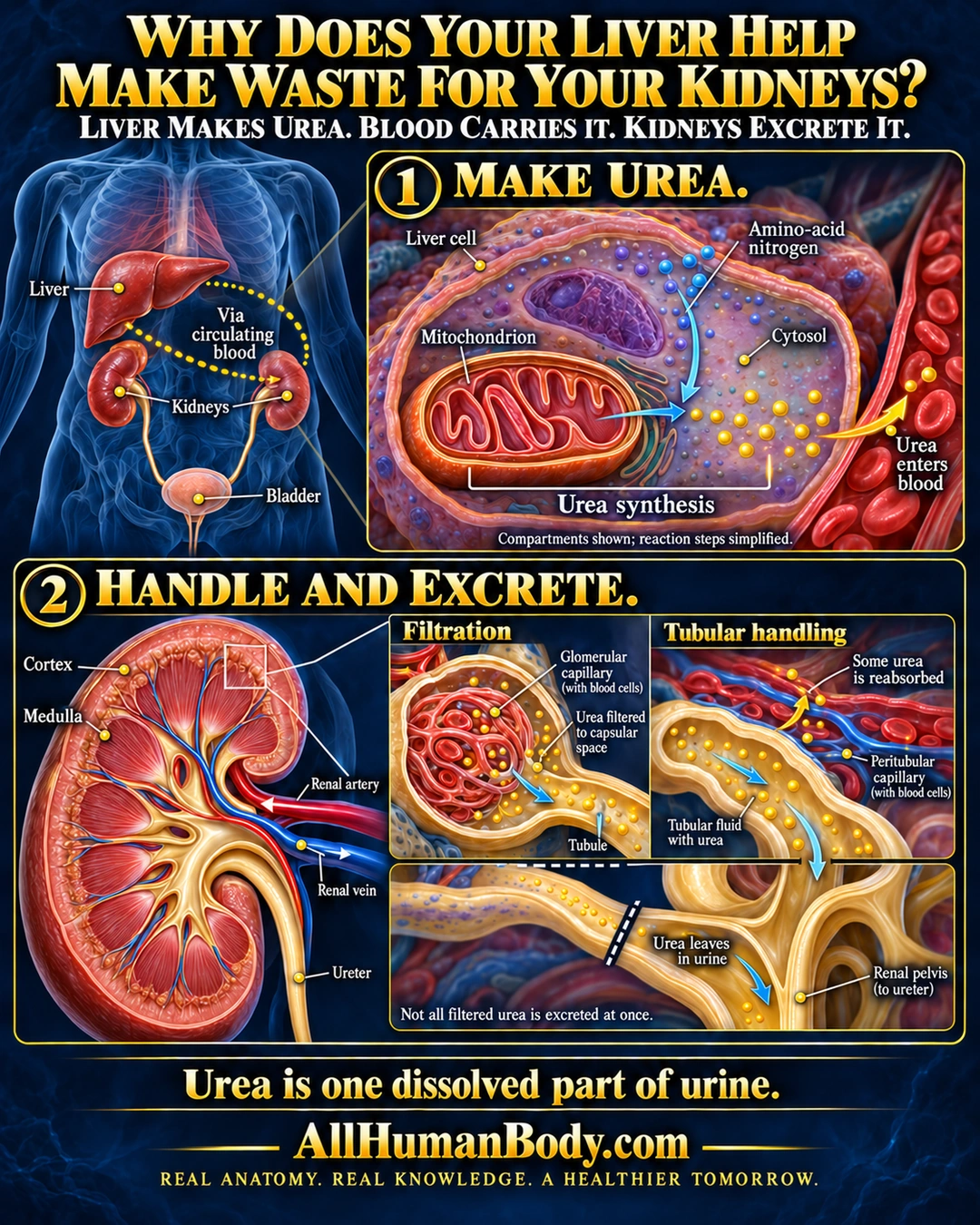
The liver packages much amino-acid nitrogen into urea, which travels in blood to the kidneys. Kidney filtration and tubular handling help determine what leaves in urine; not all filtered urea is excreted immediately.
READ THE IMAGE
What the illustration shows
The liver makes urea and the kidneys handle its excretion. A torso locator shows liver, kidneys and bladder connected by a dotted route labeled circulating blood. An enlarged liver cell distinguishes mitochondrion and cytosol, with yellow urea symbols outside the mitochondrion entering blood. A kidney section labels cortex, medulla, renal artery, renal vein and ureter. Insets show filtration from a glomerular capillary, some urea reabsorption into a nearby capillary, and urea leaving in urine after a schematic break. Urea is one dissolved part of urine.
How to interpret this poster
- A schematic cross-organ route, not a direct liver-to-bladder tube.
- Mitochondrial and cytosolic compartments are shown, not a complete enzyme-by-enzyme cycle.
- Urea is one dissolved component of urine, not urine itself, bile or a claim that all protein is waste.
- AI-assisted educational illustration; not physician certification, microscopy, a diagnosis or individualized medical advice.
- Fine annotations need enlargement; the full description provides an accessible text alternative.
AI-assisted educational illustration, adapted into web-sized images without changing its composition. This is general education, not an individual diagnosis or treatment recommendation.
EVIDENCE / CONTEXT
Sources and what they support
- Anatomy and Physiology 2e: 24.4 Protein Metabolism ↗
Amino-acid processing and hepatic urea production; simplified transamination text is not treated as an exact equation.
- Your Kidneys & How They Work ↗
Renal blood supply, filtration, tubular recovery and ureter-to-bladder urine flow.
- Anatomy and Physiology 2e: 25.6 Tubular Reabsorption ↗
Some filtered urea is reabsorbed; filtrate is modified before excretion.