Musculoskeletal / VISUAL EXPLAINER
How Does a Nerve Tell a Muscle to Contract?
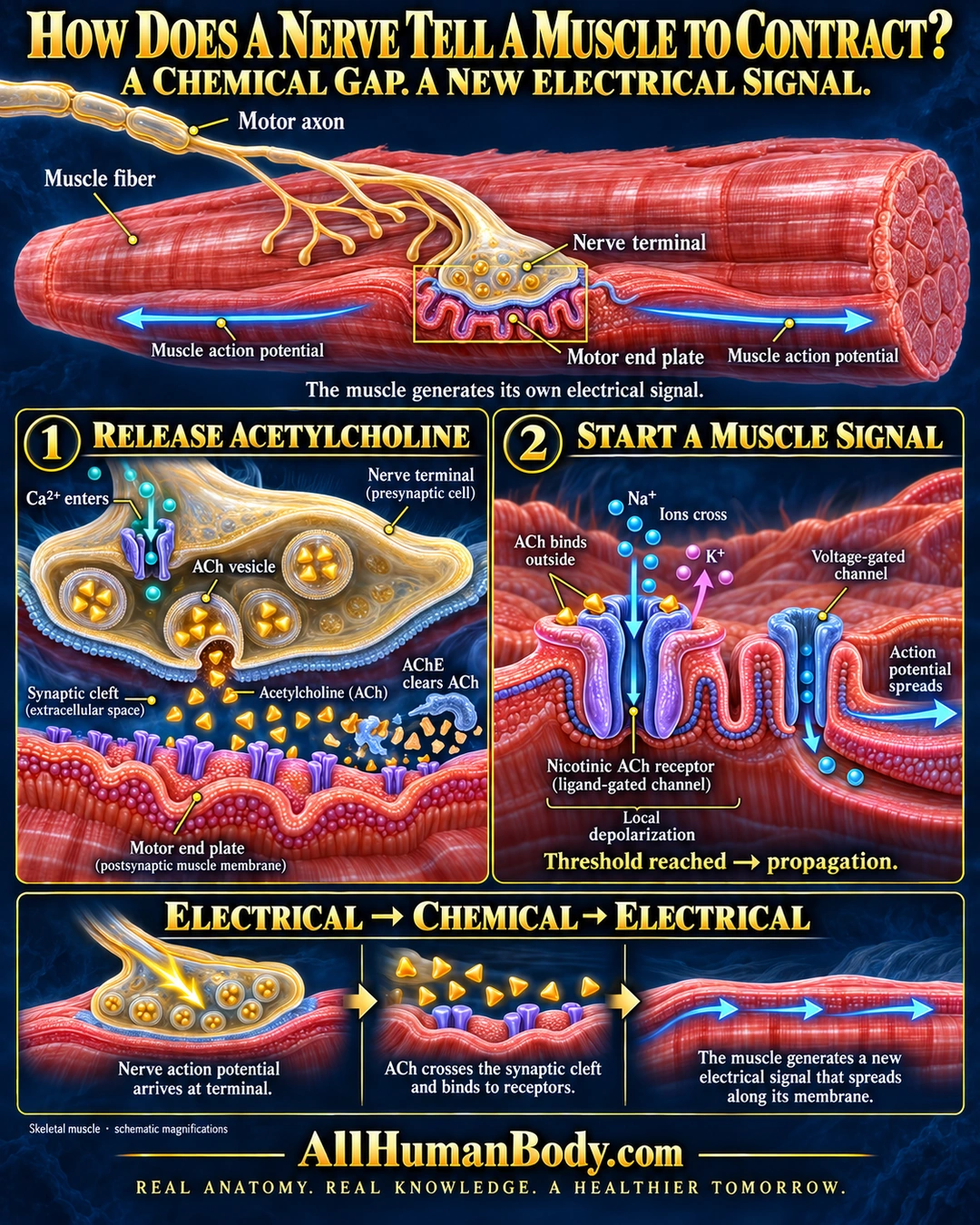
At a skeletal neuromuscular junction, a nerve signal triggers release of acetylcholine across a gap. Binding at the muscle membrane causes local depolarization that can trigger a new action potential, leading toward the later contraction machinery.
READ THE IMAGE
What the illustration shows
English medical teaching poster titled How Does a Nerve Tell a Muscle to Contract? A gold motor axon ends over red skeletal muscle fibers. A magnified junction separates a nerve terminal from folded muscle membrane by an extracellular cleft. Calcium enters the terminal, and vesicles release yellow acetylcholine symbols into the gap. A second inset shows acetylcholine binding outside a nicotinic receptor, sodium entering and potassium exiting, local depolarization, and a separate voltage-gated channel associated with propagation along muscle membrane. A lower sequence reads electrical, chemical, electrical. Blue arrows show the muscle signal spreading away from the junction. Gold AllHumanBody.com branding and slogan appear at the bottom. The image is a qualitative schematic with small labels requiring zoom.
How to interpret this poster
- The diagram stops at excitation, not the complete calcium-release and filament-shortening sequence.
- Acetylcholine binds outside the receptor; ions, not the transmitter, cross its pore.
- Grouped muscle fibers and channel shapes are schematic, not measured cellular or molecular geometry.
- AI-assisted educational illustration; not physician certification, microscopy, a diagnosis or individualized medical advice.
- Fine annotations need enlargement; the full description provides an accessible text alternative.
AI-assisted educational illustration, adapted into web-sized images without changing its composition. This is general education, not an individual diagnosis or treatment recommendation.
EVIDENCE / CONTEXT
Sources and what they support
- Anatomy and Physiology 2e: 10.2 Skeletal Muscle ↗
Separate nerve and muscle membranes, chemical transmission, local depolarization, propagation and transmitter clearance.
- Biology: 38.4 Muscle Contraction and Locomotion ↗
Calcium-dependent presynaptic vesicle release and separate muscle depolarization.