Integumentary / VISUAL EXPLAINER
Why Can a Healed Cut Leave a Scar?
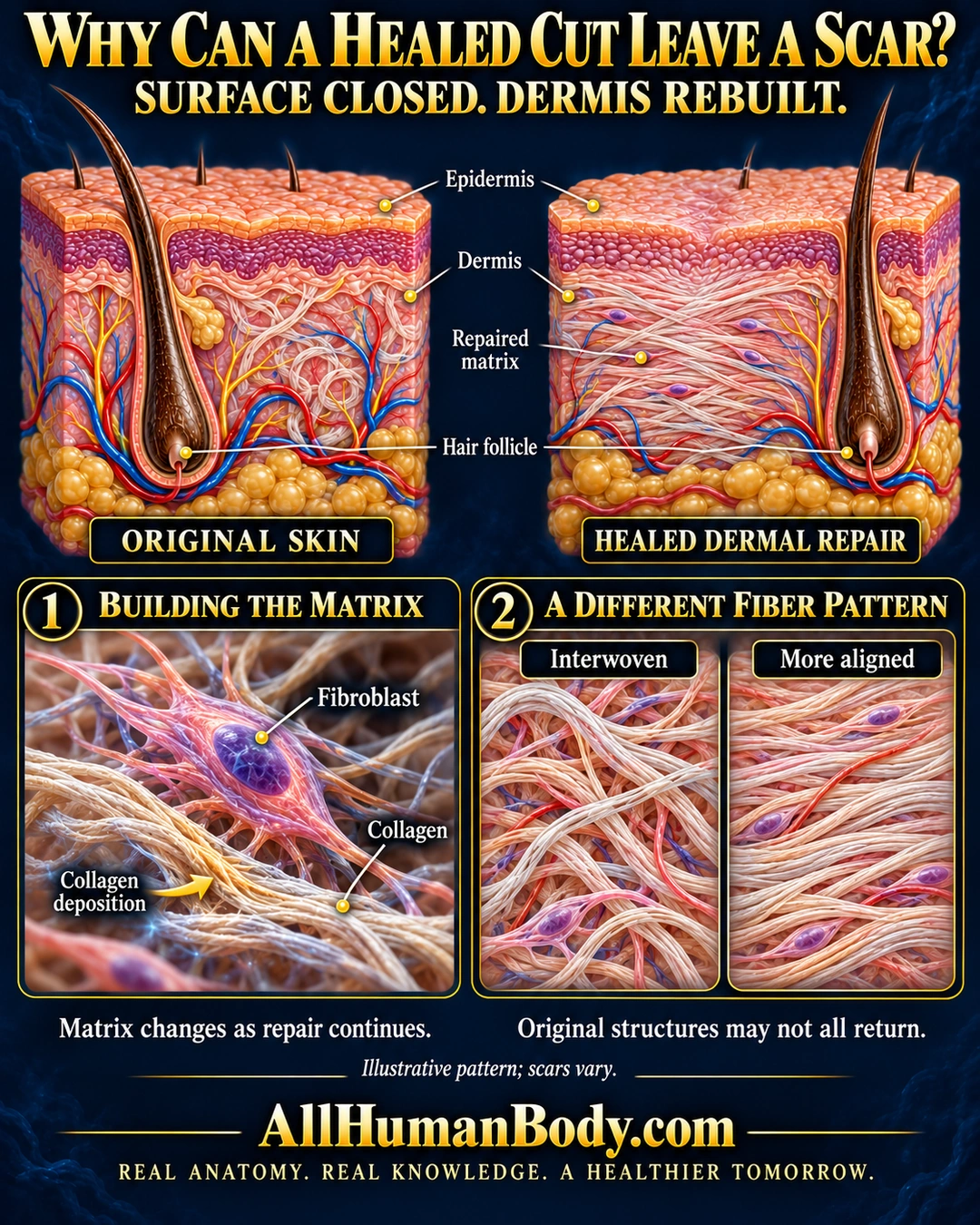
After injury involving the dermis, a closed surface can cover rebuilt tissue with a different collagen arrangement. Fibroblasts contribute new matrix and remodeling continues; repair may not restore every original structure.
READ THE IMAGE
What the illustration shows
Gold-and-navy anatomical poster titled “Why Can a Healed Cut Leave a Scar?” with the subtitle “Surface closed. Dermis rebuilt.” Two skin cutaways compare original skin with healed dermal repair. Labels identify the epidermis, dermis, repaired matrix and hair follicle. Both surfaces are closed. Original dermis contains crossing collagen bundles; the repaired central area contains more aligned, still crossing bundles with purple cells and visible blood vessels. A large hair follicle lies at the lateral edge of the repaired block, beside the central repair. Yellow fat sits beneath both blocks. A lower inset shows a pink fibroblast with a purple nucleus, separate pale extracellular collagen bundles and a collagen-deposition arrow. A second inset compares interwoven fibers with more aligned fibers. Text reads “Matrix changes as repair continues,” “Original structures may not all return,” and “Illustrative pattern; scars vary.” The footer reads “AllHumanBody.com” and “REAL ANATOMY. REAL KNOWLEDGE. A HEALTHIER TOMORROW.”
How to interpret this poster
- Representative pattern only; scars vary and bundles are not universally parallel.
- The follicle at the edge is neighboring tissue, not proof of a regenerated follicle within the repaired center.
- No healing deadline, strength guarantee, diagnosis or wound-care advice.
- AI-assisted educational illustration; not physician certification, microscopy, a diagnosis or individualized medical advice.
- Fine annotations need enlargement; the full description provides an accessible text alternative.
AI-assisted educational illustration, adapted into web-sized images without changing its composition. This is general education, not an individual diagnosis or treatment recommendation.
EVIDENCE / CONTEXT
Sources and what they support
- Scars: Who gets and causes ↗
Dermal injury and collagen-rich repair; treatment links excluded.
- Differences in collagen architecture between keloid, hypertrophic scar, normotrophic scar, and normal skin: An objective histopathological analysis ↗
Human biopsy observations of average scar-versus-normal collagen alignment differences.
Evidence correspondence is limited to the abstract.