Special Senses / VISUAL EXPLAINER
Does Your Tongue Really Have Separate Taste Zones?
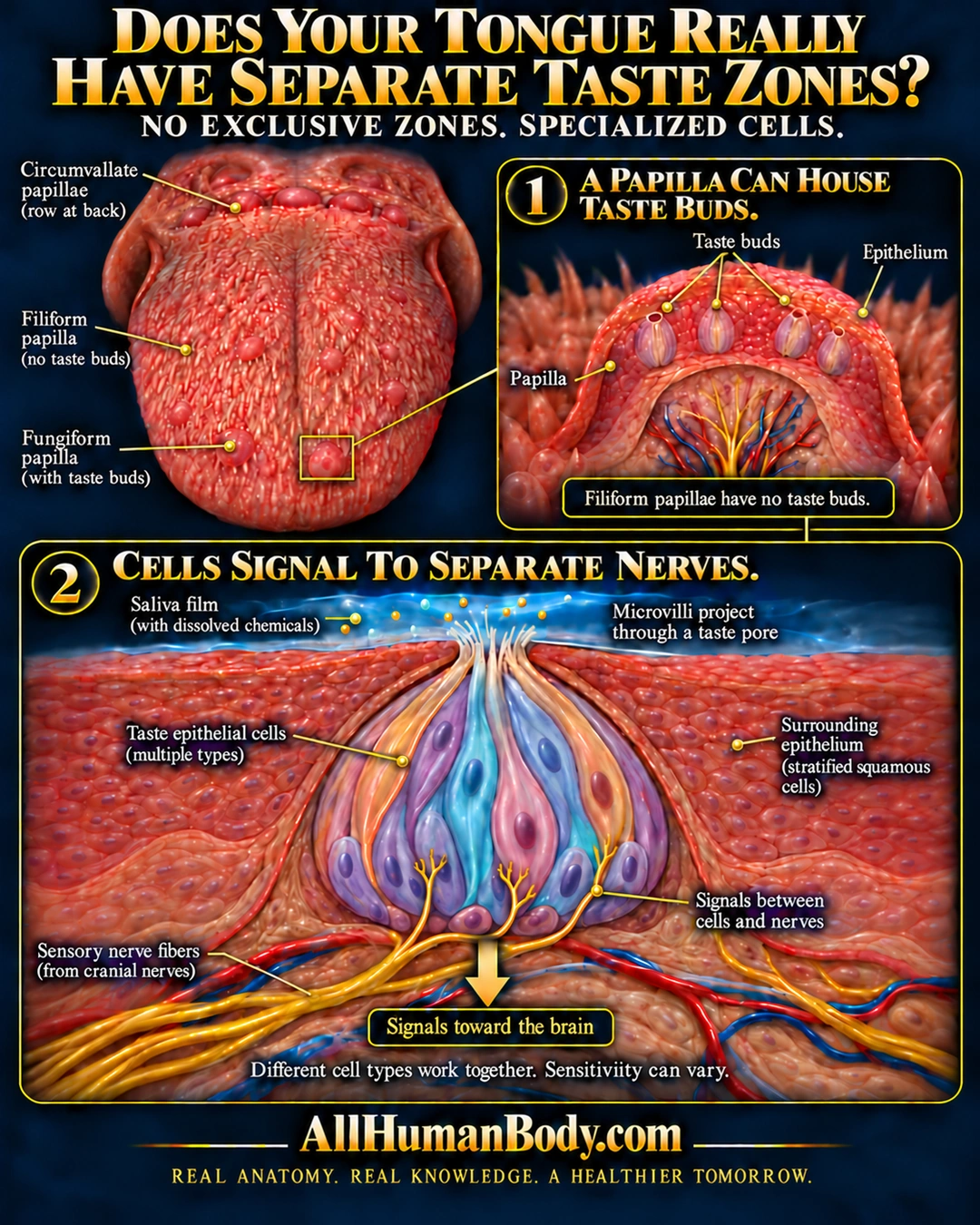
Taste qualities are not confined to exclusive tongue zones. Taste buds contain specialized epithelial cells that encounter dissolved chemicals near a pore and communicate with separate sensory nerve fibers; sensitivity can still vary.
READ THE IMAGE
What the illustration shows
Navy-and-gold anatomical poster titled “Does Your Tongue Really Have Separate Taste Zones?” with the answer “No exclusive zones. Specialized cells.” A natural red tongue shows a back row of circumvallate papillae, fine filiform texture and scattered fungiform papillae, without a colored taste-zone map. An enlarged papilla cutaway shows several representative taste buds embedded in surface epithelium and notes that filiform papillae have no taste buds. Below, a magnified bud contains colored elongated taste epithelial cells. White microvilli project through a narrow pore into a blue saliva film with dissolved particles. Three fine gold sensory nerve branches approach the cells from below, distinct from the epithelial cells; an arrow indicates signals toward the brain. A note says different cell types work together and sensitivity can vary. The footer reads AllHumanBody.com and “REAL ANATOMY. REAL KNOWLEDGE. A HEALTHIER TOMORROW.”
How to interpret this poster
- Cell colors and bud counts are illustrative, not a five-taste key or a fixed human census.
- Filiform papillae have no taste buds; a papilla is not itself a taste bud.
- The linked anchor teaches taste-bud organization rather than a complete regional-sensitivity comparison.
- Preserve full image because title and outer labels are close to edges.
- AI-assisted educational illustration; not physician certification, microscopy, a diagnosis or individualized medical advice.
- Fine annotations need enlargement; the full description provides an accessible text alternative.
AI-assisted educational illustration, adapted into web-sized images without changing its composition. This is general education, not an individual diagnosis or treatment recommendation.
EVIDENCE / CONTEXT
Sources and what they support
- Taste Disorders ↗
Distributed taste-cell types and sensory communication; no exclusive taste-zone map.
- Ultrastructure and immunocytochemistry of gustatory cells in man ↗
Human taste-bud cell morphologies, apical microvilli and separate nerve contacts.
Evidence correspondence is limited to the abstract. - Tongue ↗
Tongue papilla types and taste-bud versus mechanical papilla distinction.
- Tongue Filiform papillae ↗
Human tongue teaching specimen and explicit absence of taste buds in filiform papillae.