Musculoskeletal / VISUAL EXPLAINER
How Can Your Forearm Turn Your Palm Over?
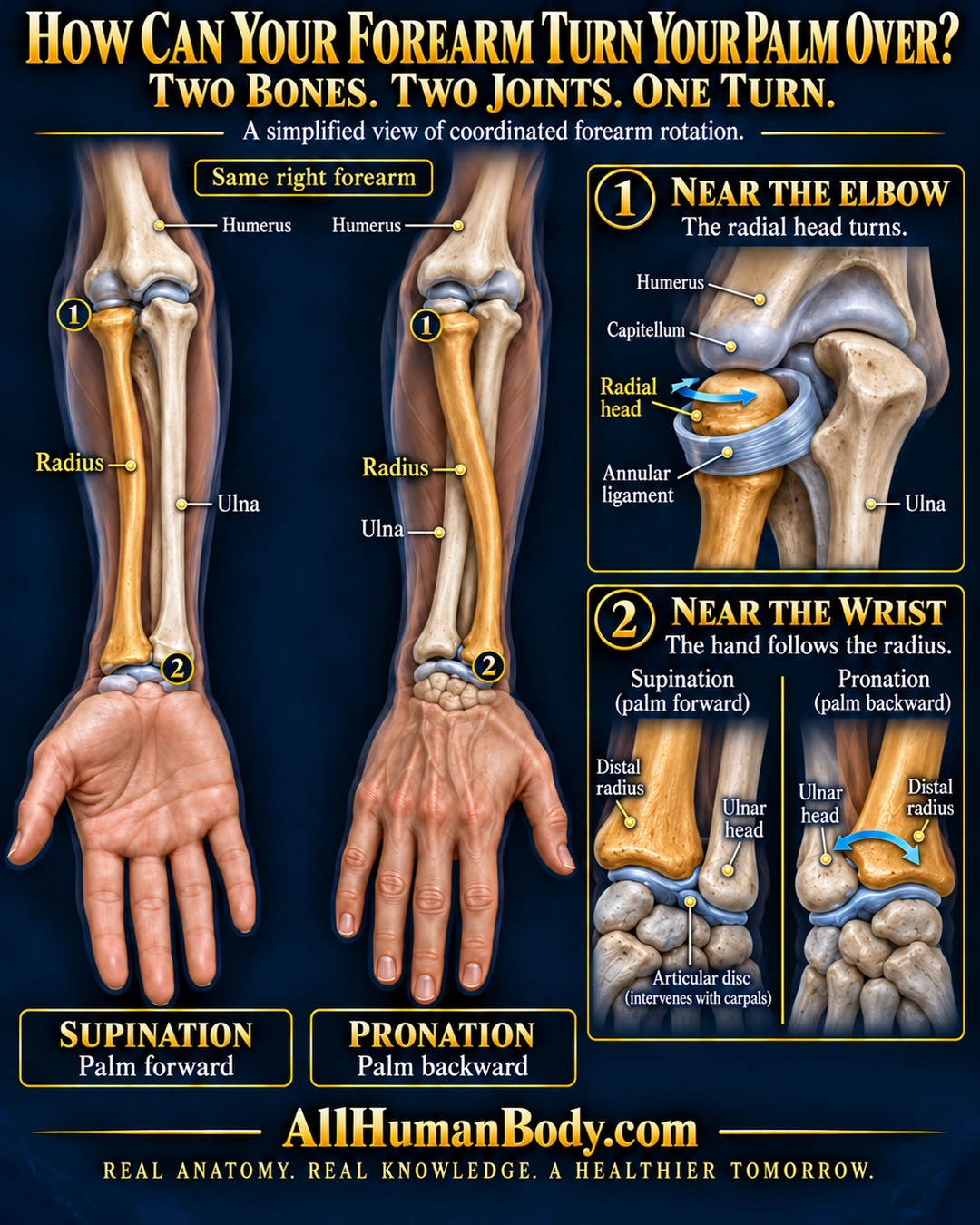
Turning the forearm coordinates motion at joints near the elbow and wrist. The radius changes position relative to the ulna, and the hand follows the distal radius; this differs from rotating the upper arm at the shoulder.
READ THE IMAGE
What the illustration shows
Navy-and-gold educational anatomy poster titled “How Can Your Forearm Turn Your Palm Over?” Two views of the same right forearm compare supination, palm forward, with pronation, palm backward. In the first view the gold radius and ivory ulna lie approximately parallel. In the second, the radius crosses in front of the ulna and remains connected to the thumb-side wrist. An elbow closeup labels the radial head and annular ligament. A wrist closeup compares the distal radius on opposite sides of the ulnar head and shows an intervening articular-disc region above the carpals. The illustrations simplify coordinated forearm rotation; fine joint geometry is schematic. Footer: AllHumanBody.com. REAL ANATOMY. REAL KNOWLEDGE. A HEALTHIER TOMORROW.
How to interpret this poster
- The illustrated straight-arm poses use palm-forward and palm-backward terminology.
- The ulna is not perfectly fixed; arrows are not measured three-dimensional trajectories.
- Fine wrist and ligament geometry is schematic; the linked lesson supplies related muscle context.
- Preserve the whole image because the title is close to the top edge.
- AI-assisted educational illustration; not physician certification, microscopy, a diagnosis or individualized medical advice.
- Fine annotations need enlargement; the full description provides an accessible text alternative.
AI-assisted educational illustration, adapted into web-sized images without changing its composition. This is general education, not an individual diagnosis or treatment recommendation.
EVIDENCE / CONTEXT
Sources and what they support
- Anatomy and Physiology 2e: 9.5 Types of Body Movements ↗
Supination/pronation and the parallel-versus-crossed radius/ulna comparison.
- The anatomy of the proximal radioulnar joint ↗
Radial head, proximal ulna and annular-ligament stabilization.
Evidence correspondence is limited to the abstract.