Integumentary / VISUAL EXPLAINER
How Does Your Skin Make and Share Pigment?
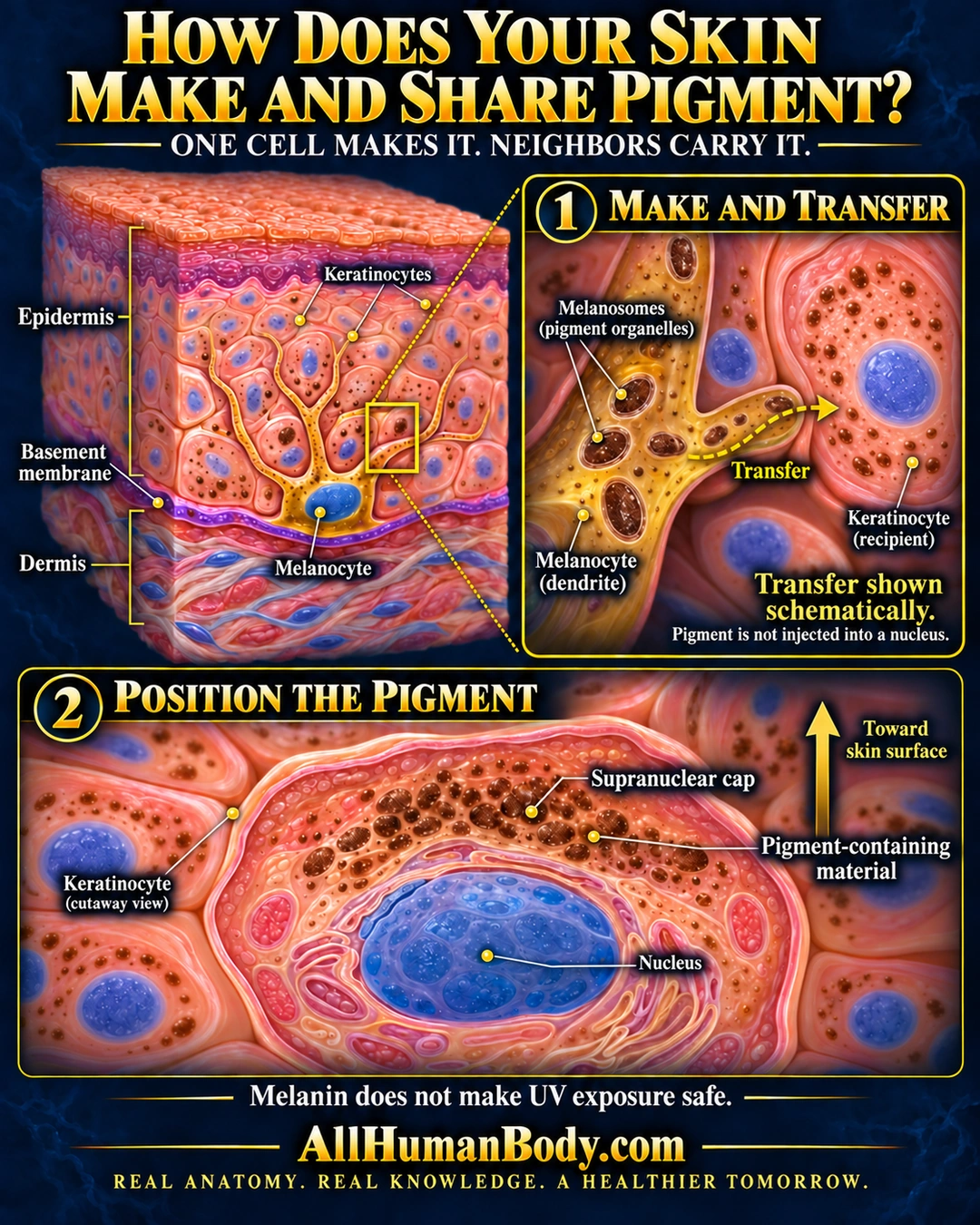
Melanocytes make pigment-containing organelles, and neighboring keratinocytes receive pigment material. Its distribution can include a cap on the skin-surface side of the nucleus; the transfer is shown as a relationship, not one proven universal route.
READ THE IMAGE
What the illustration shows
Educational anatomy poster titled “How Does Your Skin Make and Share Pigment?” with the subtitle “One cell makes it. Neighbors carry it.” A skin cutaway shows a branching gold melanocyte at the base of the epidermis, above the basement membrane and dermis, among coral keratinocytes. In the first enlargement, “Make and Transfer,” brown melanosomes lie inside a gold melanocyte dendrite. A dashed arrow labelled “Transfer” points toward a separate keratinocyte containing a blue nucleus and brown pigment. Text states “Transfer shown schematically” and “Pigment is not injected into a nucleus.” The second enlargement, “Position the Pigment,” shows a cutaway keratinocyte with a large blue nucleus. A granular brown supranuclear cap lies outside the nuclear boundary in cytoplasm on the side facing the skin surface, indicated by an upward arrow. Labels identify the nucleus and pigment-containing material. The bottom warning reads “Melanin does not make UV exposure safe.” Footer: AllHumanBody.com; “Real anatomy. Real knowledge. A healthier tomorrow.” Colors are illustrative.
How to interpret this poster
- Melanin does not make UV exposure safe.
- Transfer is schematic; recipient material is not asserted to be intact melanosomes in every case.
- Contrast colors are not measured skin tones or racial categories.
- AI-assisted educational illustration; not physician certification, microscopy, a diagnosis or individualized medical advice.
- Fine annotations need enlargement; the full description provides an accessible text alternative.
AI-assisted educational illustration, adapted into web-sized images without changing its composition. This is general education, not an individual diagnosis or treatment recommendation.
EVIDENCE / CONTEXT
Sources and what they support
- Anatomy and Physiology 2e: 5.1 Layers of the Skin ↗
Basal melanocyte location, pigment production and uptake by keratinocytes.
- The Risks of Tanning ↗
UV-related tanning does not establish safe exposure.
- Supranuclear melanin caps reduce ultraviolet induced DNA photoproducts in human epidermis ↗
Human skin-explant observations of supranuclear caps and partial shielding, not safe UV exposure.
Evidence correspondence is limited to the abstract.