Special Senses / VISUAL EXPLAINER
Why Do Your Eyes Need to Blink?
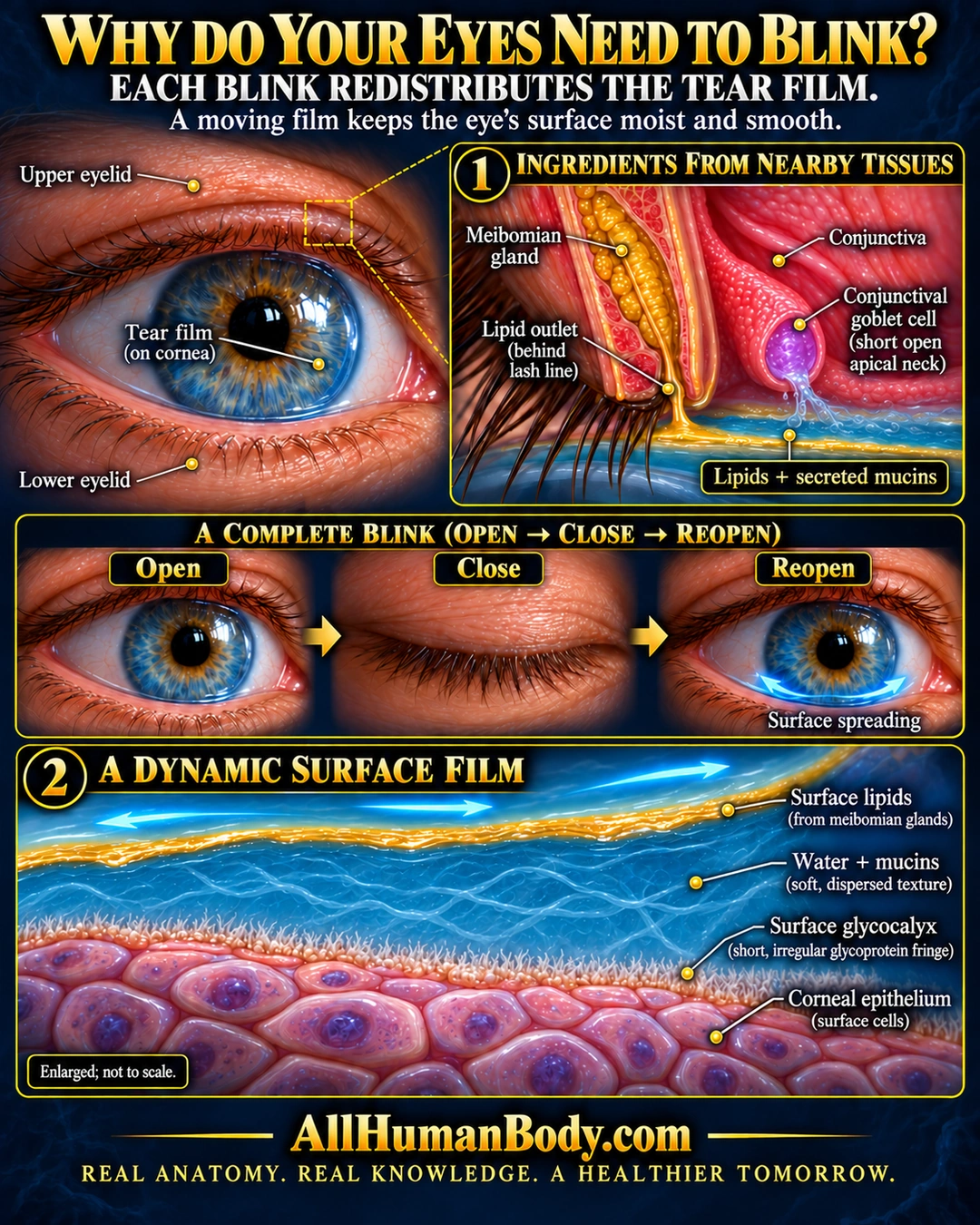
Closing and reopening the lids redistributes tears across the eye’s exposed surface. Ingredients from nearby tissues form a dynamic film over the corneal cells, helping keep the surface moist and smooth.
READ THE IMAGE
What the illustration shows
Navy-and-gold anatomy poster titled “Why Do Your Eyes Need to Blink?” The main statement says each blink redistributes the tear film. A blue eye has labels for the upper eyelid, lower eyelid, and tear film on the cornea. A lid-margin enlargement shows a lobulated meibomian gland, its lipid outlet behind the lash line, and a purple goblet cell within labeled conjunctiva releasing secretion through a short opening. Below, three views show the eye open, closed, and reopened, with blue arrows labeled “Surface spreading.” A second enlargement shows a fine gold surface-lipid region above continuous blue water and mucins, a short attached glycocalyx fringe, and pink corneal epithelial cells. Blue arrows indicate qualitative movement along the external film. The illustration says “Enlarged; not to scale.” AllHumanBody.com and “REAL ANATOMY. REAL KNOWLEDGE. A HEALTHIER TOMORROW.” appear at the bottom.
How to interpret this poster
- An illustrative complete blink, not a prescribed rate or a claim that every blink is complete.
- The film is not three rigid equal layers, and the attached glycocalyx is not motile cilia.
- The lacrimal gland is background context, not a structure labeled in this final poster.
- AI-assisted educational illustration; not physician certification, microscopy, a diagnosis or individualized medical advice.
- Fine annotations need enlargement; the full description provides an accessible text alternative.
AI-assisted educational illustration, adapted into web-sized images without changing its composition. This is general education, not an individual diagnosis or treatment recommendation.
EVIDENCE / CONTEXT
Sources and what they support
- TFOS DEWS II Tear Film Report ↗
Dynamic tear film, lipid-rich surface, mucoaqueous phase and distinct secreted versus membrane-associated mucins.
- The contribution of lipid layer movement to tear film thinning and breakup ↗
Human observations of lipid motion after blinking.
Evidence correspondence is limited to the abstract.