Digestive / VISUAL EXPLAINER
What Holds a Tooth in Its Socket?
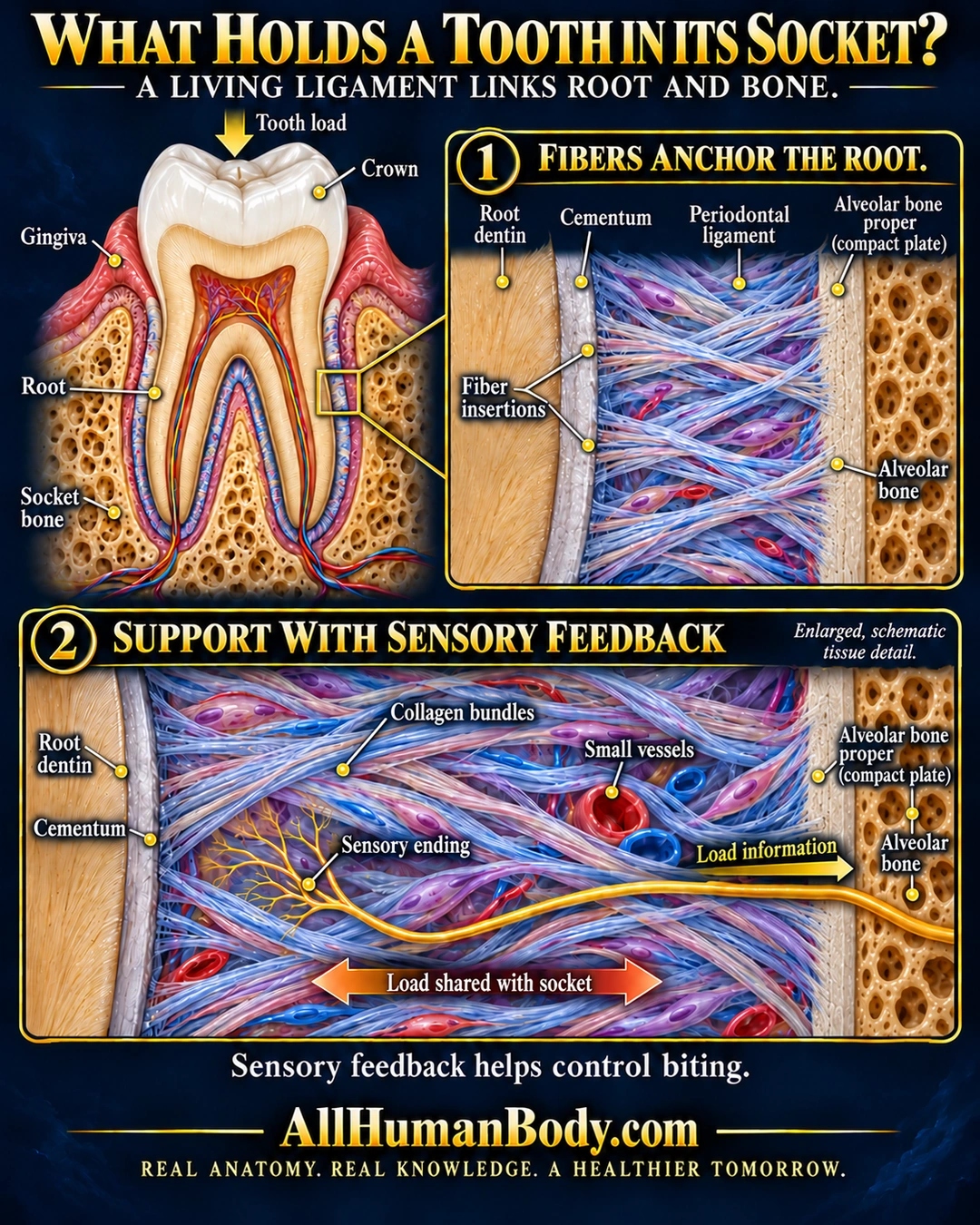
A tooth root is supported through a living periodontal ligament rather than being fused directly to socket bone. Its collagen attachment shares load, and sensory signals from this tissue help control biting.
READ THE IMAGE
What the illustration shows
Anatomy poster titled “What Holds a Tooth in Its Socket?” with the subtitle “A living ligament links root and bone.” A cutaway molar shows its crown, two roots, gingiva and surrounding socket bone, with a downward tooth-load arrow. The first enlargement shows root dentin, a cementum coat, interlacing periodontal-ligament collagen and a dense alveolar bone plate backed by porous bone. Fibers join the mineralized surfaces on both sides. The second enlargement shows collagen bundles, small red and blue vessels, and a branched yellow sensory ending in the living ligament between cementum and bone. A yellow arrow marks outgoing load information; a separate orange double-headed arrow marks load shared with the socket. Text states, “Sensory feedback helps control biting.” The details are labeled enlarged and schematic. Navy background with ivory, blue, coral and gold artwork. Footer: AllHumanBody.com. REAL ANATOMY. REAL KNOWLEDGE. A HEALTHIER TOMORROW.
How to interpret this poster
- Enlarged schematic tissue, not a measured attachment map or force sensor.
- Sensory feedback is one contribution to bite control, not the sole source of jaw position information.
- No mobility test, treatment or numerical load claim.
- AI-assisted educational illustration; not physician certification, microscopy, a diagnosis or individualized medical advice.
- Fine annotations need enlargement; the full description provides an accessible text alternative.
AI-assisted educational illustration, adapted into web-sized images without changing its composition. This is general education, not an individual diagnosis or treatment recommendation.
EVIDENCE / CONTEXT
Sources and what they support
- Anatomy and Physiology: 9.2 Fibrous Joints ↗
Fibrous tooth-to-socket attachment; immobile classification is not zero microscopic deformation.
- The biomechanical characteristics of the bone-periodontal ligament-cementum complex ↗
Human molar attachment interfaces, collagen continuity and vascular spaces.
Evidence correspondence is limited to the abstract. - Encoding of Amplitude and Rate of Tooth Loads by Human Periodontal Afferents From Premolar and Molar Teeth ↗
Human periodontal afferents convey tooth-load information.
Evidence correspondence is limited to the abstract.