Special Senses / VISUAL EXPLAINER
Why Does a Familiar Smell Fade From Notice?
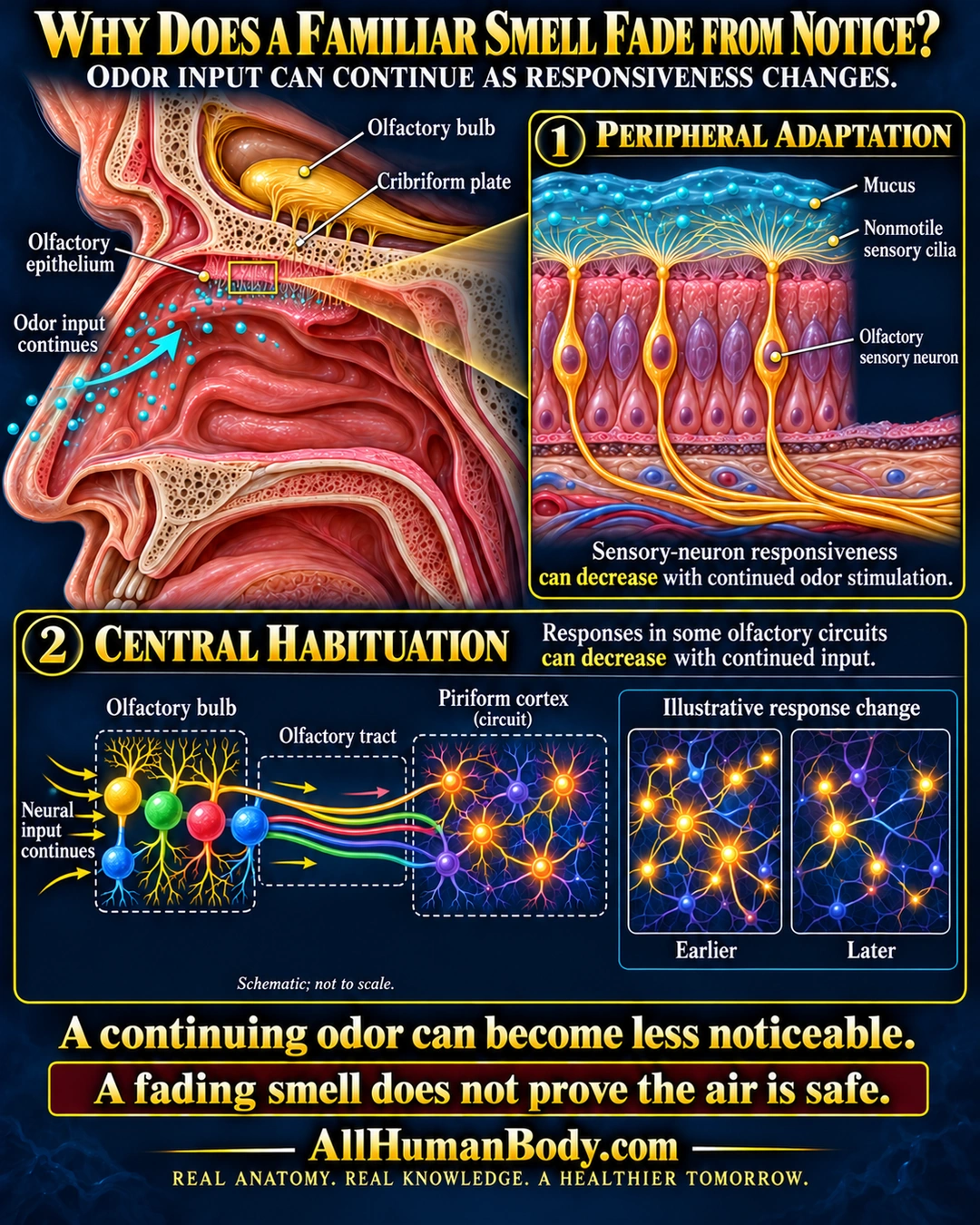
A continuing odor can become less noticeable as sensory responsiveness and central processing change. These are distinct contributions, not a universal shutdown or proof that the odor has disappeared.
READ THE IMAGE
What the illustration shows
Navy-and-gold anatomical poster titled “Why Does a Familiar Smell Fade From Notice?” A nasal cutaway shows blue odorant dots continuing toward a small olfactory region high in the nose, beneath the cribriform plate and olfactory bulb. A linked “Peripheral adaptation” enlargement shows olfactory sensory neurons among supporting cells, with fine nonmotile cilia spreading into surface mucus and axons joining bundles below. Its text says sensory-neuron responsiveness can decrease with continued odor stimulation. The separate “Central habituation” panel shows neural-input arrows entering an olfactory-bulb schematic, then a tract leading to a piriform cortical circuit. It is marked schematic and not to scale. Adjacent illustrative “Earlier” and “Later” neural networks show fewer bright response marks later, with activity still present. Text says responses in some olfactory circuits can decrease with continued input. The conclusion reads “A continuing odor can become less noticeable.” A prominent warning reads “A fading smell does not prove the air is safe.” Footer: AllHumanBody.com; “REAL ANATOMY. REAL KNOWLEDGE. A HEALTHIER TOMORROW.”
How to interpret this poster
- A fading smell does not prove the air is safe.
- Central circuitry and earlier/later activity are illustrative, not measured human recordings.
- Peripheral cellular evidence includes animal research; it does not establish exact human timing or one sole mechanism.
- AI-assisted educational illustration; not physician certification, microscopy, a diagnosis or individualized medical advice.
- Fine annotations need enlargement; the full description provides an accessible text alternative.
AI-assisted educational illustration, adapted into web-sized images without changing its composition. This is general education, not an individual diagnosis or treatment recommendation.
EVIDENCE / CONTEXT
Sources and what they support
- Time course of odorant-induced activation in the human primary olfactory cortex ↗
Human piriform-response change during continued stimulation; behavioral odor detection can persist.
Evidence correspondence is limited to the abstract. - The Na+/Ca2+ exchanger NCKX4 governs termination and adaptation of the mammalian olfactory response ↗
Animal experimental support for peripheral response adjustment, not a human intervention.
Evidence correspondence is limited to the abstract. - NIOSH Pocket Guide to Chemical Hazards: Hydrogen sulfide ↗
Official counterexample to relying on smell as proof of safe air.