Special Senses / VISUAL EXPLAINER
Why Does Chili Feel Hot Without Being Hot?
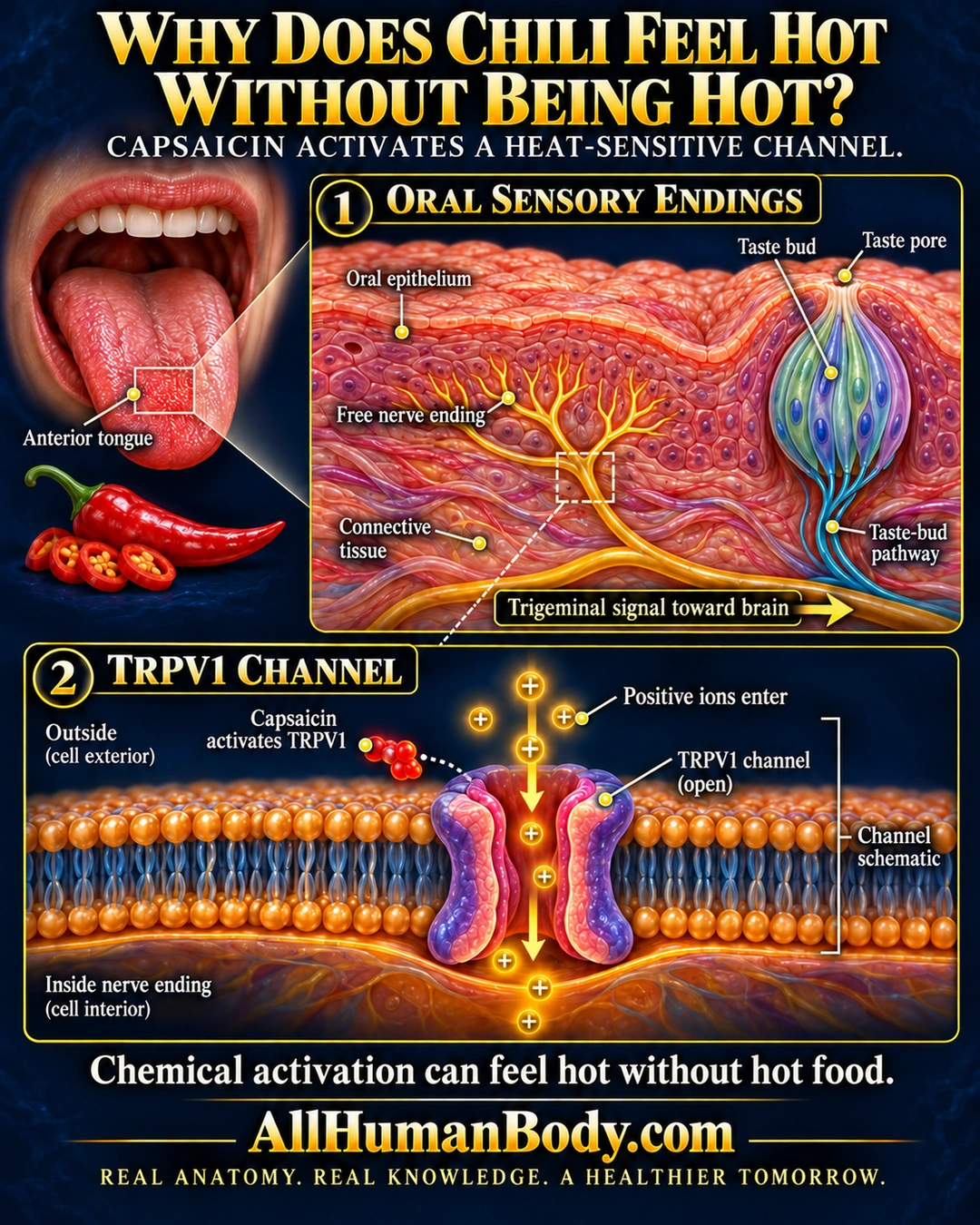
Capsaicin can activate a heat-sensitive channel on sensory endings and produce a real burning sensation without thermally hot food. This chemical irritation is distinct from taste-bud signaling.
READ THE IMAGE
What the illustration shows
Navy-and-gold anatomical poster titled “Why Does Chili Feel Hot Without Being Hot?” The subtitle explains that capsaicin activates a heat-sensitive channel. A mouth and anterior-tongue locator connect to an enlarged tissue section, where branching gold free nerve endings lie within oral epithelium beside a separate teal taste bud with a surface pore and blue taste-bud nerve pathway. A gold arrow identifies a trigeminal signal toward the brain. A second linked enlargement shows a schematic open TRPV1 channel embedded in the nerve-ending membrane. A red capsaicin symbol connects to the channel by a dotted activation cue, while gold positive-ion symbols and downward arrows pass through the pore from outside into the nerve ending. The capsaicin cue indicates activation, not an exact binding site or passage through the pore. The conclusion reads, “Chemical activation can feel hot without hot food.” Footer: AllHumanBody.com and “REAL ANATOMY. REAL KNOWLEDGE. A HEALTHIER TOMORROW.”
How to interpret this poster
- The channel is schematic, not an atomic structure or a map of the capsaicin binding pocket.
- The capsaicin marker means activation; only positive ions are shown passing through the pore.
- No claim of harmlessness, tolerance, treatment or a spicy-food challenge.
- The linked section gives chemesthesis foundations, not the detailed TRPV1 mechanism.
- AI-assisted educational illustration; not physician certification, microscopy, a diagnosis or individualized medical advice.
- Fine annotations need enlargement; the full description provides an accessible text alternative.
AI-assisted educational illustration, adapted into web-sized images without changing its composition. This is general education, not an individual diagnosis or treatment recommendation.
EVIDENCE / CONTEXT
Sources and what they support
- Taste Disorders ↗
Normal distinction between taste-bud cells and chemical-irritation sensory endings.
- Introduction to Behavioral Neuroscience: 9.1 Somatosensory Receptors ↗
Capsaicin activation of a heat-sensitive channel and inward positive-ion movement.