Musculoskeletal / VISUAL EXPLAINER
How Do Your Foot Arches Handle a Step?
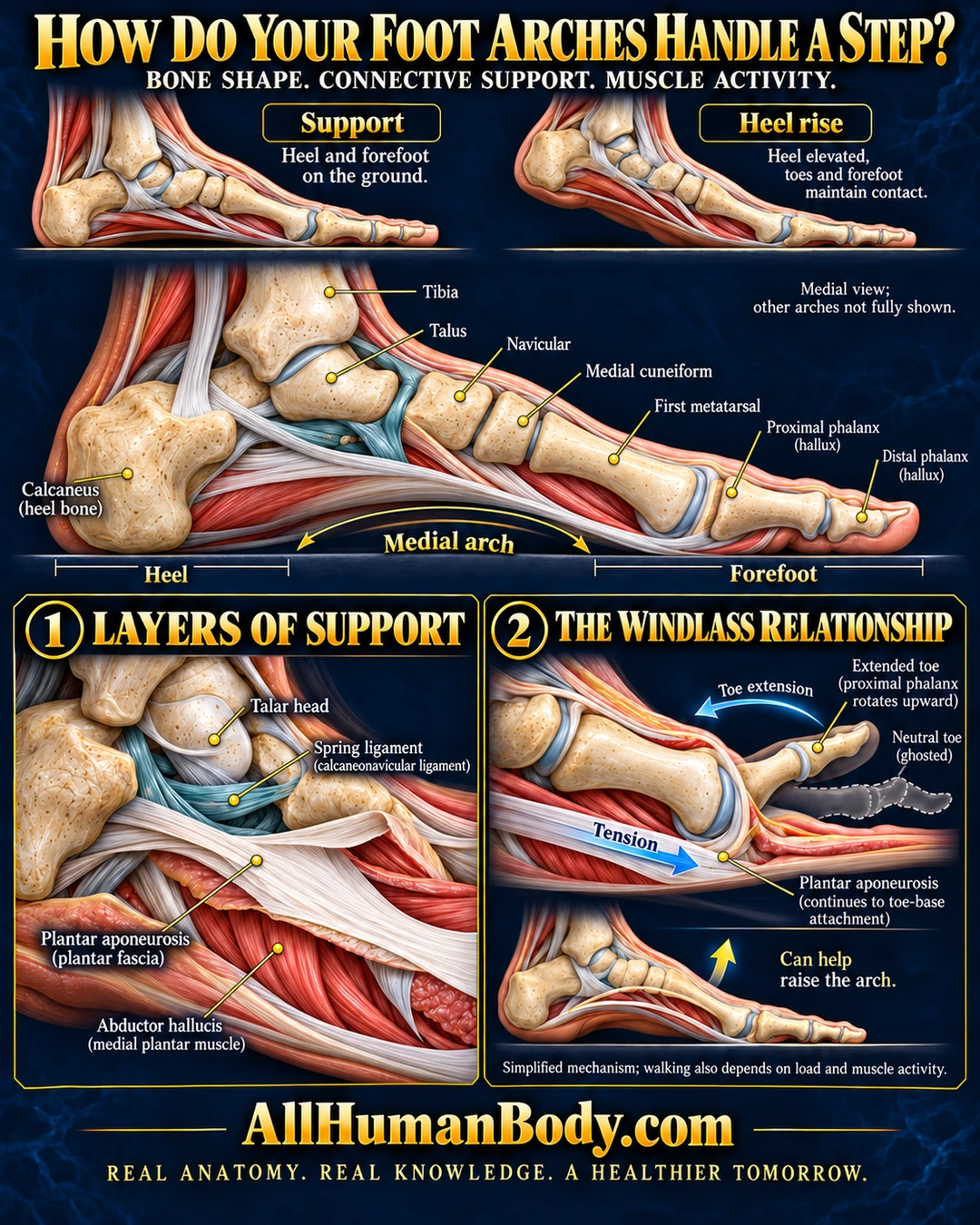
Foot support combines bone shape, connective tissue and muscle activity. Extending the toes can tension the plantar aponeurosis and help raise the medial arch, but that simplified relationship does not fully predict walking.
READ THE IMAGE
What the illustration shows
Navy-and-gold anatomical poster titled “How Do Your Foot Arches Handle a Step?” Two medial foot views compare heel-and-forefoot support with heel rise while the toes and forefoot remain on the ground. A larger view labels the tibia, calcaneus, talus, navicular, medial cuneiform, first metatarsal and the big toe’s two phalanges above a curved medial-arch arrow. A support-layer closeup identifies plantar aponeurosis, deeper spring ligament beneath the talar head, and abductor hallucis muscle. A windlass closeup contrasts a raised big toe with a ghosted neutral toe, shows plantar tissue tension, and says this can help raise the arch. A note explains that the mechanism is simplified and walking also depends on load and muscle activity. Footer: AllHumanBody.com; REAL ANATOMY. REAL KNOWLEDGE. A HEALTHIER TOMORROW.
How to interpret this poster
- Medial view does not show every arch or certify fine attachments.
- Toe extension does not universally lift or lock the arch during walking.
- The linked anchor explains the support framework rather than the full windlass mechanism.
- AI-assisted educational illustration; not physician certification, microscopy, a diagnosis or individualized medical advice.
- Fine annotations need enlargement; the full description provides an accessible text alternative.
AI-assisted educational illustration, adapted into web-sized images without changing its composition. This is general education, not an individual diagnosis or treatment recommendation.
EVIDENCE / CONTEXT
Sources and what they support
- The rise of the longitudinal arch when sitting, standing, and walking: Contributions of the windlass mechanism ↗
Toe extension and plantar tension with important static-versus-walking differences.
- Gross, histological, and microvascular anatomy and biomechanical testing of the spring ligament complex ↗
Spring-support context beneath the talar head.
Evidence correspondence is limited to the abstract.