Nervous / VISUAL EXPLAINER
Why Can Your Fingertips Feel Such Fine Detail?
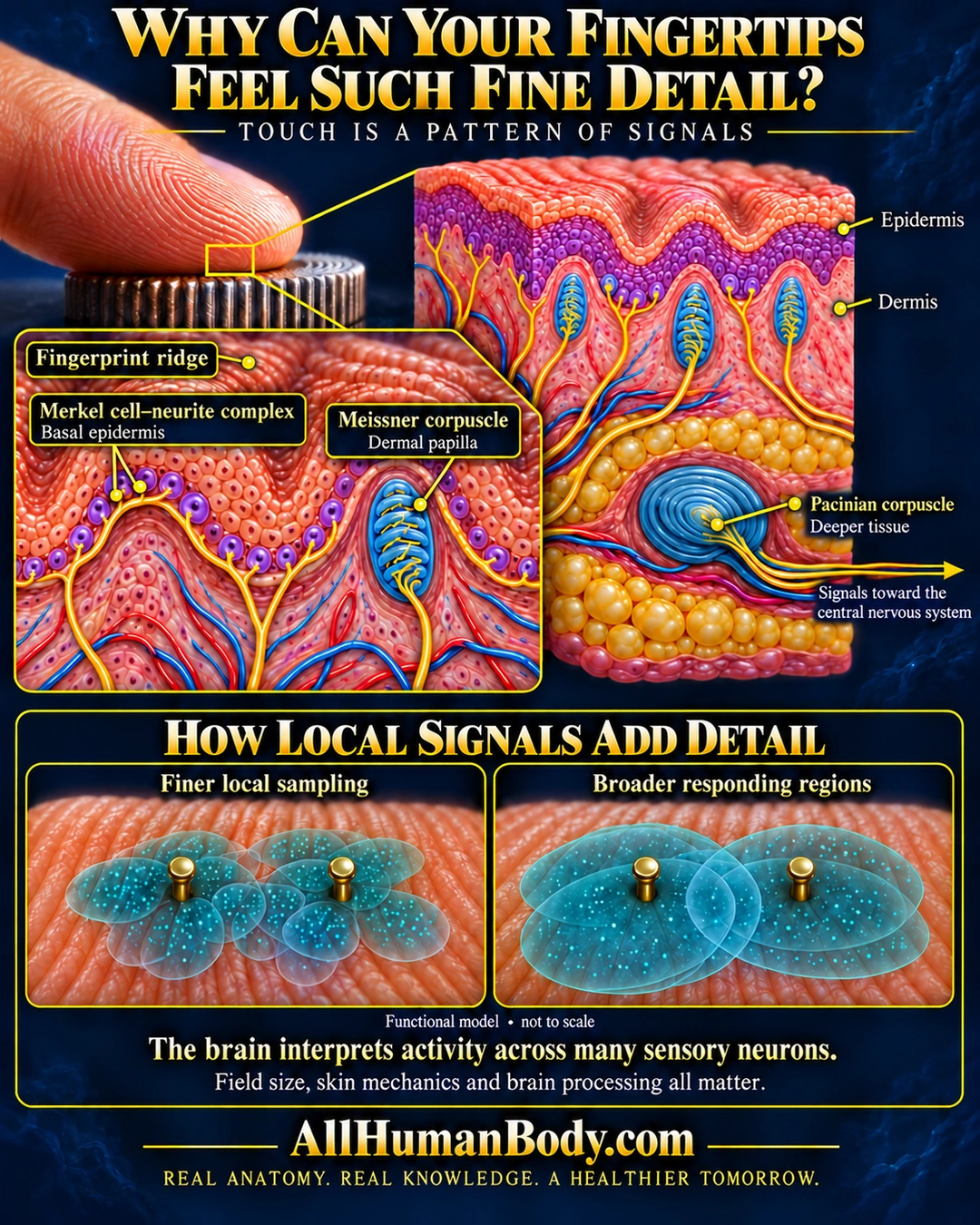
Fingertip detail is represented by patterns of sensory activity. Small, overlapping responding regions can help distinguish nearby features, while skin mechanics and brain processing also shape what is felt.
READ THE IMAGE
What the illustration shows
Educational poster titled “Why Can Your Fingertips Feel Such Fine Detail?” A fingertip touches the ridged edge of a coin, with a magnified skin cross-section and a close-up inset. Labels identify the epidermis, dermis, a surface fingerprint ridge, Merkel cell–neurite complexes in the basal epidermis, Meissner corpuscles in dermal papillae, and a deeper, onion-shaped Pacinian corpuscle surrounded by fatty tissue. Yellow sensory fibers connect to the receptors; an arrow indicates signals toward the central nervous system. Below, two side-by-side panels compare finer local sampling with broader responding regions using overlapping translucent blue patches and two contact markers on skin. The panels are labeled “Functional model • not to scale.” The takeaway says the brain interprets activity across many sensory neurons, and that field size, skin mechanics and brain processing all matter. AllHumanBody.com appears at the bottom.
How to interpret this poster
- Receptive-field patches are functional models, not visible anatomical rings.
- Selected receptors only; no exclusive sensation is assigned to one type.
- The two contacts are not a clinical two-point test or a prediction of a person’s report.
- AI-assisted educational illustration; not physician certification, microscopy, a diagnosis or individualized medical advice.
- Fine annotations need enlargement; the full description provides an accessible text alternative.
AI-assisted educational illustration, adapted into web-sized images without changing its composition. This is general education, not an individual diagnosis or treatment recommendation.
EVIDENCE / CONTEXT
Sources and what they support
- Introduction to Behavioral Neuroscience: 9.1 Somatosensory Receptors ↗
Superficial versus deep touch receptors, sensory axons and receptive fields.
- Human Touch Receptors Are Sensitive to Spatial Details on the Scale of Single Fingerprint Ridges ↗
Human afferent subfields and effects of skin deformation on spatial responses.
Evidence correspondence is limited to the abstract.