Respiratory / VISUAL EXPLAINER
How Does Your Breath Become a Voice?
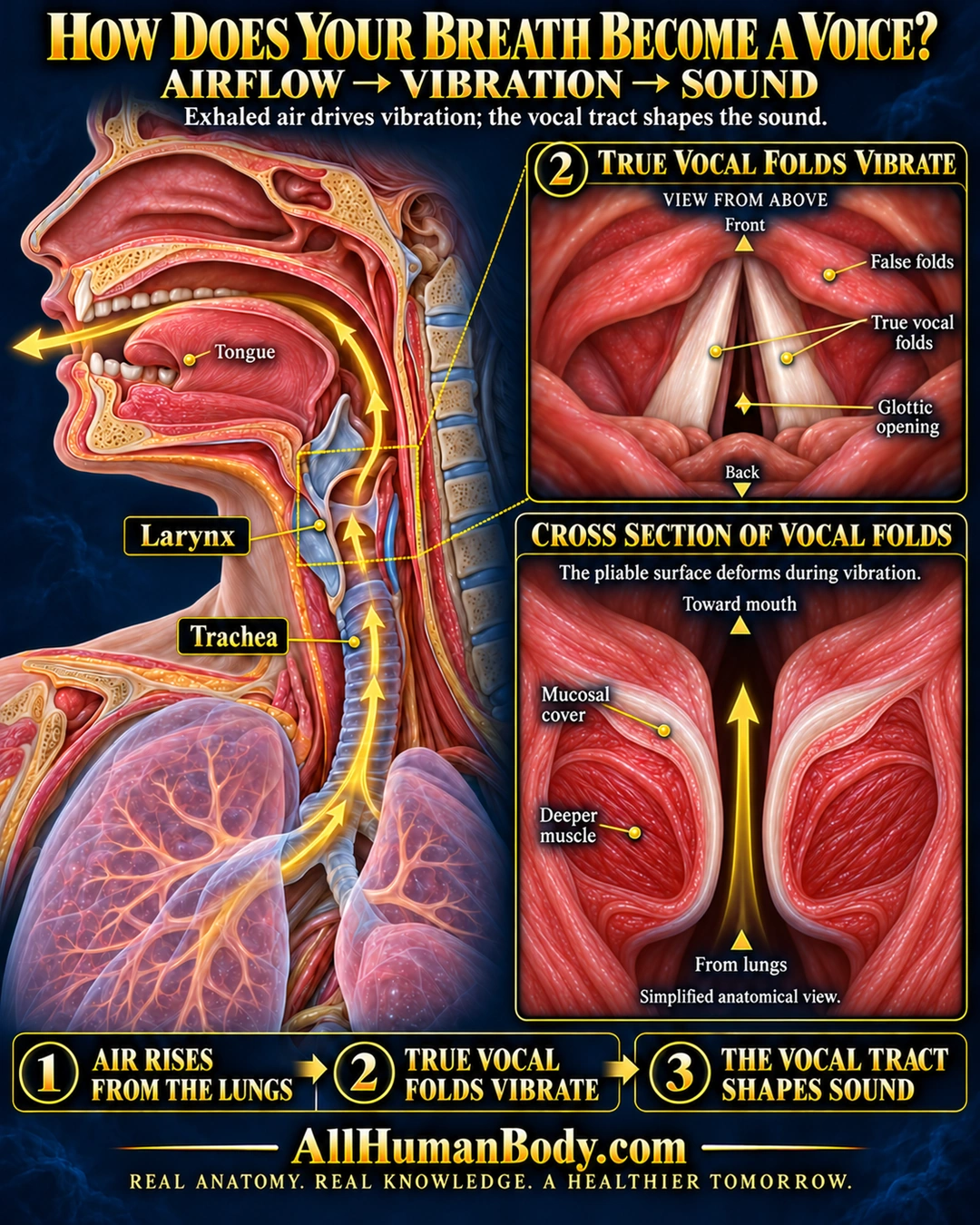
Ordinary voiced sound uses exhaled air to drive vibration of the true vocal folds. The throat and mouth then shape the sound; the illustration locates these structures rather than showing a complete vibration cycle.
READ THE IMAGE
What the illustration shows
Educational anatomy poster titled “How Does Your Breath Become a Voice?” A side cutaway of the head, neck and chest shows gold arrows rising from the lungs through the trachea and larynx, continuing through the throat and out of the mouth. Labels identify the tongue, larynx and trachea. An upper-right view from above shows two pale true vocal folds around a dark glottic opening, with coral false folds farther to the sides; front and back are marked. A lower-right simplified cross section shows paired soft-tissue folds with a pale mucosal cover over deeper red muscle and a gold arrow pointing upward through the central airway. Its text states that the pliable surface deforms during vibration. No motion sequence is shown. The bottom summarizes: air rises from the lungs, true vocal folds vibrate, and the vocal tract shapes sound. AllHumanBody.com branding appears below.
How to interpret this poster
- Not all speech is voiced.
- One static tissue section is shown, not a demonstrated mucosal-wave sequence or timing measurement.
- The linked anchor provides vocal-fold context, not a full airflow-to-oscillation explanation.
- AI-assisted educational illustration; not physician certification, microscopy, a diagnosis or individualized medical advice.
- Fine annotations need enlargement; the full description provides an accessible text alternative.
AI-assisted educational illustration, adapted into web-sized images without changing its composition. This is general education, not an individual diagnosis or treatment recommendation.
EVIDENCE / CONTEXT
Sources and what they support
- How Does the Human Body Produce Voice and Speech?: Text Version ↗
Lung airflow, vocal-fold vibration and upper-tract sound shaping.
- Anatomy and Physiology 2e: 22.1 Organs and Structures of the Respiratory System ↗
Larynx location and true versus vestibular folds; glottic opening is the intervening space.