Nervous / VISUAL EXPLAINER
Why Does a Knee Tap Make Your Leg Kick?
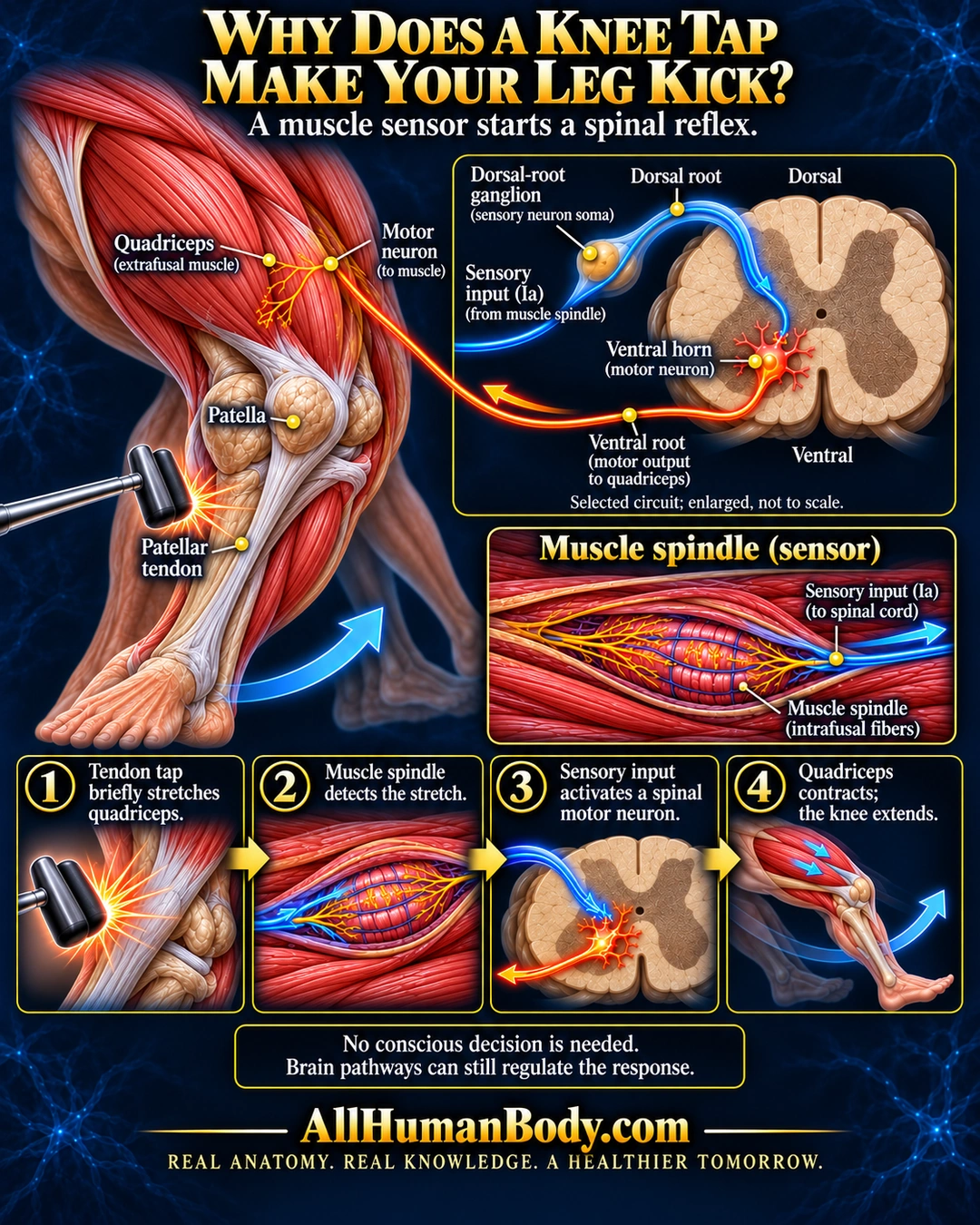
A brief stretch of quadriceps activates muscle spindles. Their sensory input can excite a spinal motor pathway that contracts quadriceps and extends the knee without a conscious decision, while brain pathways can still regulate the response.
READ THE IMAGE
What the illustration shows
Illustrated poster titled “Why Does a Knee Tap Make Your Leg Kick?” A cutaway thigh and knee shows a tap below the patella at the patellar tendon. An enlarged muscle spindle detects stretch. Blue sensory input enters the dorsal side of a spinal-cord cross-section and activates a ventral-horn motor neuron. An orange arrow carries motor output back to ordinary quadriceps muscle fibers, causing contraction and knee extension. Four numbered panels repeat the sequence. A note says no conscious decision is needed, but brain pathways can regulate the response. The circuit is labeled enlarged and not to scale. AllHumanBody.com branding appears below.
How to interpret this poster
- A selected circuit is shown, not every spinal connection, inhibitory pathway or brain influence.
- This is not a self-testing protocol, diagnostic interpretation or root-level localization chart.
- The existing linked section gives reflex foundations rather than a dedicated full patellar-reflex lesson.
- The title and panel borders are close to the edges; preserve the whole image and do not crop its teaching text.
- AI-assisted educational illustration; not physician certification, microscopy, a diagnosis or individualized medical advice.
- Fine annotations need enlargement; the full description provides an accessible text alternative.
AI-assisted educational illustration, adapted into web-sized images without changing its composition. This is general education, not an individual diagnosis or treatment recommendation.
EVIDENCE / CONTEXT
Sources and what they support
- Anatomy and Physiology 2e: 16.4 The Sensory and Motor Exams ↗
Tendon-related muscle stretch, spindle input and spinal motor response; examination interpretation excluded.
- Spinal Reflexes and Descending Motor Pathways ↗
Muscle-spindle afferents, direct same-muscle excitation and higher-level modulation.