Integumentary / VISUAL EXPLAINER
Where Does a Growing Fingernail Come From?
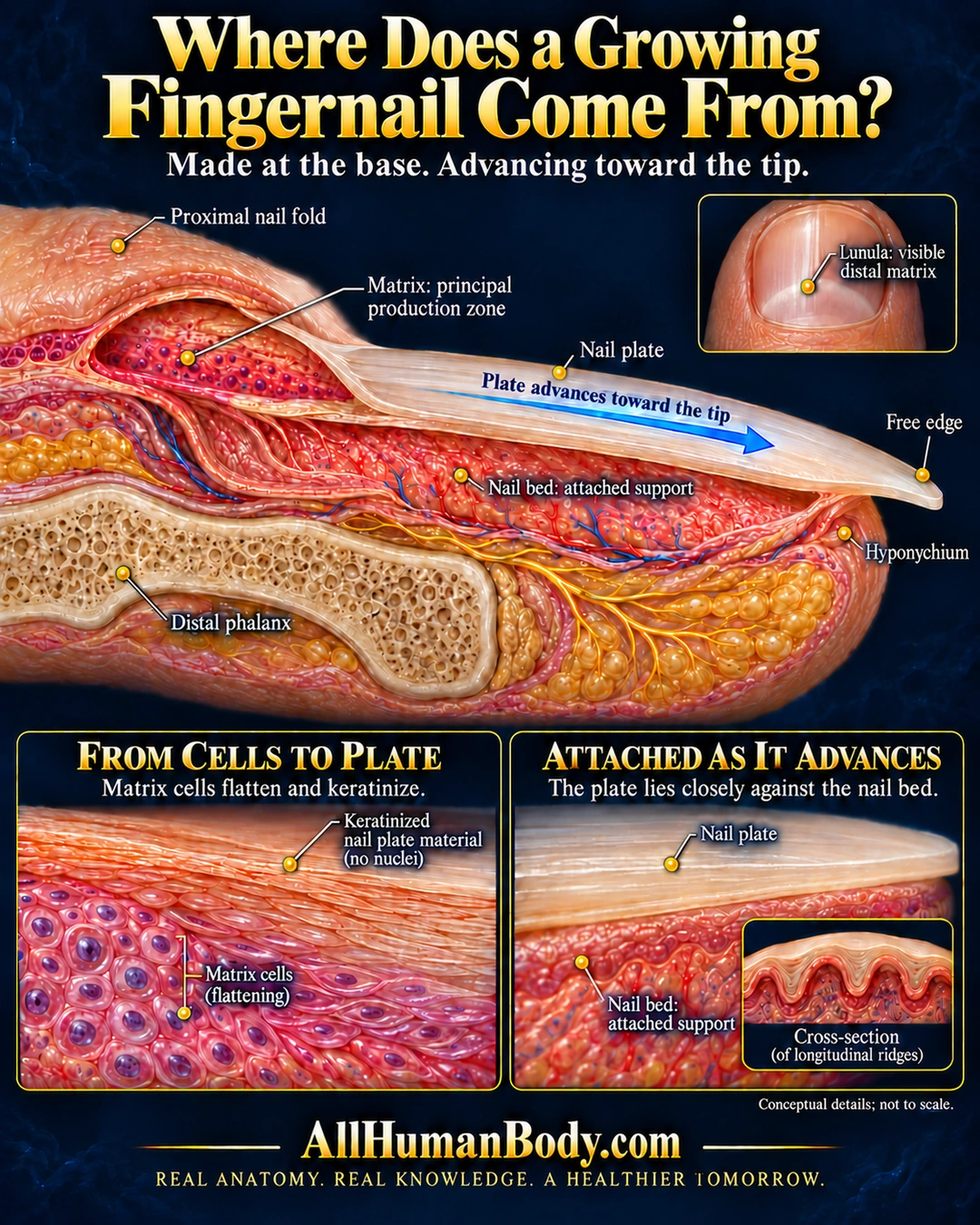
The matrix near the nail base is the principal source of the nail plate. Its cells become compact keratinized material, and the plate advances toward the fingertip while closely supported by the nail bed.
READ THE IMAGE
What the illustration shows
Anatomy poster titled “Where Does a Growing Fingernail Come From?” A large longitudinal fingertip cutaway shows the proximal nail fold and nucleated matrix at left, an ivory nail plate closely overlying the vascular nail bed, and the free edge at the fingertip on the right. A blue arrow on the plate points toward the tip. Labels identify the matrix as the principal production zone, the supporting nail bed, hyponychium and distal phalanx. A small top-view nail inset identifies the lunula as visible distal matrix. Below, one enlarged panel shows nucleated matrix cells becoming flattened keratinized plate material without nuclei. Another shows close plate–bed contact with a transverse inset of longitudinal ridges. Gold AllHumanBody.com branding and the full slogan appear on a navy background.
How to interpret this poster
- This does not claim that the bed contributes nothing or explain every microscopic attachment-remodeling process.
- No growth-rate promise, diagnosis or grooming advice is given.
- The final poster does not label the cuticle; the lunula represents visible distal matrix and its visibility varies.
- AI-assisted educational illustration; not physician certification, microscopy, a diagnosis or individualized medical advice.
- Fine annotations need enlargement; the full description provides an accessible text alternative.
AI-assisted educational illustration, adapted into web-sized images without changing its composition. This is general education, not an individual diagnosis or treatment recommendation.
EVIDENCE / CONTEXT
Sources and what they support
- Anatomy of the nail unit and the nail biopsy ↗
Matrix production, bed attachment, distal barrier and proximal-fold anatomy.
Evidence correspondence is limited to the abstract. - Nails ↗
Matrix cell production, distal keratinized plate progression and nail-unit ridges.