Digestive / VISUAL EXPLAINER
Why Is Poop Usually Brown?
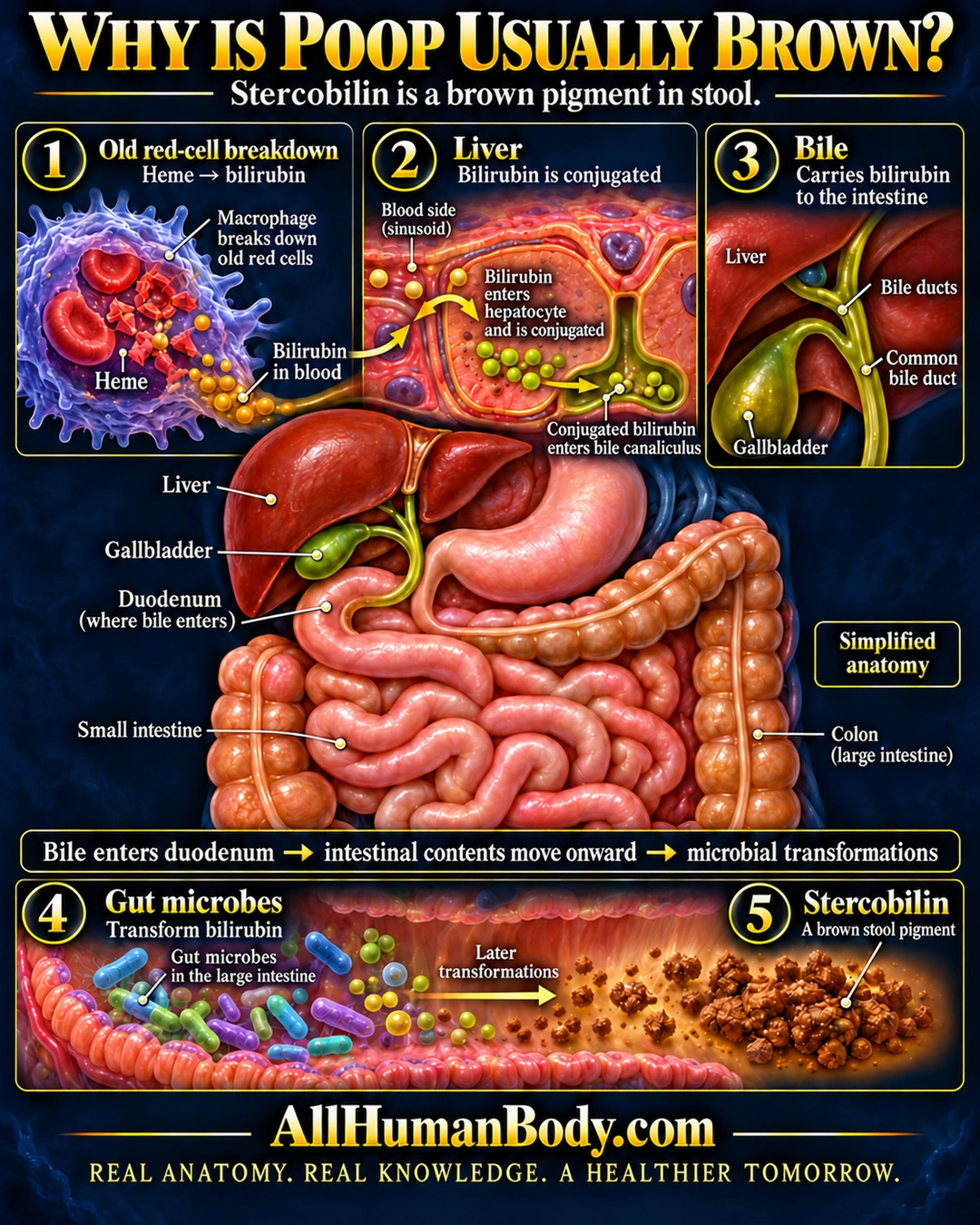
Breakdown of heme, much of it from old red blood cells, produces bilirubin. The liver processes it for bile delivery to the intestine, where microbial and later transformations lead to pigments including brown stercobilin.
READ THE IMAGE
What the illustration shows
Navy-and-gold medical education poster titled “Why Is Poop Usually Brown?” The answer reads, “Stercobilin is a brown pigment in stool.” Five numbered stages show a macrophage breaking down old red blood cells to form bilirubin from heme; bilirubin entering a liver cell, being conjugated and entering a separate bile canaliculus; bile carrying bilirubin toward the intestine; gut microbes transforming bilirubin; and later transformations yielding brown stercobilin. The central simplified anatomy shows the liver, gallbladder, bile duct entering the duodenum, small intestine and surrounding colon. A separate magnified inset labels the liver, bile ducts, common bile duct and gallbladder. A text strip reads, “Bile enters duodenum → intestinal contents move onward → microbial transformations.” The bottom inset depicts microbes and a brown pigment cluster. Footer: AllHumanBody.com. REAL ANATOMY. REAL KNOWLEDGE. A HEALTHIER TOMORROW.
How to interpret this poster
- The pathway groups several transformations; one microbial enzyme is not shown as completing every step.
- Brown stool is not a health certificate, and this is not a stool-color diagnostic guide.
- Biliary and microscopic anatomy is simplified; blood and bile remain distinct compartments.
- AI-assisted educational illustration; not physician certification, microscopy, a diagnosis or individualized medical advice.
- Fine annotations need enlargement; the full description provides an accessible text alternative.
AI-assisted educational illustration, adapted into web-sized images without changing its composition. This is general education, not an individual diagnosis or treatment recommendation.
EVIDENCE / CONTEXT
Sources and what they support
- UGT1A1 gene ↗
Red-cell-related bilirubin production, hepatic conjugation and elimination in bile.
- Anatomy and Physiology 2e: 23.6 Accessory Organs in Digestion: The Liver, Pancreas, and Gallbladder ↗
Bile delivery, separate hepatic blood/bile compartments and the stercobilin stool-pigment endpoint.
- This Gut Enzyme Helps Turn Urine Yellow… and Affects Our Health, Too ↗
Direct researcher explanation of gut-bacterial conversion of bilirubin to urobilinogen, one step rather than the whole pigment pathway.