Lymphatic & Immune / VISUAL EXPLAINER
How Does Lymph Move Without a Central Heart?
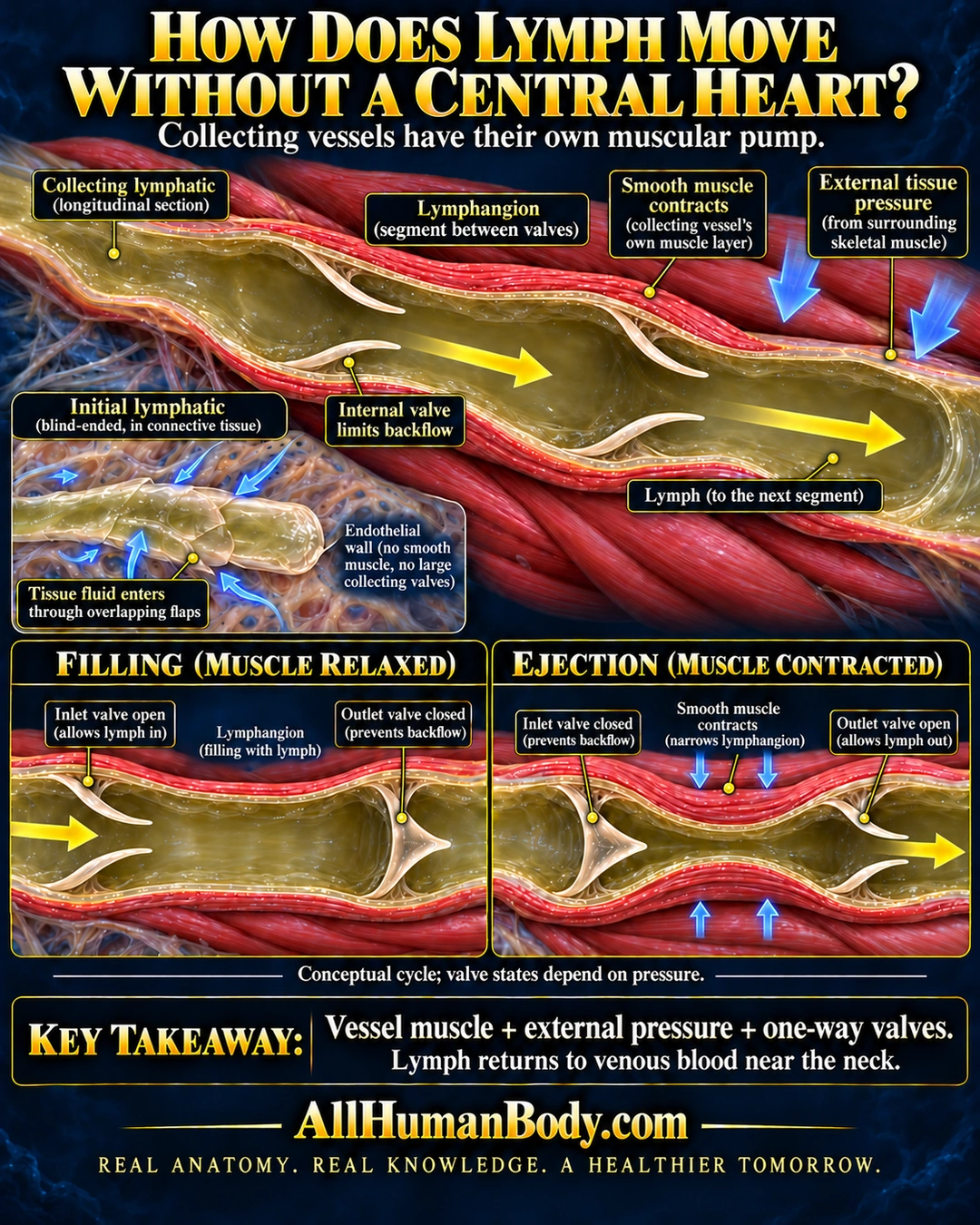
Collecting lymphatic vessels have muscular walls that can help propel lymph. Surrounding tissue pressure and pressure-operated valves also contribute, while thin-walled initial lymphatics collect fluid from tissues.
READ THE IMAGE
What the illustration shows
Educational poster titled “How Does Lymph Move Without a Central Heart?” A longitudinal view of a collecting lymphatic vessel shows pale lymph moving left to right through paired one-way valves. Smooth muscle in the vessel wall contracts, while surrounding skeletal muscle can provide external pressure. A lymphangion is identified as the segment between valves. A separate inset shows tissue fluid entering a thin-walled, blind-ended initial lymphatic through overlapping endothelial flaps; it has no smooth-muscle coat or large collecting valves. Two lower panels illustrate a conceptual pressure-dependent cycle: during filling, the segment is relaxed, the inlet valve open and outlet closed; during ejection, the segment narrows, the inlet closes and outlet opens. The takeaway is that vessel muscle, external pressure and one-way valves support lymph transport. Lymph ultimately returns to venous blood near the neck. AllHumanBody.com.
How to interpret this poster
- The valve states are selected pressure-dependent examples, not a universal synchronized cycle.
- Valves limit backflow but do not supply pumping energy; lymph does not depend solely on exercise.
- AI-assisted educational illustration; not physician certification, microscopy, a diagnosis or individualized medical advice.
- Fine annotations need enlargement; the full description provides an accessible text alternative.
AI-assisted educational illustration, adapted into web-sized images without changing its composition. This is general education, not an individual diagnosis or treatment recommendation.
EVIDENCE / CONTEXT
Sources and what they support
- Contractile physiology of lymphatics ↗
Intrinsic collecting-vessel contraction and extrinsic pumping mechanisms.
Evidence correspondence is limited to the abstract. - Lymphatic pumping: mechanics, mechanisms and malfunction ↗
Active collecting-vessel muscle and functional valves in lymph propulsion.
Evidence correspondence is limited to the abstract. - Anatomy and Physiology 2e: 21.1 Anatomy of the Lymphatic and Immune Systems ↗
Initial fluid entry, external forces, collecting valves and return to neck veins.