Musculoskeletal / VISUAL EXPLAINER
Why Are You a Little Taller After a Night’s Rest?
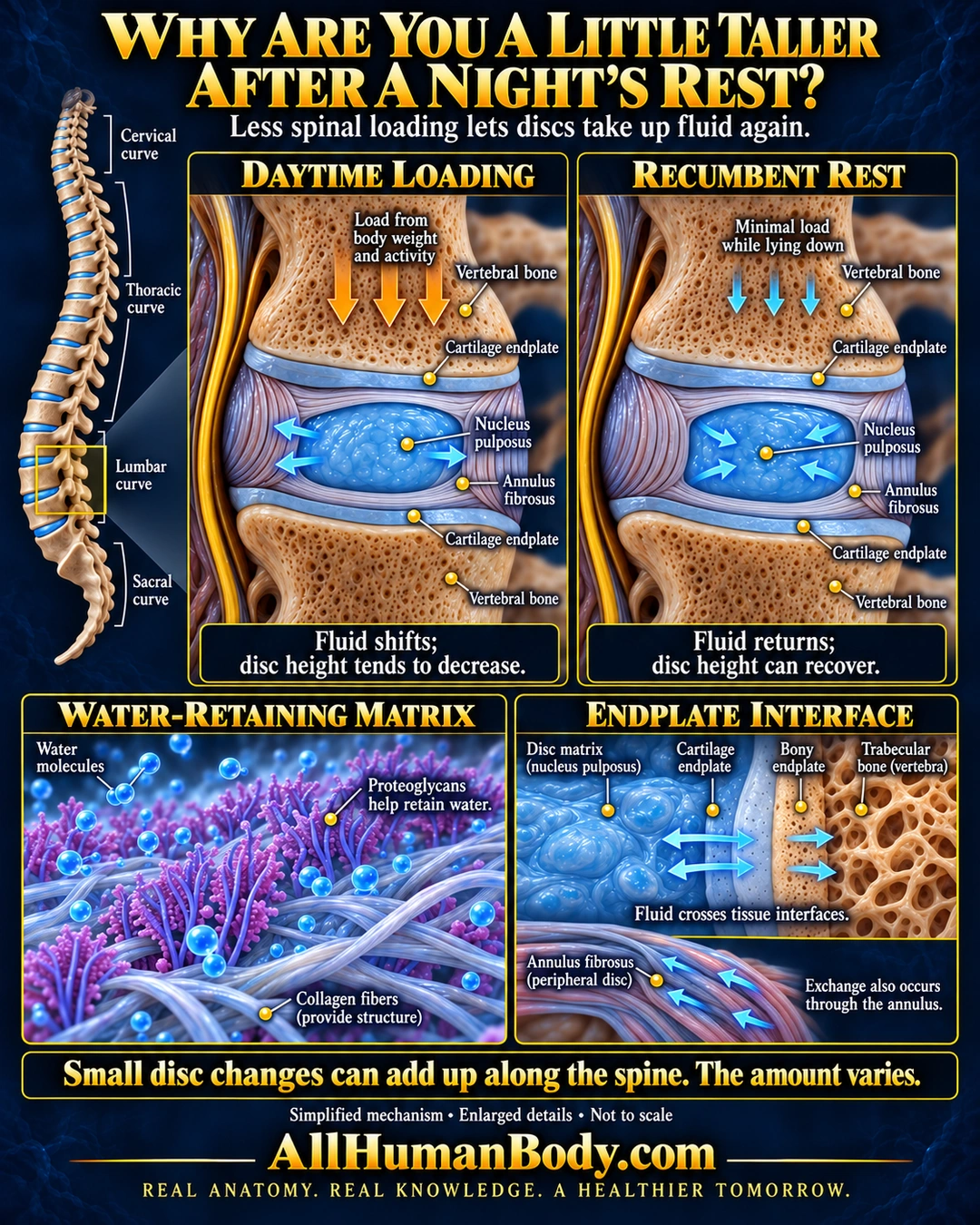
Spinal loading changes disc fluid content and height. Reduced loading during recumbent rest allows fluid return, so small reversible changes across the spine can contribute to daily height differences; the amount varies.
READ THE IMAGE
What the illustration shows
Navy-and-gold anatomy poster explaining why a person can be a little taller after resting overnight. A spine locator highlights the lumbar region. Two cutaway views compare daytime loading with lying-down rest. Both discs contain hydrated nucleus pulposus surrounded by fibrous annulus; arrows show outward fluid shifts during loading and inward return during rest. Text says disc height tends to decrease with loading and can recover with rest. Lower insets show proteoglycans helping retain water among collagen fibers, and exchange across cartilage and bony endplate interfaces and through the annulus. The takeaway says small disc changes can add up along the spine, with the amount varying. Simplified, enlarged details are not to scale. AllHumanBody.com branding appears below.
How to interpret this poster
- The comparisons and arrows are qualitative, not measured height gains, fluid paths or matched specimen geometry.
- Animal and modeling studies inform mechanism only; their measurements are not presented as personal human predictions.
- The linked lesson supplies disc-structure foundations rather than a dedicated overnight-height explanation.
- AI-assisted educational illustration; not physician certification, microscopy, a diagnosis or individualized medical advice.
- Fine annotations need enlargement; the full description provides an accessible text alternative.
AI-assisted educational illustration, adapted into web-sized images without changing its composition. This is general education, not an individual diagnosis or treatment recommendation.
EVIDENCE / CONTEXT
Sources and what they support
- Segmental quantitative MR imaging analysis of diurnal variation of water content in the lumbar intervertebral discs ↗
Human diurnal changes in lumbar disc MRI measurements; MRI signal is a proxy rather than a pure water map.
Evidence correspondence is limited to the abstract. - Effects of aging and degeneration on the human intervertebral disc during the diurnal cycle: a finite element study ↗
Proteoglycan-associated fluid retention and modeled disc mechanics; no degeneration prediction adopted.
Evidence correspondence is limited to the abstract. - The poro-elastic behaviour of the intervertebral disc: A new perspective on diurnal fluid flow ↗
Disc fluid exchange and the need to consider annular as well as endplate routes.
Evidence correspondence is limited to the abstract.