Special Senses / VISUAL EXPLAINER
How Your Ear Separates High and Low Sounds
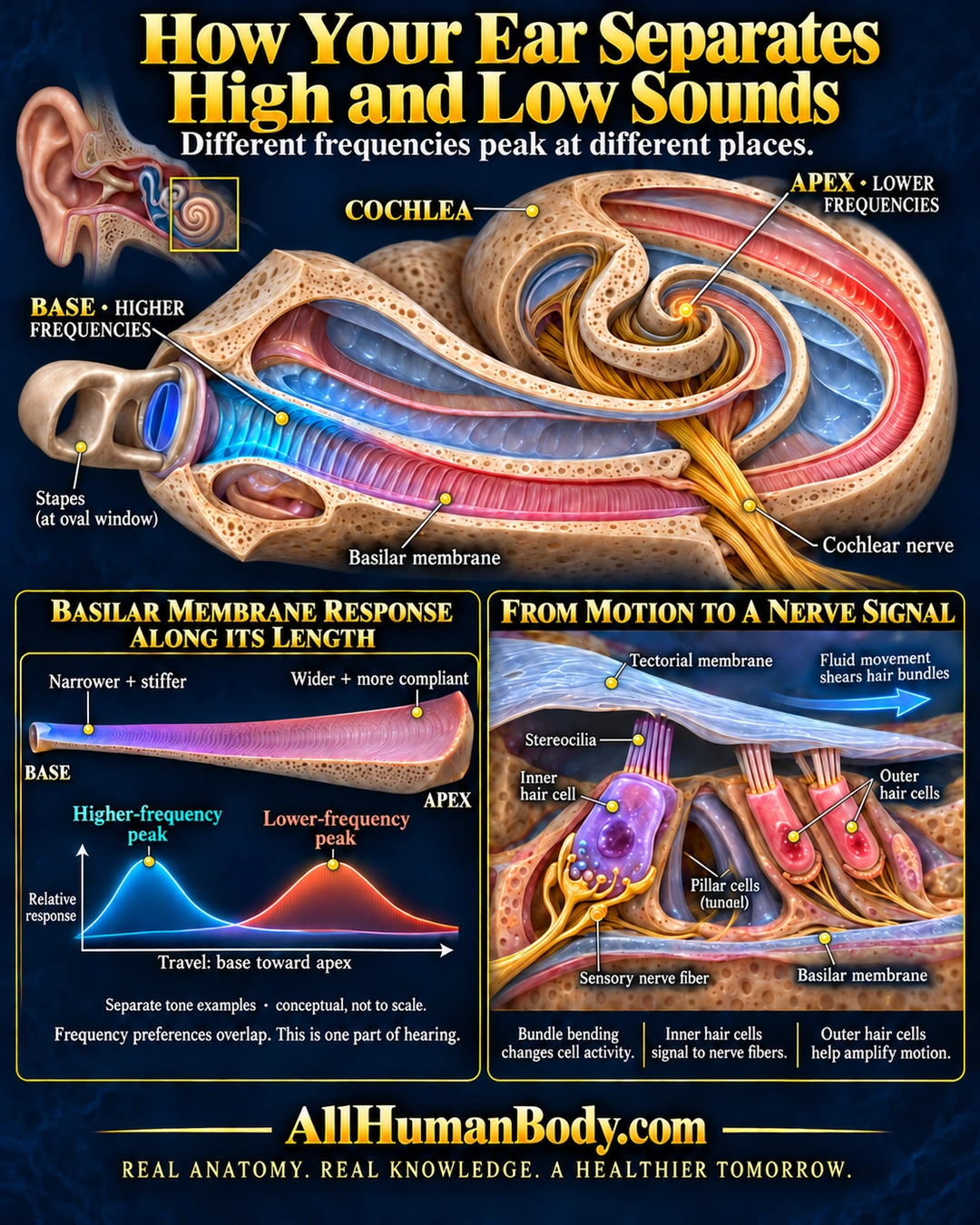
Different sound frequencies produce their strongest cochlear responses at different places. Higher-frequency peaks are nearer the base and lower-frequency peaks nearer the apex; overlapping preferences and hair-cell activity contribute to hearing.
READ THE IMAGE
What the illustration shows
An illustrated cochlear cutaway explains how different sound frequencies peak at different places. Higher frequencies peak near the base, on the partition just inside the oval window; lower frequencies peak toward the inner spiral apex. An uncoiled basilar-membrane diagram widens from a narrower, stiffer base to a wider, more compliant apex. Two conceptual response curves show a higher-frequency peak near the base and a lower-frequency peak farther toward the apex; frequency preferences overlap. A magnified inset shows an inner hair cell beneath the tectorial membrane with a fluid gap above its sensory bundle, separate nerve terminals at its base, outer hair cells and a pillar-cell tunnel. Bundle bending changes cell activity, inner hair cells signal to nerve fibers, and outer hair cells help amplify motion. The diagrams are simplified and not to scale. Small labels are clearer when enlarged.
How to interpret this poster
- Curves compare separate tones conceptually, not measured responses or a sound changing frequency as it travels.
- Place coding is one part of hearing, not a complete account of pitch perception.
- The artistic cutaway does not certify every scala, nerve trajectory or microscopic cell row.
- AI-assisted educational illustration; not physician certification, microscopy, a diagnosis or individualized medical advice.
- Fine annotations need enlargement; the full description provides an accessible text alternative.
AI-assisted educational illustration, adapted into web-sized images without changing its composition. This is general education, not an individual diagnosis or treatment recommendation.
EVIDENCE / CONTEXT
Sources and what they support
- How Do We Hear? ↗
Sound-driven cochlear motion, sensory hair cells and auditory-nerve output.
- Auditory System: Structure and Function ↗
Frequency-related peak position, basilar-membrane mechanics, inner-cell output and outer-cell amplification.