Digestive / VISUAL EXPLAINER
Why Doesn’t Your Stomach Digest Itself?
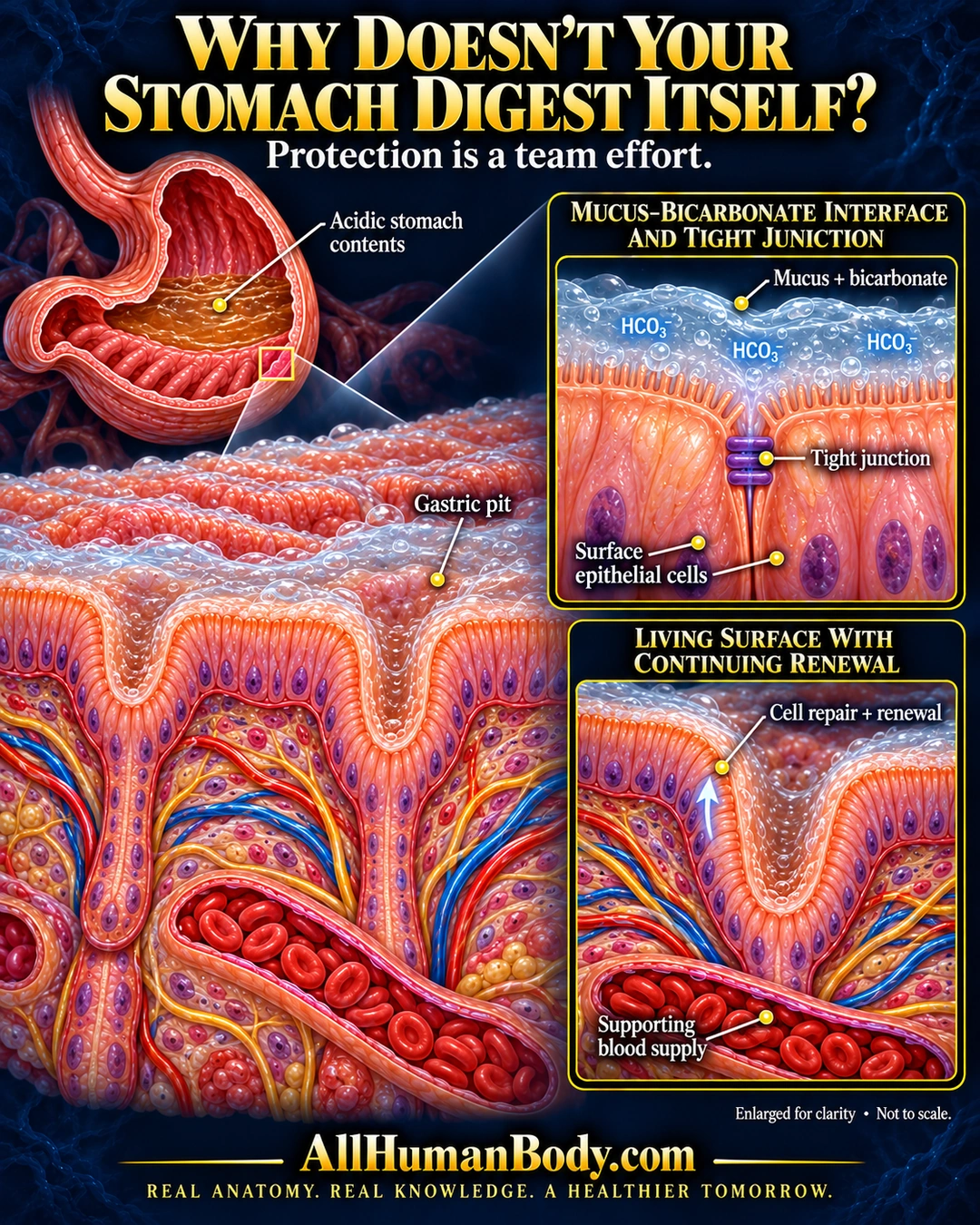
The stomach lining is protected by several cooperating mechanisms: mucus and bicarbonate, connected epithelial cells, ongoing repair and renewal, and supporting blood flow. Protection is maintained rather than provided by an invulnerable coating.
READ THE IMAGE
What the illustration shows
Medical illustration titled “Why Doesn’t Your Stomach Digest Itself?” with the subtitle “Protection is a team effort.” A cutaway stomach containing brown-orange acidic fluid points to an enlarged lining. Translucent mucus coats a continuous layer of columnar surface cells and dips into gastric pits, with simplified gland-like structures and enclosed blood vessels beneath. An upper inset shows bicarbonate, labeled HCO₃⁻, within the mucus and a tight junction between adjacent epithelial cells near their upper edges. A lower inset shows a short upward arrow for cell repair and renewal along the pit lining, above a vessel containing red blood cells. The image explains protection through mucus and bicarbonate, connected epithelial cells, ongoing renewal and supporting blood flow. Structures are enlarged and not to scale. Footer: AllHumanBody.com.
How to interpret this poster
- Gland and pit detail is schematic, not an exact histology plate.
- No fixed acidity, turnover time, ulcer diagnosis or prevention promise is implied.
- AI-assisted educational illustration; not physician certification, microscopy, a diagnosis or individualized medical advice.
- Fine annotations need enlargement; the full description provides an accessible text alternative.
AI-assisted educational illustration, adapted into web-sized images without changing its composition. This is general education, not an individual diagnosis or treatment recommendation.
EVIDENCE / CONTEXT
Sources and what they support
- Anatomy and Physiology 2e: 23.4 The Stomach ↗
Mucus, bicarbonate, epithelial junctions and replacement in the mucosal barrier.
- Gastroduodenal mucosal protection ↗
A dynamic barrier involving mucus, epithelial restitution and mucosal vasculature.
Evidence correspondence is limited to the abstract.